. 2019 Mar;37(3):252-258.
doi: 10.1038/s41587-019-0016-3. Epub 2019 Feb 18.

Hypoimmunogenic derivatives of induced pluripotent stem cells evade immune rejection in fully immunocompetent allogeneic recipients

Affiliations

Hypoimmunogenic derivatives of induced pluripotent stem cells evade immune rejection in fully immunocompetent allogeneic recipients

Tobias Deuse et al. Nat Biotechnol. 2019 Mar.

Erratum in

Abstract

Autologous induced pluripotent stem cells (iPSCs) constitute an unlimited cell source for patient-specific cell-based organ repair strategies. However, their generation and subsequent differentiation into specific cells or tissues entail cell line-specific manufacturing challenges and form a lengthy process that precludes acute treatment modalities. These shortcomings could be overcome by using prefabricated allogeneic cell or tissue products, but the vigorous immune response against histo-incompatible cells has prevented the successful implementation of this approach. Here we show that both mouse and human iPSCs lose their immunogenicity when major histocompatibility complex (MHC) class I and II genes are inactivated and CD47 is over-expressed. These hypoimmunogenic iPSCs retain their pluripotent stem cell potential and differentiation capacity. Endothelial cells, smooth muscle cells, and cardiomyocytes derived from hypoimmunogenic mouse or human iPSCs reliably evade immune rejection in fully MHC-mismatched allogeneic recipients and survive long-term without the use of immunosuppression. These findings suggest that hypoimmunogenic cell grafts can be engineered for universal transplantation.


Conflict of interest statement

Competing interests

The authors declare no competing interests.

Figures
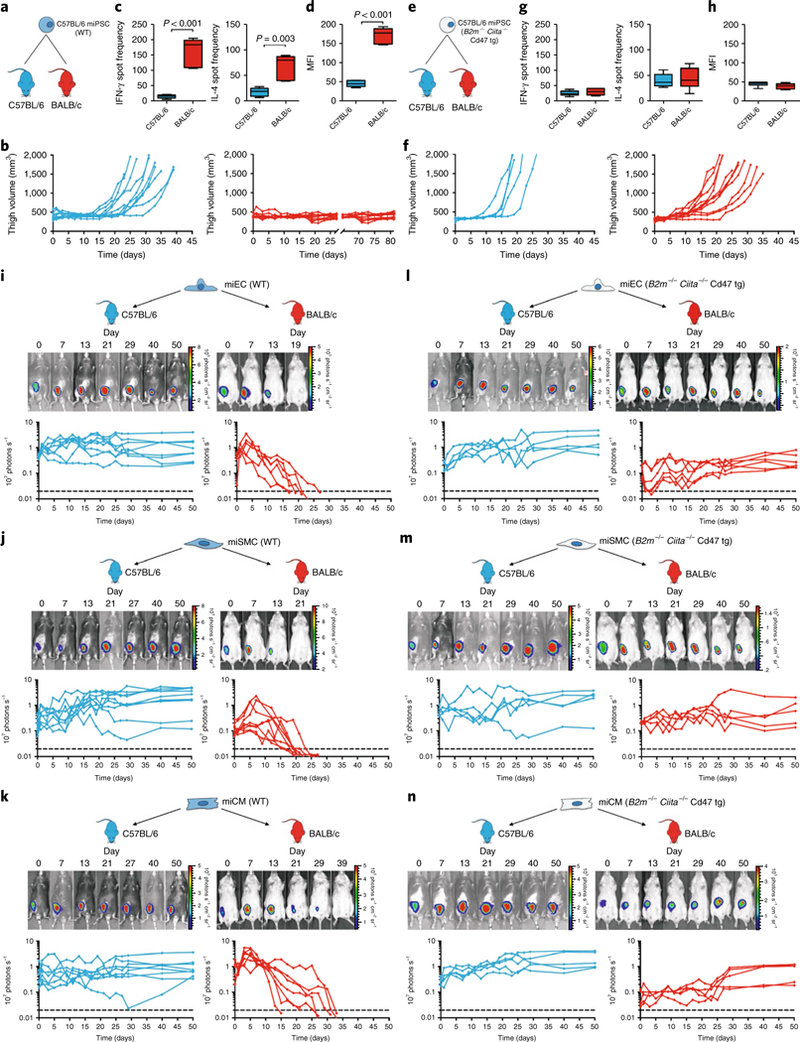
Fig. 1 |
Fig. 1 |. Survival of miPSCs and miPSC derivatives.
a, WT C57BL/6 miPSCs were injected into the thigh muscle of syngeneic C57BL/6 or allogeneic BALB/c mice. b, Teratoma formation was observed by measuring the thigh muscle (n = 10 per group). c, IFN-γ and IL-4 enzyme-linked immunospots (Elispots) with splenocytes recovered 5 days after the transplantation (box 25th to 75th percentile with median, whiskers min–max, five animals per group, two-tailed Student’s t-test). d, Mean fluorescence imaging (MFI) of IgM binding to WT miPSCs incubated with recipient serum after 5 days (box 25th to 75th percentile with median, whiskers min–max, six animals per group, two-tailed Student’s t-test). e, B2m−/−Ciita−/− Cd47 tg C57BL/6 miPSCs were transplanted into syngeneic C57BL/6 or allogeneic BALB/c recipients. f, Thigh volume C57BL/6 (n = 5) and BALB/c (n = 11) animals. The overall percentage of cell grafts that survived and formed teratomas in BALB/c was 100%. g, IFN-γ and IL-4 Elispots with splenocytes recovered 5 days after the transplantation and B2m−/−Ciita−/− Cd47 tg miPSCs stimulator cells (box 25th to 75th percentile with median, whiskers min–max, n = 6 per group, two-tailed Student’s t-test). h, MFI of IgM binding to B2m−/−Ciita−/− Cd47 tg miPSCs incubated with recipient serum after 5 days (box 25th to 75th percentile with median, whiskers min–max, six animals per group, two-tailed Student’s t-test). in, Grafts of Fluc+ C57BL/6 miPSC derivatives in C57BL/6 or BALB/c recipients were longitudinally followed by bioluminescent imaging (BLI). One representative animal is depicted per group and the BLI values of all animals are plotted. All WT miPSC-derived miECs (i, eight animals in C57BL/6 and six animals in BALB/c), miSMCs (j, nine animals in C57BL/6 and eight animals in BALB/c) and miCMs (k, eight animals in C57BL/6 and seven animals in BALB/c) showed long-term survival in syngeneic C57BL/6 recipients but were rejected in allogeneic BALB/c animals. In contrast, all B2m−/−Ciita−/− Cd47 tg miPSC-derived miECs (l, five animals in C57BL/6 and six animals in BALB/c), miSMCs (m, five animals in C57BL/6 and five animals in BALB/c) and miCMs (n, five animals in C57BL/6 and five animals in BALB/c) showed long-term survival in both syngeneic C57BL/6 and allogeneic BALB/c recipients.
Fig. 2 |
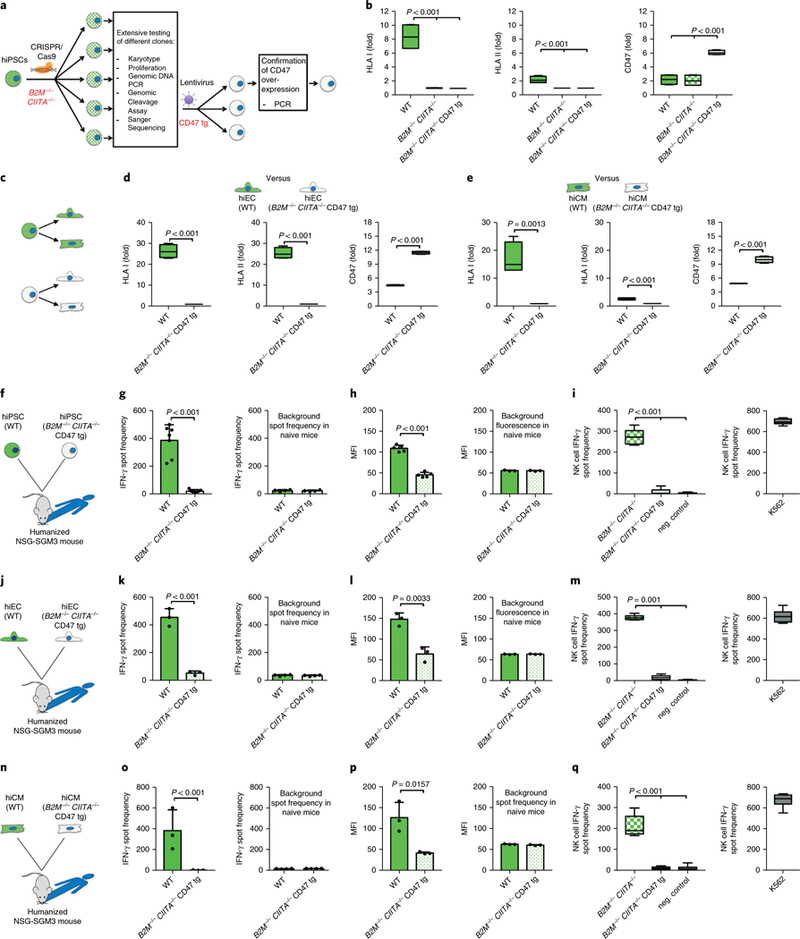
Fig. 2 |. Immune response against hiPSC derivatives.
a, WT hiPSCs first underwent B2M and CIITA gene disruption and then CD47 transgene overexpression b, Gene editing of hiPSCs was confirmed by flow cytometry (box 25th to 75th percentile with median, whiskers min–max, four independent experiments per graph, analysis of variance (ANOVA) with Bonferroni’s post-hoc test). c, WT and B2M−/−CIITA−/− CD47 tg hiPSCs were differentiated into both hiECs and hiCMs. de, The immune phenotype of WT and B2M−/−CIITA−/− CD47 tg hiECs (d) and hiCMs (e) is shown (box 25th to 75th percentile with median, whiskers min–max, four independent experiments per graph, two-tailed Student’s t-test). f, WT or B2M−/−CIITA−/− CD47 tg hiPSC grafts were injected into allogeneic humanized NSG-SGM3 mice. g, IFN-γ Elispots were performed after 5 days (mean ± s.d., n = 7 per group, two-tailed Student’s t-test), the background spot frequency in naïve mice is shown (mean ± s.d., four animals per group, two-tailed Student’s t-test). h, MFI of IgM binding to either hiPSC incubated with recipient serum after 5 days (mean ± s.d., five animals per group, two-tailed Student’s t-test), the background fluorescence in naïve mice is shown (mean ± s.d., three animals per group, Student’s t-test). i, IFN-γ Elispots with human NK cells were performed with B2M−/−CIITA−/− hiPSC or B2M−/−CIITA−/− CD47 tg hiPSC (box 25th to 75th percentile with median, whiskers min–max, six independent experiments, ANOVA with Bonferroni’s post-hoc test). j, WT or B2M−/−CIITA−/− CD47 tg hiEC grafts were injected into allogeneic humanized NSG-SGM3 mice. k, IFN-γ Elispots were performed after 5 days (mean ± s.d., three animals per group, two-tailed Student’s t-test), the background spot frequency in naïve mice is shown (mean ± s.d., four animals per group, two-tailed Student’s t-test). l, MFI of IgM binding to either hiEC incubated with recipient serum after 5 days (mean ± s.d., three animals per group, two-tailed Student’s t-test), the background fluorescence in naïve mice is shown (mean ± s.d., three animals per group, Student’s t-test). m, IFN-γ Elispots with human NK cells were performed with B2M−/−CIITA−/− hiECs or B2M−/−CIITA−/− CD47 tg hiECs (box 25th to 75th percentile with median, whiskers min–max, six independent experiments, ANOVA with Bonferroni’s post-hoc test). n, WT or B2M−/−CIITA−/− CD47 tg hiCM grafts were injected into allogeneic humanized NSG-SGM3 mice. o, IFN-γ Elispots were performed after 5 days (mean ± s.d., three animals per group, two-tailed Student’s t-test), the background spot frequency in naïve mice is shown (mean ± s.d., four animals per group, two-tailed Student’s t-test). p, MFI of IgM binding to either hiCM incubated with recipient serum after 5 days (mean ± s.d., three animals per group, two-tailed Student’s t-test), the background fluorescence in naïve mice is shown (mean ± s.d., three animals per group, Student’s t-test). q, IFN-γ Elispots with human NK cells were performed with B2M−/−CIITA−/− hiCMs or B2M−/−CIITA−/− CD47 tg hiCMs (box 25th to 75th percentile with median, whiskers min–max, six independent experiments, ANOVA with Bonferroni’s post-hoc test).
Fig. 3 |
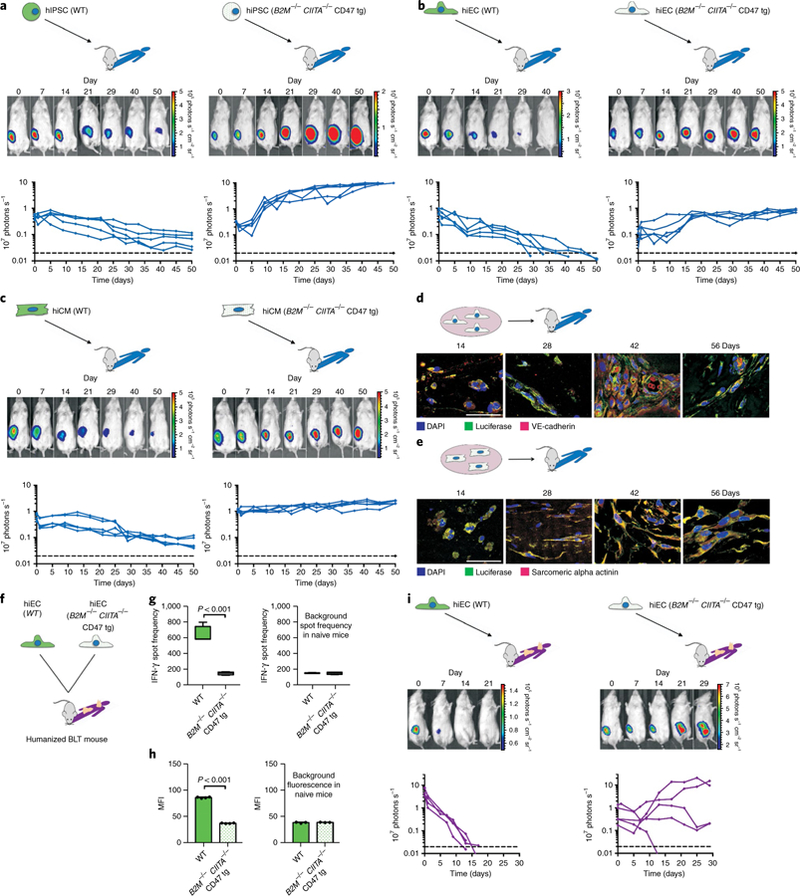
Fig. 3 |. Survival of hiPSCs and hiPSC derivatives in allogeneic hosts.
Grafts of Fluc+ WT or B2M−/−CIITA−/− CD47 tg hiPSCs, hiECs and hiCMs were transplanted into allogeneic humanized mice (NSG-SGM3 mice in ae, BLT mice in fi) and were longitudinally followed by BLI. One representative animal is depicted per group and the BLI values of all animals are plotted. a, BLI signals over time of WT and B2M−/−CIITA−/− CD47 tg hiPSC grafts (n = 5 per group). b, WT and B2M−/−CIITA−/− CD47 tg hiECs were transplanted as in a (n = 5 per group). c, WT and B2M−/−CIITA−/− CD47 tg hiCMs (n = 5). d, B2M−/−CIITA−/− CD47 tg hiECs started to organize into a more complex structure, which included primitive vascular structures (representative pictures of three independent experiments). Scale bar, 50 μm. e, The B2M−/−CIITA−/− CD47 tg hiCMs began to organize into a more polarized framework and maintained their sarcomeric alpha-actinin cytoskeletal structure typical of cardiomyocytes (representative pictures of three independent experiments). Scale bar, 50 μm. f, WT or B2M−/−CIITA−/− CD47 tg hiECs were transplanted into allogeneic humanized BLT mice. g, IFN-γ Elispots were performed after 5 days (box 25th to 75th percentile with median, whiskers min–max, four animals per group, two-tailed Student’s t-test), the background spot frequency in naïve mice is shown. h, MFI of IgM binding to either hiEC incubated with recipient serum after 5 days (mean ± s.d., four animals per group, two-tailed Student’s t-test), the background fluorescence in naïve mice is shown (mean ± s.d., three animals per group, two-tailed Student’s t-test). i, Grafts of Fluc+ WT or B2M−/−CIITA−/− CD47 tg hiECs were transplanted into allogeneic humanized BLT mice and were longitudinally followed by BLI. All WT hiEC grafts were rejected within roughly 14 days (four animals). Four of the five B2M−/−CIITA−/− CD47 tg hiEC grafts permanently survived, the one failure is believed not to be immune-mediated (five animals).

Comment in

References

    1. Gyongyosi M et al. Meta-analysis of cell-based CaRdiac stUdiEs (ACCRUE) in patients with acute myocardial infarction based on individual patient data. Circ. Res 116, 1346–1360 (2015). - PMC - PubMed
    1. Fisher SA, Doree C, Mathur A & Martin-Rendon E Meta-analysis of cell therapy trials for patients with heart failure. Circ. Res 116, 1361–1377 (2015). - PubMed
    1. Kandala J et al. Meta-analysis of stem cell therapy in chronic ischemic cardiomyopathy. Am. J. Cardiol 112, 217–225 (2013). - PubMed
    1. Fernandez-Aviles F et al. Global position paper on cardiovascular regenerative medicine. Eur. Heart J 38, 2532–2546 (2017). - PMC - PubMed
    1. Lipsitz YY, Timmins NE & Zandstra PW Quality cell therapy manufacturing by design. Nat. Biotechnol 34, 393–400 (2016). - PubMed

Publication types

MeSH terms

Substances