


Understanding the relationship between perceived school climate and bullying: A mediator analysis
- PMID: 30778279
- PMCID: PMC6377176
- DOI: 10.1080/15388220.2018.1453820
Understanding the relationship between perceived school climate and bullying: A mediator analysis
Abstract
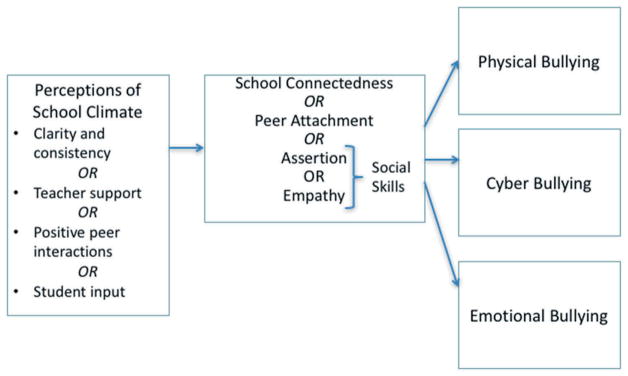
This study assesses how perceptions of school climate and four mediating factors (school connectedness, peer attachment, assertiveness, and empathy) influence reports of bullying behaviors among 2,834 students in 14 middle schools. Results revealed that students in positive school climates reported experiencing fewer physical, emotional, and cyberbullying behaviors. They also reported greater levels of school connectedness, peer attachment, assertiveness, and empathy, which in turn helped explain the influence of perceived school climate on bullying. In addition, the greater levels of empathy that students reported, the more likely they were to report being bullied. These results highlight the role that perceptions of school climate can play in influencing bullying and underscore the importance of mediating factors as schools work to track and improve school climate.
Keywords: Evaluation; RCT; positive youth development; restorative practices.
Conflict of interest statement
Conflict of Interest The authors have no conflict of interests to declare.
Figures
References
-
- Acosta J. The effects of cultural differences on peer group relationships. Journal of Prevention & Intervention in the Community. 2003;25(2):13–26. doi: 10.1300/J005v25n02_02. - DOI
-
- Acosta JD, Chinman M, Ebener P, Phillips A, Xenakis L, Malone PS. A cluster-randomized trial of restorative practices: An illustration to spur high-quality research and evaluation. Journal of Educational and Psychological Consultation. 2016:1–18. doi: 10.1080/10474412.2016.1217488. - DOI - PMC - PubMed
-
-
Act, E. S. S. (2015). Pub. L. No. 114–95. In 114th Congress.
-
-
- Anderman EM. School effects on psychological outcomes during adolescence. Journal of Educational Psycholgoy. 2002;94:795–809. doi: 10.1037/0022-0663.94.4.795. - DOI
Grants and funding
LinkOut - more resources
Full Text Sources