


A Case for Promoting Movement Medicine: Preventing Disability in the LIFE Randomized Controlled Trial
- PMID: 30778518
- PMCID: PMC6777081
- DOI: 10.1093/gerona/glz050
A Case for Promoting Movement Medicine: Preventing Disability in the LIFE Randomized Controlled Trial
Abstract
Background: The movement profile of older adults with compromised function is unknown, as is the relationship between these profiles and the development of major mobility disability (MMD)-a critical clinical outcome. We first describe the dimensions of movement in older adults with compromised function and then examine whether these dimensions predict the onset of MMD.
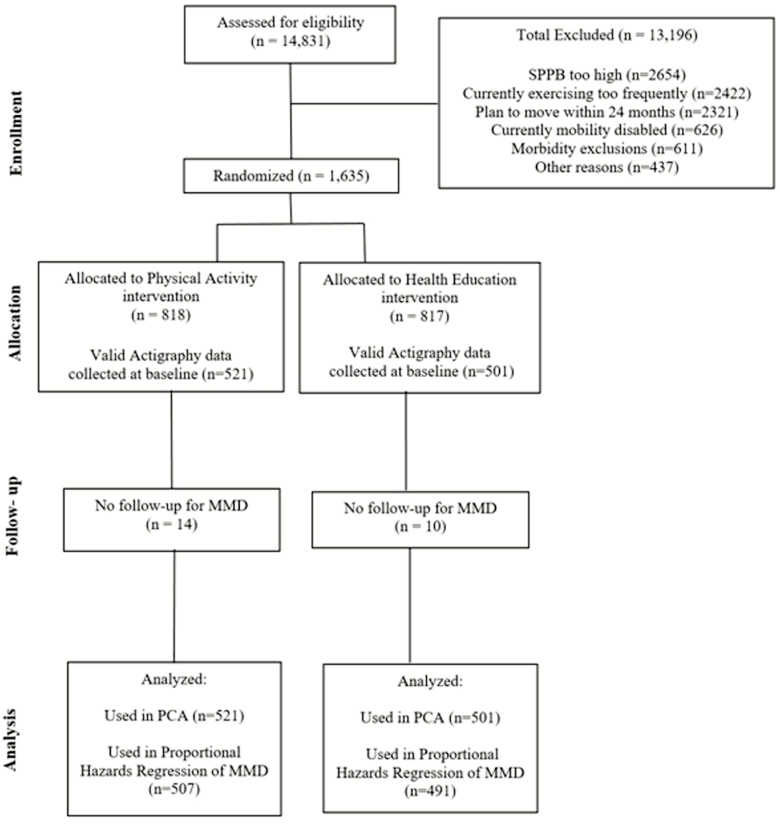
Methods: Older adults at risk for MMD (N = 1,022, mean age = 78.7 years) were randomized to receive a structured physical activity intervention or health education control. We assessed MMD in 6-month intervals (average follow-up of 2.2 years until incident MMD), with activity assessed at baseline, 6-, 12- and 24-month follow-up via accelerometry.
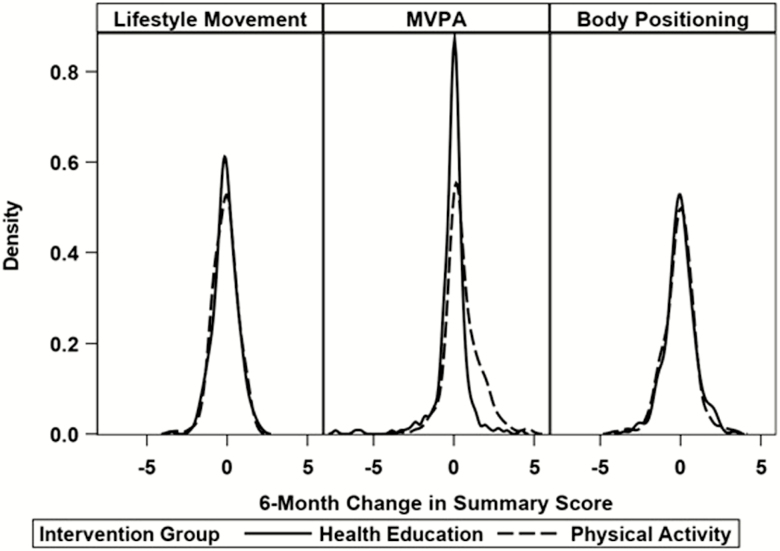
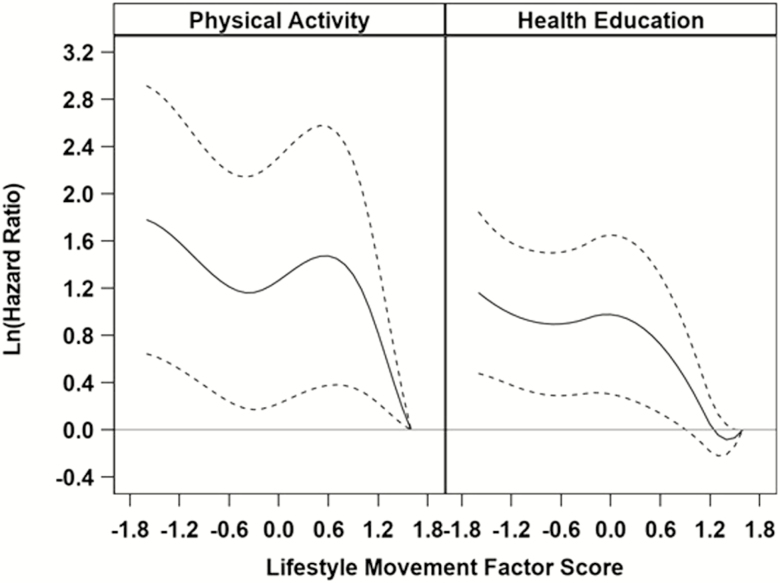
Results: A principal components analysis of 11 accelerometer-derived metrics yielded three components representing lifestyle movement (LM), extended bouts of moderate-to-vigorous physical activity (MVPA), and stationary body posture. LM accounted for the greatest proportion of variance in movement (53%). Within health education, both baseline LM (HR = 0.74; 95% CI 0.62 to 0.88) and moderate-to-vigorous physical activity (HR = 0.69; 95% CI 0.54 to 0.87) were associated with MMD, whereas only LM was associated with MMD within physical activity (HR = 0.74; 95% CI 0.61 to 0.89). There were similar nonlinear relationships present for LM in both physical activity and health education (p < .04), whereby risk for MMD was lower among individuals with higher levels of LM.
Conclusions: Both LM and moderate-to-vigorous physical activity should be central in treatment regimens for older adults at risk for MMD.
Trial registration: clinicaltrials.gov Identifier NCT01072500.
Keywords: Accelerometry; Disability; Exercise; Physical activity; Sedentary.
© The Author(s) 2019. Published by Oxford University Press on behalf of The Gerontological Society of America. All rights reserved. For permissions, please e-mail: journals.permissions@oup.com.
Figures
References
-
- Kraus L. 2016 Disability Statistics Annual Report Durham, NH: University of New Hampshire. https://disabilitycompendium.org/sites/default/files/user-uploads/2016_A.... Accessed June 4, 2018.
-
- US Census Bureau. An Aging Nation: Projected Number of Children and Older Adults https://www.census.gov/library/visualizations/2018/comm/historic-first.html. Accessed June 4, 2018.
