. 2019 Jun 1;74(6):1578-1585.
doi: 10.1093/jac/dkz053.

Silver nanoparticles present high intracellular and extracellular killing against Staphylococcus aureus

Affiliations

Silver nanoparticles present high intracellular and extracellular killing against Staphylococcus aureus

Jason Kang et al. J Antimicrob Chemother. .

Abstract

Objectives: Bone and joint infections caused by Staphylococcus aureus are becoming increasingly difficult to treat due to rising antibiotic resistance, resilient biofilms and intracellular survival of S. aureus. It has been challenging to identify and develop antimicrobial agents that can be used to kill extracellular and intracellular bacteria while having limited toxicity towards host cells. In addressing this challenge, this study investigates the antimicrobial efficacy and toxicity of silver nanoparticles (AgNPs).

Methods: Intracellular bacteria were generated using a co-culture model of human osteoblast cells and S. aureus. Extracellular and intracellular S. aureus were treated with AgNPs, antibiotics and their combinations, and numbers of colonies were quantified. Toxicity of AgNPs against human osteoblast cells was determined by quantifying the number of viable cells after treatment.

Results: AgNPs demonstrated excellent antimicrobial activity against extracellular S. aureus with a 100% killing efficacy at concentrations as low as 56 μM, along with a high intracellular killing efficacy of 76% at 371 μM. AgNPs were non-toxic or slightly toxic towards human osteoblasts at the concentrations studied (up to 927 μM). Moreover, smaller-sized (40 nm) AgNPs were more efficacious in killing bacteria compared with their larger-sized (100 nm) counterparts and synergistic antimicrobial effects against extracellular bacteria were observed when AgNPs were combined with gentamicin.

Conclusions: AgNPs and their combination with antibiotics have demonstrated high extracellular and intracellular bacterial killing and presented unique aspects for potential clinical applications, especially for chronic and recurrent infections where intracellular bacteria may be the cause.


Figures

Figure 1.
Figure 1.
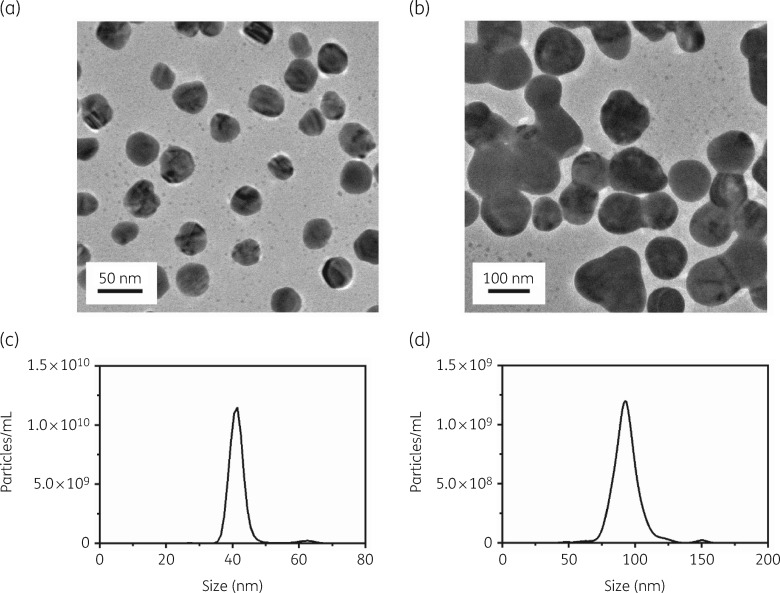
Morphology and size distribution of AgNPs. TEM images of (a) 40 nm and (b) 100 nm AgNPs and size distribution of (c) 40 nm and (d) 100 nm AgNPs.
Figure 2.
Figure 2.
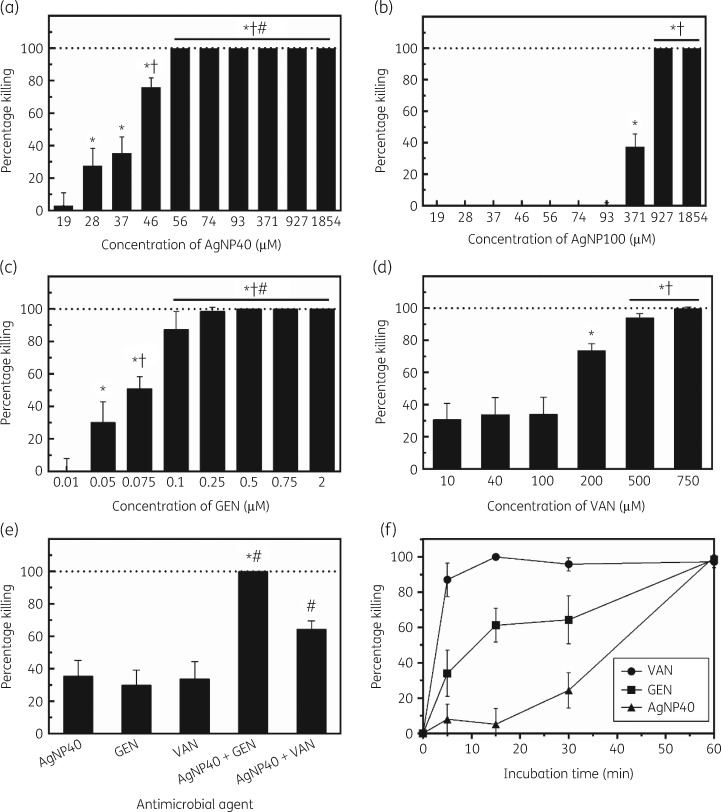
Extracellular bacterial killing efficacy and kinetics of AgNPs, gentamicin and vancomycin. (a) 40 nm AgNP treatment for 1 h at 37°C (*P < 0.0001 compared with 19 μM, P < 0.0001 compared with 28 and 37 μM, #P = 0.0001 compared with 46 μM). (b) 100 nm AgNP treatment for 1 h at 37°C (*P < 0.0001 compared with 93 μM, P < 0.0001 compared with 371 μM). (c) Gentamicin treatment for 1 h at 37°C (*P < 0.0001 compared with 0.01 μM, P < 0.001 compared with 0.05 μM, #P < 0.0001 compared with 0.075 μM). (d) Vancomycin treatment (*P < 0.0001 compared with 10, 40 and 100 μM, P < 0.001 compared with 200 μM). (e) Combination treatments for 1 h at 37°C (*P < 0.0001 compared with AgNPs and gentamicin, #P < 0.0001 compared with AgNPs and vancomycin). (f) Kinetic profiles at 37°C. AgNP40, 40 nm AgNPs; AgNP100, 100 nm AgNPs; GEN, gentamicin; VAN, vancomycin.
Figure 3.
Figure 3.
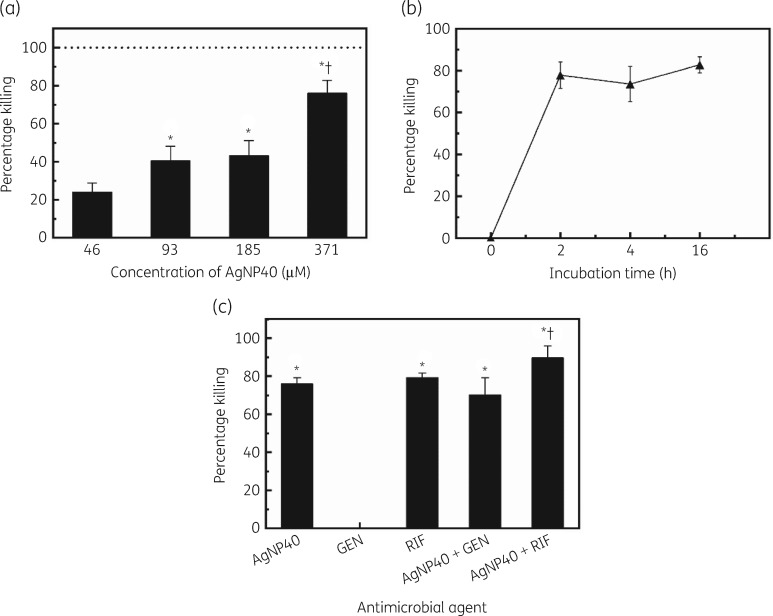
Intracellular bacterial killing efficacy and kinetics studies. (a) Intracellular bacterial killing efficacy of AgNPs at various concentrations (*P < 0.001 compared with 46 μM, P < 0.0001 compared with 93 and 185 μM). (b) Kinetics of AgNPs in killing intracellular S. aureus. (c) Intracellular bacterial killing efficacy of AgNPs, gentamicin, rifampicin and their combinations (*P < 0.0001 compared with gentamicin, P = 0.0002 compared with AgNPs, P = 0.0056 compared with rifampicin, P < 0.0001 compared with AgNPs + gentamicin). AgNP40, 40 nm AgNPs; GEN, gentamicin; RIF, rifampicin.
Figure 4.
Figure 4.
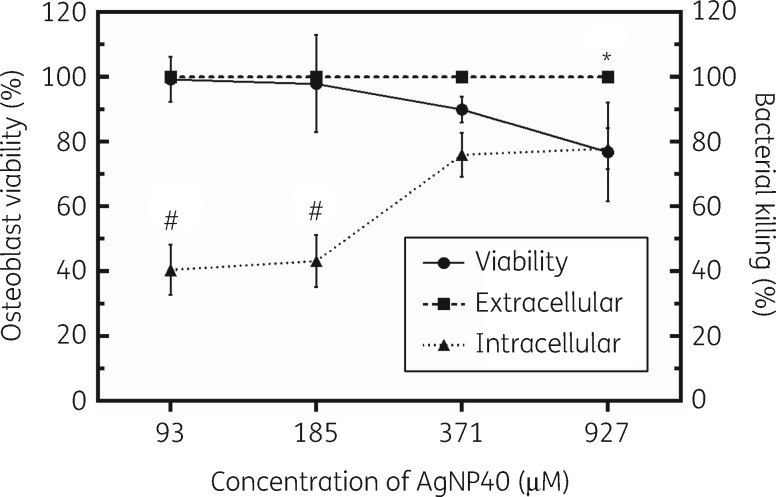
Osteoblast viability and extracellular and intracellular bacterial killing of AgNPs. *P = 0.044 compared with viability at 93 μM. #P < 0.0001 compared with percentage killing at 371 and 927 μM. AgNP40, 40 nm AgNPs.

References

    1. Kavanagh N, Ryan EJ, Widaa A. et al. Staphylococcal osteomyelitis: disease progression, treatment challenges, and future directions. Clin Microbiol Rev 2018; 31: e00084–17. - PMC - PubMed
    1. Corrado A, Donato P, Maccari S. et al. Staphylococcus aureus-dependent septic arthritis in murine knee joints: local immune response and beneficial effects of vaccination. Sci Rep 2016; 6: 38043.. - PMC - PubMed
    1. Sendi P, Banderet F, Graber P. et al. Periprosthetic joint infection following Staphylococcus aureus bacteremia. J Infect 2011; 63: 17–22. - PubMed
    1. Corey GR. Staphylococcus aureus bloodstream infections: definitions and treatment. Clin Infect Dis 2009; 48 Suppl 4: S254–9. - PubMed
    1. Besier S, Smaczny C, von Mallinckrodt C. et al. Prevalence and clinical significance of Staphylococcus aureus small-colony variants in cystic fibrosis lung disease. J Clin Microbiol 2007; 45: 168–72. - PMC - PubMed

Publication types