


Mortality Risk and Risk Factors in Patients with Posttraumatic Epilepsy: A Population-Based Cohort Study
- PMID: 30781634
- PMCID: PMC6406809
- DOI: 10.3390/ijerph16040589
Mortality Risk and Risk Factors in Patients with Posttraumatic Epilepsy: A Population-Based Cohort Study
Abstract
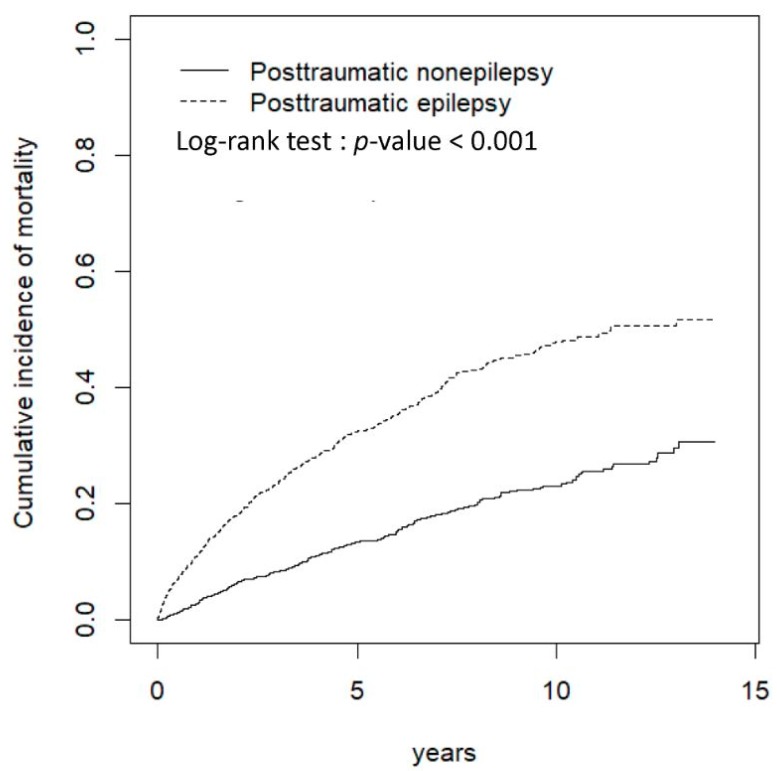
Aim: Use the National Health Insurance Research Database of Taiwan to determine whether patients with posttraumatic epilepsy (PTE) have an increased risk of mortality. Methods: Patients ≥20 years old ever admitted because of head injury (per International Classification of Diseases, Ninth Revision, Clinical Modification (ICD-9-CM) codes 850⁻854 and 959.01) during 2000⁻2012 were enrolled into a traumatic brain injury (TBI) cohort. The TBI cohort was divided into with PTE (ICD-9-CM code 345) and posttraumatic nonepilepsy (PTN) cohorts. We compared the PTE and PTN cohorts in terms of age, sex, and comorbidities. We calculated adjusted hazard ratios (aHRs) and 95% confidence intervals (CIs) of all-cause mortality risk in these cohorts. Results: Patients with PTE had a higher incidence rate (IR) of mortality than did patients with TBI alone (IR per 1000 person-years: 71.8 vs. 27.6), with an aHR 2.31 (95% CI = 1.96⁻2.73). Patients with PTE aged 20⁻49, 50⁻64, and ≥65 years had, respectively, 2.78, 4.14, and 2.48 times the mortality risk of the PTN cohort. Patients with any comorbidity and PTE had 2.71 times the mortality risk as patients in the PTN cohort. Furthermore, patients with PTE had 28.2 increased hospital days and 7.85 times as frequent medical visits per year compared with the PTN cohort. Conclusion: Taiwanese patients with PTE had approximately 2 times the mortality risk and an increased medical burden compared to patients with TBI only. Our findings provide crucial information for clinicians and the government to improve TBI outcomes.
Keywords: National Health Insurance; cohort study; mortality; posttraumatic epilepsy; traumatic brain injury.
Conflict of interest statement
The authors declare no conflict of interest.
Figures
References
-
- Centers for Disease Control and Prevention Report to Congress. Traumatic brain injury in the United States: Epidemiology and rehabilitation. Atlanta: National Center for Injury Prevention and Control, Division of Unintentional Injury Prevention. [(accessed on 15 February 2019)];2015 Available online: https://www.cdc.gov/traumaticbraininjury/pubs/congress_epi_rehab.html.
-
- Perry D.C., Sturm V.E., Peterson M.J., Pieper C.F., Bullock T., Boeve B.F., Miller B.L., Guskiewicz K.M., Berger M.S., Kramer J.H., et al. Association of traumatic brain injury with subsequent neurological and psychiatric disease: A meta-analysis. J. Neurosurg. 2016;124:511–526. doi: 10.3171/2015.2.JNS14503. - DOI - PMC - PubMed
-
- Institute of Medicine . Volume 7: Long-Term Consequences of Traumatic Brain Injury. The National Academies Press; Washington, DC, USA: 2009. [(accessed on 15 February 2019)]. Gulf war and health. Available online: https://www.nap.edu/read/12436/chapter/9. - PubMed
-
- Ventura T., Harrison-Felix C., Carlson N., Diguiseppi C., Gabella B., Brown A., Devivo M., Whiteneck G. Mortality after discharge from acute care hospitalization with traumatic brain injury: A population-based study. Arch. Phys. Med. Rehabil. 2010;91:20–29. doi: 10.1016/j.apmr.2009.08.151. - DOI - PubMed
Publication types
MeSH terms
LinkOut - more resources
Full Text Sources
Medical
