


Association between Availability of Neighborhood Fast Food Outlets and Overweight Among 5⁻18 Year-Old Children in Peninsular Malaysia: A Cross-Sectional Study
- PMID: 30781699
- PMCID: PMC6406246
- DOI: 10.3390/ijerph16040593
Association between Availability of Neighborhood Fast Food Outlets and Overweight Among 5⁻18 Year-Old Children in Peninsular Malaysia: A Cross-Sectional Study
Abstract
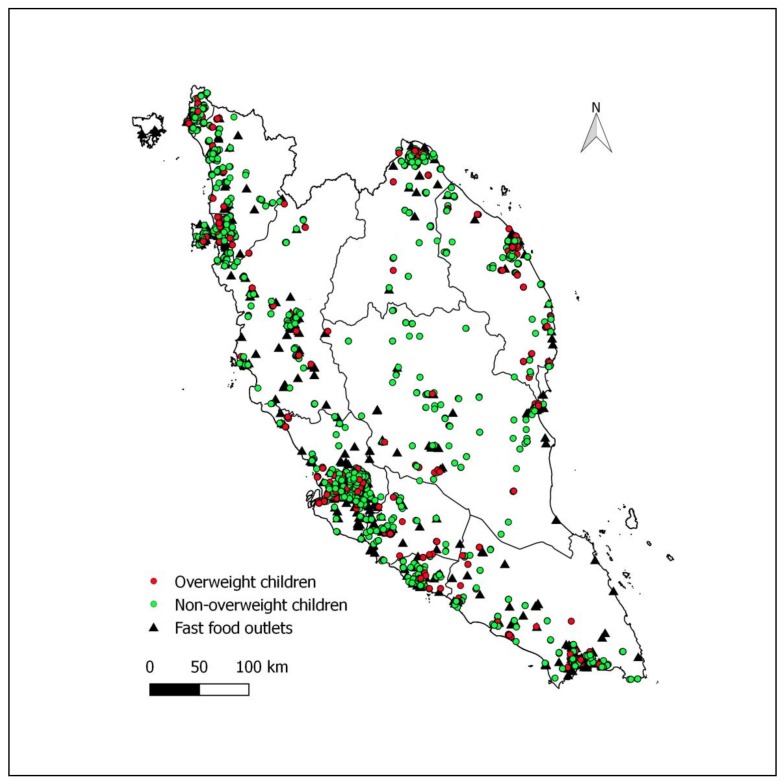
A growing number of fast-food outlets in close proximity to residential areas raises a question as to its impact on childhood overweight and obesity. This study aimed at determining the relationship between the availability of fast-food outlets that were in close proximity to residential areas and overweight among Malaysian children aged 5 to 18 years. Measurement data on the weight and height of 5544 children (2797 boys, 2747 girls) were obtained from the National Health and Morbidity Survey 2011. Overweight (including obesity) is defined as BMI-for-age z-score > +1 SD based on the WHO growth reference. Geographic information system geospatial analysis was performed to determine the number of fast-food outlets within 1000 m radius from the children's residential address. Multiple logistic regression was conducted to examine the association between the availability of fast-food outlets (none or more than one outlet) and overweight with adjustment for age, sex, ethnicity, monthly household income, parental educational level, residential area and supermarket density. Our results showed that the prevalence of overweight was 25.0% and there was a statistically significant association between the density of fast-food outlets and overweight (odds ratio: 1.23, 95% confidence interval: 1.03, 1.47). Our study suggested that the availability of fast-food outlets with close proximity in residential areas was significantly associated with being overweight among children. Limiting the number of fast-food outlets in residential areas could have a significant effect in reducing the prevalence of overweight among Malaysian children.
Keywords: children; fast food; geospatial analysis; overweight.
Conflict of interest statement
The authors declare no conflict of interest. The funders had no role in the design of the study; in the collection, analyses, or interpretation of data; in the writing of the manuscript, or in the decision to publish the results.
Figures
References
-
- Institute for Public Health . National Health and Morbidity Survey 2011 (NHMS 2011). Non-Communicable Diseases. Insitute for Public Health, Ministry of Health; Kuala Lumpur, Malaysia: 2011.
-
- Institute for Public Health . National Health and Morbidity Survey 2015 (NHMS 2015): Non-Communicable Diseases, Risk Factors and Other Health Problems. Institute for Public Health; Kuala Lumpur, Malaysia: 2015.
-
- Ang Y.N., Wee B.S., Poh B.K., Ismail M.N. Multifactorial influences of childhood obesity. Curr. Obes. Rep. 2013;2:10–22. doi: 10.1007/s13679-012-0042-7. - DOI
Publication types
MeSH terms
LinkOut - more resources
Full Text Sources
Medical
