


An Integrative Systems Perspective on Plant Phosphate Research
- PMID: 30781872
- PMCID: PMC6410211
- DOI: 10.3390/genes10020139
An Integrative Systems Perspective on Plant Phosphate Research
Abstract
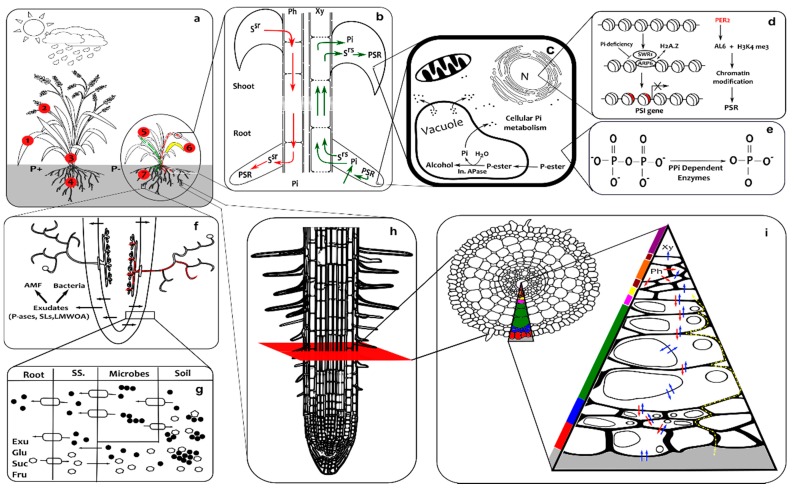
The case for improving crop phosphorus-use-efficiency is widely recognized. Although much is known about the molecular and regulatory mechanisms, improvements have been hampered by the extreme complexity of phosphorus (P) dynamics, which involves soil chemistry; plant-soil interactions; uptake, transport, utilization and remobilization within plants; and agricultural practices. The urgency and direction of phosphate research is also dependent upon the finite sources of P, availability of stocks to farmers and reducing environmental hazards. This work introduces integrative systems approaches as a way to represent and understand this complexity, so that meaningful links can be established between genotype, environment, crop traits and yield. It aims to provide a large set of pointers to potential genes and research practice, with a view to encouraging members of the plant-phosphate research community to adopt such approaches so that, together, we can aid efforts in global food security.
Keywords: global food security; mathematical modelling; phosphorus use efficiency; regulation of phosphate uptake; systems biology.
Conflict of interest statement
The authors declare no conflict of interest. The funders had no role in the design of the study; in the collection, analyses, or interpretation of data; in the writing of the manuscript, or in the decision to publish the results.
Figures

References
-
- Bruinsma J. World Agriculture: Towards 2015/2030: An FAO Perspective. Routledge; London, UK: 2017.
Publication types
MeSH terms
Substances
Grants and funding
LinkOut - more resources
Full Text Sources
