


Improved performance of district health systems through implementing health center clinical and administrative standards in the Amhara region of Ethiopia
- PMID: 30782158
- PMCID: PMC6381692
- DOI: 10.1186/s12913-019-3939-y
Improved performance of district health systems through implementing health center clinical and administrative standards in the Amhara region of Ethiopia
Abstract
Background: Standards represent benchmarks against which improvements can be measured. In 2016, the Federal Ministry of Health developed and endorsed a set of standards entitled the Ethiopian Health Center Reform Implementation Guidelines (EHCRIGs). This study aims to assess the effects of planned interventions on performance and quality of services in primary health care units (PHCUs).
Methods: A quasi-experimental pre-post study design was used to compare the performance of PHCUs against the ECHRIG standards before and after its implementation in 76 woredas of the Amhara region from July - December 2017. Pre and post-intervention validation measurements of performance improvement in 76 woredas were conducted. The data were entered and analyzed using Statistical Package for Social Sciences.
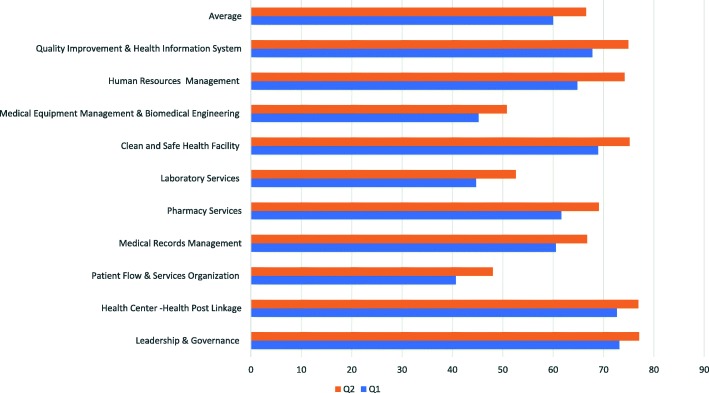
Result: For this study, ten sessions of two-day trainings were conducted for 1306 staff. Additionally, on-site mentoring and coaching was conducted for a period of three months. The average EHCRIG standards met before and after intervention totaled 59 and 66%, respectively. The scores showed a positive correlation coefficient (r = 0.74) with statistical significant paired sample t-test with t = - 7.15, df = 75, P < 0.000. In addition, the mean scores among performance tiers were 74, 66 and 65% for high, medium and low performing woredas respectively. The One-way Analysis of Variance (ANOVA) showed a borderline significant difference between groups with (F = 2.4, P < 0.09).
Conclusions: The implementation of the standards has garnered significant improvements in performance at the primary health care level. Therefore, continuing the initiated strengthening of health system performance against the standards and evaluation of the quality of primary health services is recommended.
Keywords: EHCRIGs; Health center reform; Performance improvement; Primary health care; Standards.
Conflict of interest statement
Authors’ information
MDA: MPH, Senior Health Systems Strengthening Adviser at USAID Transform: Primary Health Care, JSI Research and Training Institute Inc., Addis Ababa, Ethiopia. BFD: MPH, Deputy Chief of Party at USAID Transform: Primary Health Care, JSI Research and Training Institute, Inc. TAB: MPH, Health Extension and Primary Health Care Directorate, Federal Ministry of Health, Addis Ababa, and Ethiopia. ADA: MPH, Amhara Regional State Health Bureau, Disease Prevention and Health Promotion Core Process, Bahir Dar, Ethiopia.
Ethics approval and consent to participate
The research protocol of this quasi-experimental pre-post-intervention study was reviewed and granted (Certification reference number: HRTT02/137/2018) from the Amhara National Regional State Health Bureau Research and Ethics Review Committee. In addition, permission to conduct the study was obtained from USAID Transform: Primary Health Care project, JSI Research & Training Institute, Inc. [8]. Written informed consent was obtained from all study participants after providing brief explanations about the purpose and procedure of the study. To maintain the confidentiality of collected data, anonymity was maintained throughout the research process.
Consent for publication
Not Applicable.
Competing interests
The authors declare that they have no competing interests.
Publisher’s Note
Springer Nature remains neutral with regard to jurisdictional claims in published maps and institutional affiliations.
Figures
References
-
- WHO . Everybody’s business--strengthening health systems to improve health outcomes: WHO's framework for action. Geneva: World Health Organization; 2007.
-
- Armbruster S, McCarty A, Moran J. Guide to the stages of performance management: A guide to help health departments make progress toward a culture of performance management. Washington: Public Health Foundation; 2018.
-
- FMOH . Health sector transformation plan. Addis Ababa: Federal Ministry of Health of Ethiopia; 2015.
Publication types
MeSH terms
Grants and funding
LinkOut - more resources
Full Text Sources
Medical
Miscellaneous
