


Automated oxygen administration versus conventional oxygen therapy after major abdominal or thoracic surgery: study protocol for an international multicentre randomised controlled study
- PMID: 30782716
- PMCID: PMC6340445
- DOI: 10.1136/bmjopen-2018-023833
Automated oxygen administration versus conventional oxygen therapy after major abdominal or thoracic surgery: study protocol for an international multicentre randomised controlled study
Abstract
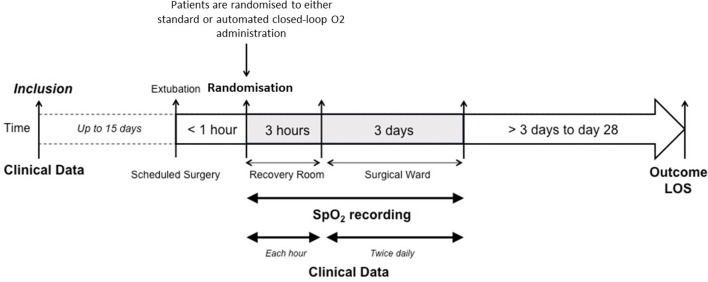
Introduction: Hypoxemia and hyperoxia may occur after surgery with potential related complications. The FreeO2 PostOp trial is a prospective, multicentre, randomised controlled trial that evaluates the clinical impact of automated O2 administration versus conventional O2 therapy after major abdominal or thoracic surgeries. The study is powered to demonstrate benefits of automated oxygen titration and weaning in term of oxygenation, which is an important surrogate for complications after such interventions.
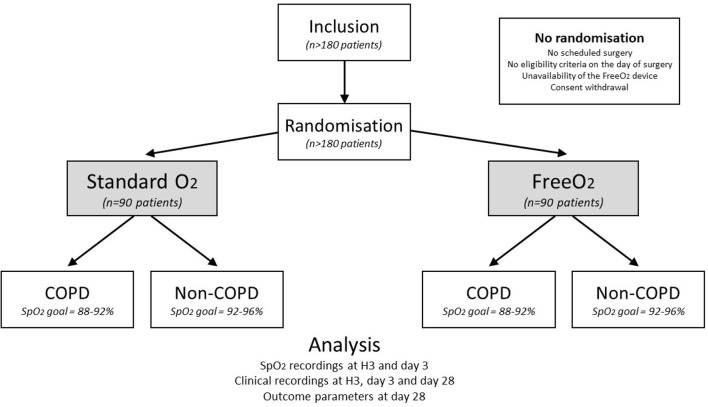
Methods and analysis: After extubation, patients are randomly assigned to the Standard (manual O2 administration) or FreeO2 group (automated closed-loop O2 administration). Stratification is performed for the study centre and a medical history of chronic obstructive pulmonary disease (COPD). Primary outcome is the percentage of time spent in the target zone of oxygen saturation, during a 3-day time frame. In both groups, patients will benefit from continuous oximetry recordings. The target zone of oxygen saturation is SpO2=88%-92% for patients with COPD and 92%-96% for patients without COPD. Secondary outcomes are the nursing workload assessed by the number of manual O2 flow adjustments, the time spent with severe desaturation (SpO2 <85%) and hyperoxia area (SpO2 >98%), the time spent in a hyperoxia area (SpO2 >98%), the VO2, the duration of oxygen administration during hospitalisation, the frequency of use of mechanical ventilation (invasive or non-invasive), the duration of the postrecovery room stay, the hospitalisation length of stay and the survival rate.
Ethics and dissemination: The FreeO2 PostOp study is conducted in accordance with the declaration of Helsinki and was registered on 11 September 2015 (http://www.clinicaltrials.gov). First patient inclusion was performed on 14 January 2016. The results of the study will be presented at academic conferences and submitted to peer-reviewed journals.
Trial registration number: NCT02546830.
Keywords: abdominal surgery; hyperoxia; hypoxemia; oxygen therapy; postoperative complications; thoracic surgery.
© Author(s) (or their employer(s)) 2019. Re-use permitted under CC BY-NC. No commercial re-use. See rights and permissions. Published by BMJ.
Conflict of interest statement
Competing interests: EL’h reports lecture fees and travel expenses for lectures given at academic meetings from GE Healthcare, Sedana Medical, Smiths Medical, Air Liquide Medical Systems. EL’h and FL are the inventors of the FreeO2 device and founded Oxynov Inc. to develop the commercial device. The firm Oxynov Inc. provides the automated oxygen therapy equipment to all the participating centres but has no other involvement in the study.
Figures
References
-
- Committee GS. Global strategy for the diagnosis, maagement, and prevention of chronic obstructive pulmonary disease. 2016. Date http://goldcopd.org/global-strategy-diagnosis-management-prevention-copd... (last accessed 30 Mar 2018).
Publication types
MeSH terms
Associated data
LinkOut - more resources
Full Text Sources
Medical
