Review
. 2019 Apr 5;294(14):5340-5351.
doi: 10.1074/jbc.REV118.002958. Epub 2019 Feb 19.

Evolution of the multi-tRNA synthetase complex and its role in cancer

Affiliations
Review

Evolution of the multi-tRNA synthetase complex and its role in cancer

Do Young Hyeon et al. J Biol Chem. .

Abstract

Aminoacyl-tRNA synthetases (ARSs) are enzymes that ligate their cognate amino acids to tRNAs for protein synthesis. However, recent studies have shown that their functions are expanded beyond protein synthesis through the interactions with diverse cellular factors. In this review, we discuss how ARSs have evolved to expand and control their functions by forming protein assemblies. We particularly focus on a macromolecular ARS complex in eukaryotes, named multi-tRNA synthetase complex (MSC), which is proposed to provide a channel through which tRNAs reach bound ARSs to receive their cognate amino acid and transit further to the translation machinery. Approximately half of the ARSs assemble into the MSC through cis-acting noncatalytic domains attached to their catalytic domains and trans-acting factors. Evolution of the MSC included its functional expansion, during which the MSC interaction network was augmented by additional cellular pathways present in higher eukaryotes. We also discuss MSC components that could be functionally involved in the pathophysiology of tumorigenesis. For example, the activities of some trans-acting factors have tumor-suppressing effects or maintain DNA integrity and are functionally compromised in cancer. On the basis of Gene Ontology analyses, we propose that the regulatory activities of the MSC-associated ARSs mainly converge on five biological processes, including mammalian target of rapamycin (mTOR) and DNA repair pathways. Future studies are needed to investigate how the MSC-associated and free-ARSs interact with each other and other factors in the control of multiple cellular pathways, and how aberrant or disrupted interactions in the MSC can cause disease.

Keywords: Aminoacyl-tRNA synthetases; Cancer; aminoacyl tRNA synthetase; cancer biology; intracellular processing; multi-tRNA synthetase complex; network analysis; pathology; protein synthesis; protein–protein interaction.


Conflict of interest statement

The authors declare that they have no conflicts of interest with the contents of this article

Figures
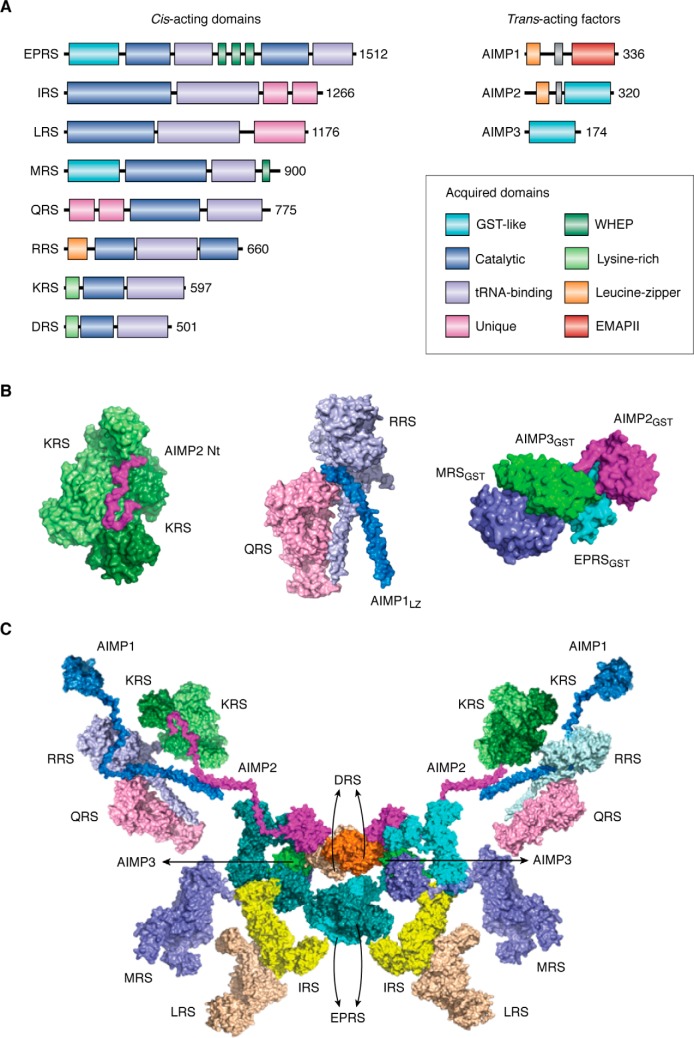
Figure 1.
Figure 1.
MSC and sub-MSC structures and signaling network functionally related to cancer. A, human MSC components have several appended domains or motifs. The conserved catalytic domains and tRNA recognition domains are shown in dark gray or light gray boxes. GST-like domains are shown in the EPRS, MRS, AIMP2, and AIMP3, whereas the WHEP domains are shown in ERPS and MRS. Leucine–zipper motif is also observed in AIMP1, AIMP2, and RRS. AIMP1 has an EMAPII domain that is involved in several cellular responses. Whereas the DRS and KRS have the lysine-rich domains in the N-terminal region, LRS and IRS have the appended sequences. QRS also has the appended sequences in the C-terminal regions. B, known sub-MSC complex structures. The KRS homodimer (light and dark green) is anchored to the N-terminal peptide region of AIMP2 within the MSC (left) (16). The N-terminal helix of AIMP1 forms the ternary complex with the noncatalytic N-terminal extensions of RRS and the C-terminal core of QRS to assemble a heterotrimeric complex (center) (30). The MRS, AIMP3, EPRS, and AIMP2 are tightly linked through their GST-homology domains (right) (17). C, bisymmetrical model describing one of the possible arrangements of the MSC–ARS/AIMPs is shown as bisymmetrical model, based on the subcomplex and interaction data (17). In this model, homodimerization of DRS and PRS contributes to the bilateral symmetry of the whole complex.
Figure 2.
Figure 2.
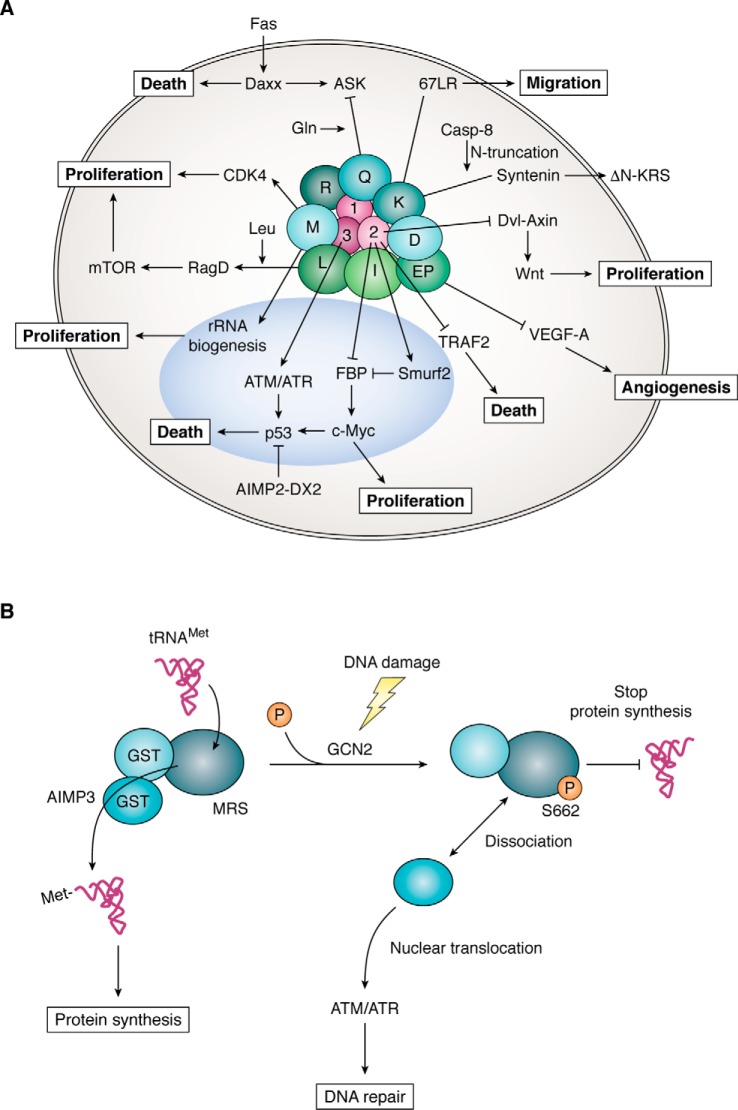
Signaling network of the MSC components related to protein synthesis and cancer. A, cancer-related signaling network mediated by the MSC-forming ARSs and AIMPs. LRS functioning as a leucine sensor interacts with the RagD GTPase to stimulate the mTOR pathway (50, 51). KRS forms a metastasis-promoting interaction with the 67-kDa laminin receptor in the cell membrane (54, 55). Caspase-8 cleaves the N-terminal 12 amino acids of KRS, exposing its PDZ-binding motif at the C terminus. Syntenin binds to the exposed PDZ-binding motif of KRS and facilitates the exosome-mediated secretion of MSC-dissociated KRS (56). Induced by growth stimuli, MRS is translocated to the nucleoli to stimulate rRNA synthesis (15). MRS binds to and stabilizes CDK4 to promote the cell cycle in p16-negative cancers (57). QRS binds to apoptosis signal-regulating kinase 1 (ASK1) to regulate apoptosis in a glutamine-dependent manner (58). EPRS forms the GAIT (interferon γ–activated inhibitor of translation) complex with other cell factors to regulate the expression of VEGF-A mRNA (59). AIMP2 is one of three nonenzymatic factors, and it works as a potent tumor suppressor through multiple pathways, including TGF-β- (36), TNFα- (37), Wnt- (38), and p53 (39)-mediated pathways. AIMP3 is mobilized to the nucleus by DNA damage (46, 47) or via an oncogenic stimulus (21) to activate p53 via ATM/ATR for DNA repair. B, MRS forms a complex with AIMP3 via their GST-homology domains (17). AIMP3 relays methionylated tRNA to the initiation factor to facilitate protein synthesis (11). However, upon DNA damage, MRS is phosphorylated by the activated GCN2 at the serine 662 residue that blocks tRNAMet binding, leading to the inhibition of protein synthesis (48). The dissociated AIMP3 is translocated into nucleus and activates ATM and ATR for DNA repair (21).
Figure 3.
Figure 3.
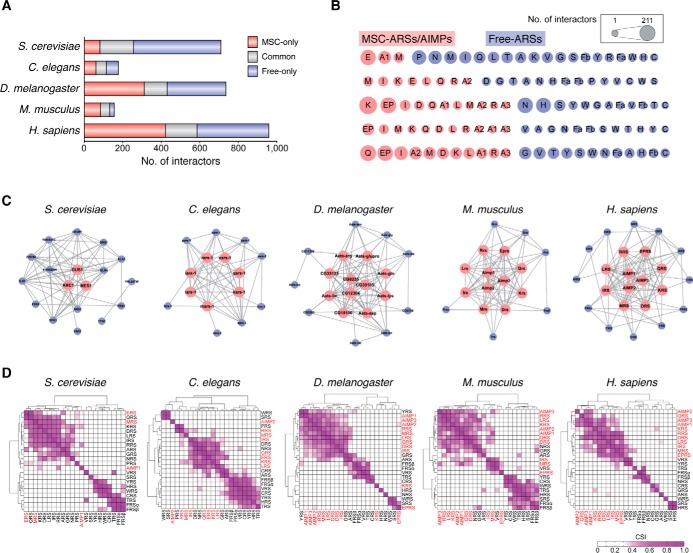
Comparative interactome analysis of ARSs in five species. A, protein–protein interactions of ARSs and AIMPs. The identified ARS interactors were grouped as those specifically interacting with MSC–ARSs/AIMPs (MSC-only), with free-ARSs (free-only), and with both MSC–ARSs/AIMPs and free-ARSs (common). B, number of interactors for individual MSC–ARSs/AIMPs (pink circles) and free-ARSs (purple circles). The circle sizes (see box) represent the interactome size of each ARS or AIMP in five species from yeast (top) to human (bottom). C, networks describing protein–protein interactions (gray edges) among ARSs and AIMPs are shown in five species. Pink and purple nodes denote MSC–ARSs/AIMPs and free-ARSs, respectively. D, hierarchical clustering of ARSs and AIMPs using their scores, called CSIs, which represent the degrees of shared interactors between the pairs of ARSs and AIMPs in each of the five species. Ward linkage and Euclidean distance as the similarity measures were used for the clustering (67, 68). The color bar represents the gradient of CSI scores. MSC–ARSs/AIMPs and free-ARSs were labeled in red and black, respectively.
Figure 4.
Figure 4.
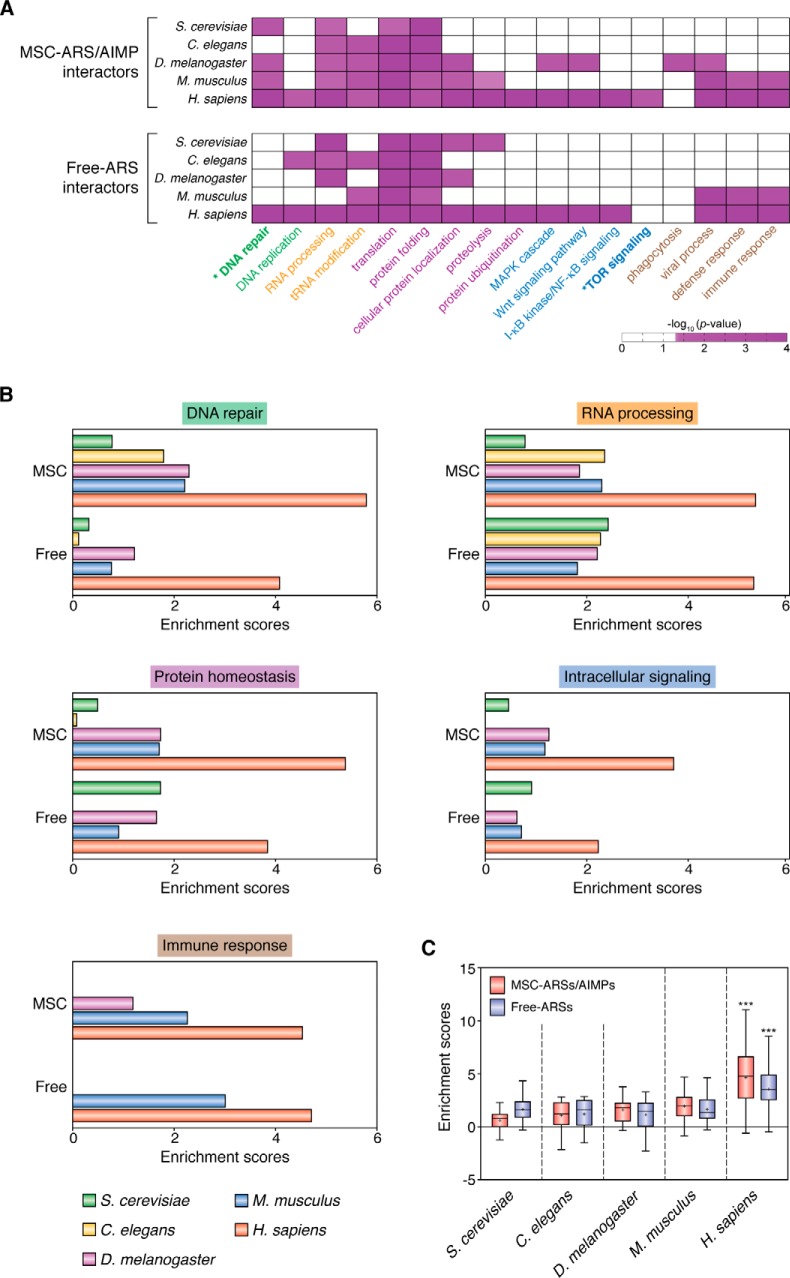
Comparative functional enrichment analysis of ARS interactomes in five species. A, GOBPs enriched by the interactors of MSC–ARSs/AIMPs and free-ARSs in S. cerevisiae, C. elegans, D. melanogaster, M. musculus, and H. sapiens. The five enriched cellular processes are labeled in different colors: 1) DNA replication (DNA repair and replication; green); 2) RNA processing (tRNA modification and RNA processing; orange); 3) protein homeostasis (translation, protein localization, and proteolysis; purple); 4) intracellular signaling (Wnt, MAPK, mTOR, and NF-κB signaling; blue); and 5) immune response (defense response, phagocytosis, and viral process; brown). The color bar represents the gradient of −log10 (p value), where the p value is the significance of the GOBPs being enriched by the interactors, which was computed from DAVID software. For visualization, hierarchical clustering was performed for each group of cellular processes using Ward linkage and Euclidean distance as the similarity measure. B, enrichment scores of the indicated representative processes (DNA repair, RNA processing, protein localization–proteolysis, immune response–viral process, and intracellular signaling) for the five groups of cellular processes enriched by MSC–ARS/AIMP (top) and free-ARS interactors (bottom) in the five species. C, distributions of the enrichment scores of the representative processes by MSC–ARS/AIMP (pink) and free-ARS interactors (purple) in the five species are shown using box plots. Z >2.33, *, p < 0.05, and ***, p < 0.001, two-way ANOVA with Bonferroni's post-hoc correction. See supporting information for methodological details.
Figure 5.
Figure 5.
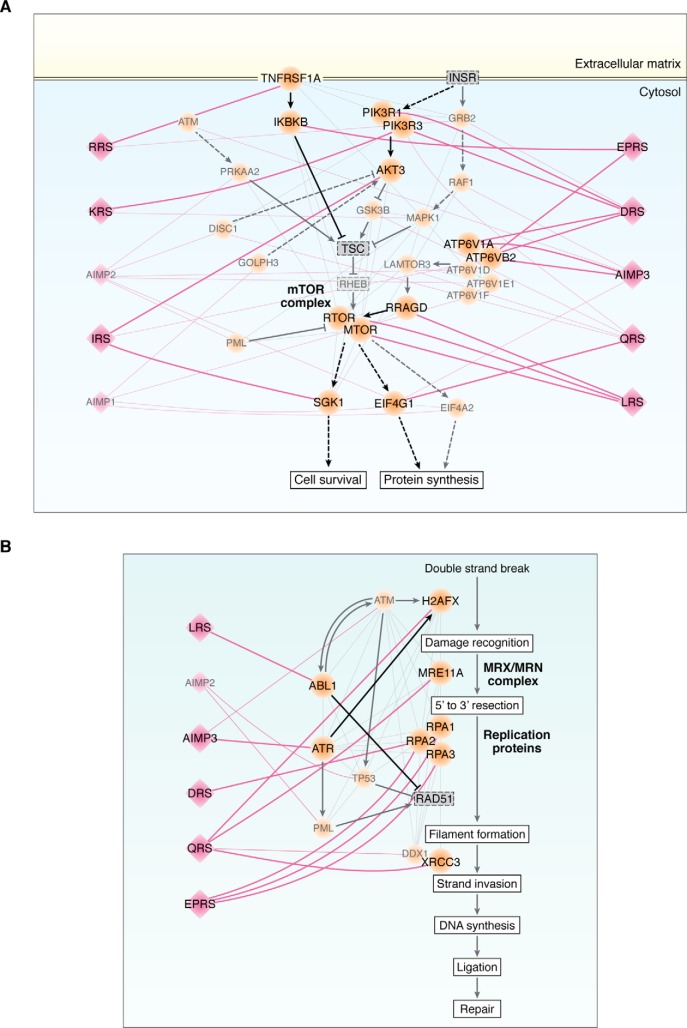
Systematic association of the MSC components with mTOR and DNA repair pathways. Network models describing interactions of MSC–ARS/AIMPs with molecules involved in the mTOR signaling (A) and HR-based DNA repair pathways (B) in H. sapiens. Pink diamonds and orange circles represent MSC–ARS/AIMPs and their interactors in the pathways, respectively. Pink lines are the interactions between MSC–ARS/AIMPs and their interactors in the two pathways. Gray lines indicate the known interactions among the cellular factors in the pathways. Known activation (arrows) and inhibition (inhibition symbols) information obtained from Kyoto Encyclopedia of Genes and Genomes (KEGG) pathway database and the previous literature are denoted with black lines. Solid and dashed lines are direct and indirect interactions between the molecules, respectively. Active interactions between the pairs of MSC–ARS/AIMPs and the molecules in the pathways with significant mRNA expression–survival correlations are highlighted with thick pink lines. See supporting information for methodological details. ATP6V1A/B2/D/E1/F are the components of ATPases in phagosomes or lysosomes (A). QRS interacts with MRE11, a component of MRN complex involved in the initial processing of double-strand DNA breaks before HR-based DNA repair. EPRS and DRS interact with RPA1/2/3 that prevent ssDNA from winding back before HR-based DNA repair. QRS, LRS, and AIMP3 interact with H2AFX, ABL1, and ATR, respectively, which are involved in RAD51-mediated heteroduplex formation during HR-based DNA repair. QRS interacts with XRCC3 and DDX1 involved in DNA extension during HR-based DNA repair (B).

References

    1. McClain W. H. (1993) Rules that govern tRNA identity in protein synthesis. J. Mol. Biol. 234, 257–280 10.1006/jmbi.1993.1582 - DOI - PubMed
    1. Swanson R., Hoben P., Sumner-Smith M., Uemura H., Watson L., and Söll D. (1988) Accuracy of in vivo aminoacylation requires proper balance of tRNA and aminoacyl-tRNA synthetase. Science 242, 1548–1551 - PubMed
    1. Delarue M. (1995) Aminoacyl-tRNA synthetases. Curr. Opin. Struct. Biol. 5, 48–55 10.1016/0959-440X(95)80008-O - DOI - PubMed
    1. Kim S., You S., and Hwang D. (2011) Aminoacyl-tRNA synthetases and tumorigenesis: more than housekeeping. Nat. Rev. Cancer 11, 708–718 10.1038/nrc3124 - DOI - PubMed
    1. Lee S. W., Cho B. H., Park S. G., and Kim S. (2004) Aminoacyl-tRNA synthetase complexes: beyond translation. J. Cell Sci. 117, 3725–3734 10.1242/jcs.01342 - DOI - PubMed

Publication types

MeSH terms