


Adenovirus-mediated herpes simplex virus thymidine kinase gene therapy combined with ganciclovir induces hepatoma cell apoptosis
- PMID: 30783433
- PMCID: PMC6364201
- DOI: 10.3892/etm.2019.7147
Adenovirus-mediated herpes simplex virus thymidine kinase gene therapy combined with ganciclovir induces hepatoma cell apoptosis
Abstract
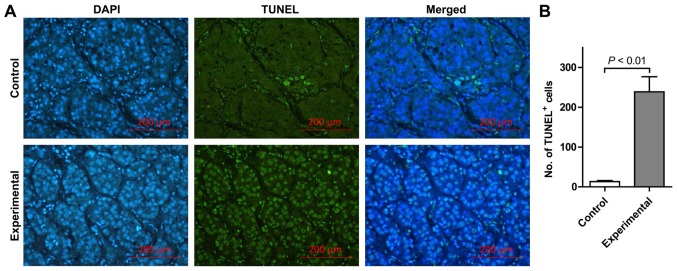
The present study aimed to examine the apoptotic effects of adenovirus (ADV)-mediated herpes simplex virus thymidine kinase (ADV-TK) combined with ganciclovir (GCV) in tissues obtained from patients with hepatocellular carcinoma in order to provide a theoretical basis for the development of this gene therapy program. Apoptosis detection was conducted using the terminal deoxynucleotidyl-transferase-mediated dUTP nick end labelling assay and the apoptosis index was compared between the experimental; and control groups. Furthermore, the protein expression levels of caspase-3, B-cell lymphoma-2 (Bcl-2), Bcl-2-assoicated protein X (Bax) and nuclear factor (NF)-κB were examined in pathological specimens using immunohistochemical staining. The Bax/Bcl-2 ratio and the release of cytochrome c were examined using western blot analysis. Results indicated that combined ADV-TK and GCV treatment significantly increased the number of apoptotic cells compared with the control group (P<0.05). Immunohistological analysis revealed that ADV-TK and GCV treatment significantly increased the number of caspase-3-positive cells, reduced the Bax/Bcl-2 ratio and NF-κB expression levels and promoted the release of cytochrome c compared with the control group (P<0.01). In conclusion, the present results suggest that combined ADV-TK and GCV treatment exerts its effect through the apoptotic signaling pathway.
Keywords: apoptosis mechanism; gene therapy; hepatocellular carcinoma.
Figures

Similar articles
-
Adenovirus vector-mediated herpes simplex virus-thymidine kinase gene/ganciclovir system exhibits anti-tumor effects in an orthotopic hepatocellular carcinoma model.Pharmazie. 2014 Jul;69(7):547-52. Pharmazie. 2014. PMID: 25073402
-
Adenovirus-mediated herpes simplex virus thymidine kinase gene therapy in BT4C rat glioma model.Cancer Gene Ther. 2002 Nov;9(11):917-24. doi: 10.1038/sj.cgt.7700515. Cancer Gene Ther. 2002. PMID: 12386830
-
[Effects of adenovirus-mediated HSV-tk/GCV system on lens epithelium].Zhonghua Yan Ke Za Zhi. 2002 Oct;38(10):618-22. Zhonghua Yan Ke Za Zhi. 2002. PMID: 12487913 Chinese.
-
Differential chemosensitivity of breast cancer cells to ganciclovir treatment following adenovirus-mediated herpes simplex virus thymidine kinase gene transfer.Cancer Gene Ther. 1999 Mar-Apr;6(2):179-90. doi: 10.1038/sj.cgt.7700005. Cancer Gene Ther. 1999. PMID: 10195885
-
Mitochondrial amplification of death signals determines thymidine kinase/ganciclovir-triggered activation of apoptosis.Cancer Res. 2000 Jun 15;60(12):3212-7. Cancer Res. 2000. PMID: 10866313
Cited by
-
β2-Adrenergic receptor agonist enhances the bystander effect of HSV-TK/GCV gene therapy in glioblastoma multiforme via upregulation of connexin 43 expression.Mol Ther Oncolytics. 2022 Jun 6;26:76-87. doi: 10.1016/j.omto.2022.05.010. eCollection 2022 Sep 15. Mol Ther Oncolytics. 2022. PMID: 35795095 Free PMC article.
-
Oncolytic virus-based hepatocellular carcinoma treatment: Current status, intravenous delivery strategies, and emerging combination therapeutic solutions.Asian J Pharm Sci. 2023 Jan;18(1):100771. doi: 10.1016/j.ajps.2022.100771. Epub 2022 Dec 29. Asian J Pharm Sci. 2023. PMID: 36896445 Free PMC article. Review.
References
-
- Faloppi L, Scartozzi M, Maccaroni E, Di Pietro Paolo M, Berardi R, Del Prete M, Cascinu S. Evolving strategies for the treatment of hepatocellular carcinoma: From clinical-guided to molecularly-tailored therapeutic options. Cancer Treat Rev. 2011;37:169–177. doi: 10.1016/j.ctrv.2010.08.001. - DOI - PubMed
LinkOut - more resources
Full Text Sources
Research Materials