Review
. 2019 May 7:15:425-450.
doi: 10.1146/annurev-clinpsy-050718-095625. Epub 2019 Feb 20.

Adolescent Suicide as a Failure of Acute Stress-Response Systems

Affiliations
Review

Adolescent Suicide as a Failure of Acute Stress-Response Systems

Adam Bryant Miller et al. Annu Rev Clin Psychol. .

Abstract

Suicide is the second leading cause of death worldwide for adolescents. Despite decades of research on correlates and risk factors for adolescent suicide, we know little about why suicidal ideation and behavior frequently emerge in adolescence and how to predict, and ultimately prevent, suicidal behavior among youths. In this review, we first discuss knowledge regarding correlates, risk factors, and theories of suicide. We then review why adolescence is a period of unique vulnerability, given changing biology and social network reorganization. Next, we present a conceptual model through which to interpret emerging findings in adolescent suicide research. We suggest that a promising area for future research is to examine adolescent suicide as a failure of biological responses to acute stress in the proximal moments of a suicidal crisis. After reviewing initial evidence for this conceptualization, we review future directions for studies on adolescent suicide.

Keywords: acute suicidal crisis; proximal risk factors; stress response; suicidal behavior; suicidal thoughts.


Figures
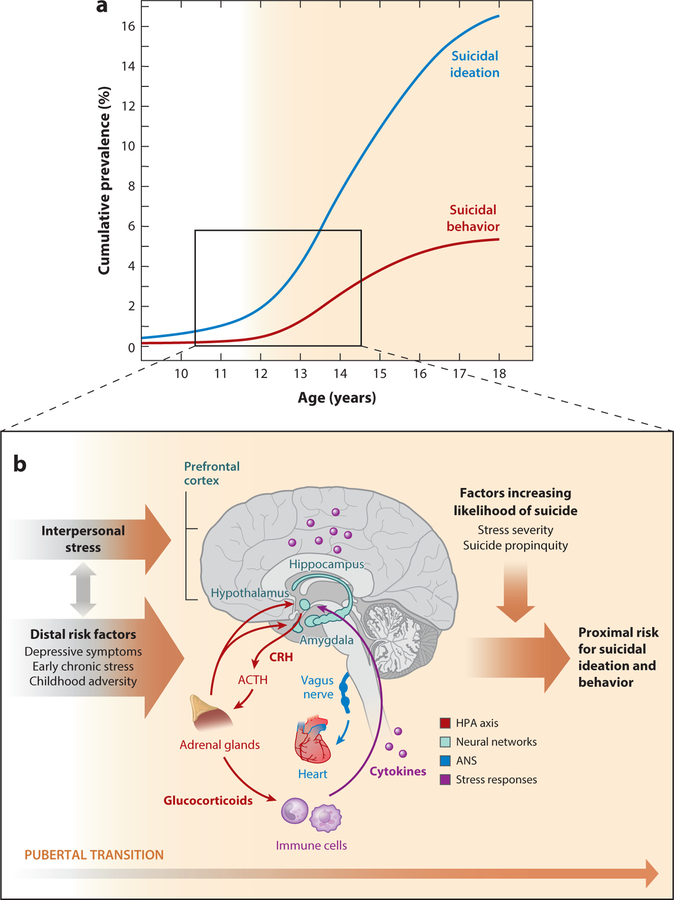
Figure 1
Figure 1
Heuristic model of adolescent suicidal ideation and behavior as a failure of biological responses to acute stress. (a) Developmental onset and prevalence of suicidal ideation and behavior (data from Nock et al. 2013). (b) Risks for suicidal ideation and behavior begin to increase exponentially at the pubertal transition. This increase occurs during a period of significant changes in biological systems that respond to acute stress. Our model suggests that interpersonal stressors and distal risk factors directly influence biological stress-response systems. In turn, failures of biological responses to acute stress confer risks for suicidal ideation and behavior, particularly among those facing stress exceeding their own personal threshold and those with prior exposure to suicidal ideation and behavior. Key stress-response systems that have been linked with suicidal ideation and behavior are depicted. Abbreviations: ACTH, adrenocorticotropic hormone; ANS, autonomic nervous system; CRH, corticotropin-releasing hormone; HPA, hypothalamic–pituitary–adrenal.

References

    1. Allen MT, Matthews KA. 1997. Hemodynamic responses to laboratory stressors in children and adolescents: the influences of age, race, and gender. Psychophysiology 34(3):329–39 - PubMed
    1. Asarnow JR, Hughes JL, Babeva KN, Sugar CA. 2017. Cognitive-behavioral family treatment for suicide attempt prevention: a randomized controlled trial. J. Am. Acad. Child Adolesc. Psychiatry 56(6):506–14 - PMC - PubMed
    1. Barsegyan A, Mackenzie SM, Kurose BD, McGaugh JL, Roozendaal B. 2010. Glucocorticoids in the prefrontal cortex enhance memory consolidation and impair working memory by a common neural mechanism. PNAS 107(38):16655–60 - PMC - PubMed
    1. Baumeister RF. 1990. Suicide as escape from self. Psychol. Rev 97(1):90–113 - PubMed
    1. Bearman PS, Moody J. 2004. Suicide and friendships among American adolescents. Am. J. Public Health 94(1):89–95 - PMC - PubMed

Publication types