


Maternal outcomes by race during postpartum readmissions
- PMID: 30786255
- PMCID: PMC6589347
- DOI: 10.1016/j.ajog.2019.02.016
Maternal outcomes by race during postpartum readmissions
Abstract
Background: Maternal race may be an important risk factor for postpartum readmissions and associated adverse outcomes.
Objective: To determine the association of race with serious complications during postpartum readmissions.
Study design: This repeated cross-sectional analysis used the National (Nationwide) Inpatient Sample from the Healthcare Cost and Utilization Project from 2012 to 2014. Women ages 15-54 readmitted postpartum after a delivery hospitalization were identified by Centers for Disease Control and Prevention criteria. Race and ethnicity were characterized as non-Hispanic white, non-Hispanic black, Hispanic, Asian or Pacific islander, Native American, other, and unknown. Overall risk for readmission by race was determined. Risk for severe maternal morbidity during readmissions by race was analyzed. Individual outcomes including pulmonary edema/acute heart failure and stroke also were analyzed by race. Log-linear regression models including demographics, hospital factors, and comorbid risk were used to analyze risk for severe maternal morbidity during postpartum readmissions.
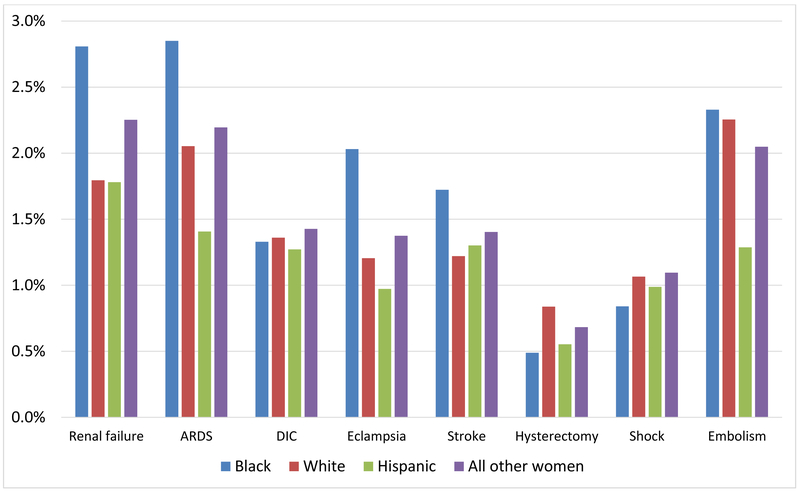
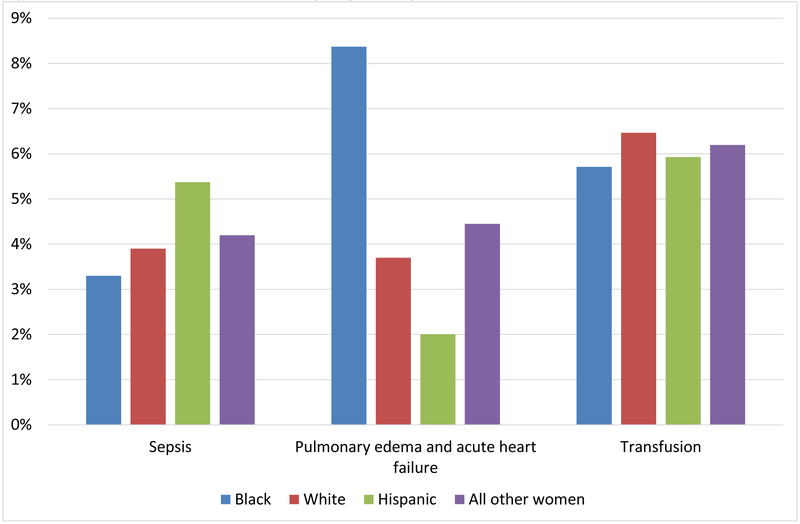
Results: Of 11.3 million births, 207,730 (1.8%) women admitted postpartum from 2012 to 2014 were analyzed, including 96,670 white, 47,015 black, and 33,410 Hispanic women. Compared with non-Hispanic white women, non-Hispanic black women were at 80% greater risk of postpartum readmission (95% confidence interval, 79%-82%) whereas Hispanic women were at 11% lower risk of readmission (95% confidence interval, 10%-12%). In unadjusted analysis, compared with non-Hispanic white women, non-Hispanic black women admitted postpartum were at 27% greater risk of severe maternal morbidity (95% confidence interval, 24%-30%) whereas Hispanic women were at 10% lower risk (95% confidence interval, 7%-13%). In the adjusted model, non-Hispanic black women were at 16% greater risk for severe maternal morbidity during readmission than non-Hispanic white women (95% confidence interval, 10%-22%), whereas Hispanic women were at 7% lower risk (95% confidence interval, 1%-12%). Differences in severe maternal morbidity risk between other racial groups and non-Hispanic white women were not significant. In addition to overall morbidity, non-Hispanic black women were at significantly greater risk for eclampsia, acute respiratory distress syndrome, and renal failure than other racial groups (P<.05 all). Black women were at 126% greater risk for pulmonary edema/acute heart failure than white women (95% confidence interval, 117%-136%).
Conclusion: Black women were more likely (1) to be readmitted postpartum, (2) to suffer severe maternal morbidity during readmission, and (3) to suffer life threatening complications such as pulmonary edema/acute heart failure. At-risk women including black women with cardiovascular risk factors may benefit from short-term postpartum follow-up.
Keywords: disparities; ethnicity; postpartum readmissions; race; severe maternal morbidity.
Copyright © 2019 Elsevier Inc. All rights reserved.
Conflict of interest statement
Figures
References
-
- Clapp MA, Little SE, Zheng J, Robinson JN. A multi-state analysis of postpartum readmissions in the United States. American journal of obstetrics and gynecology. 2016;215(1):113.e111–113.e110. - PubMed
-
- ACOG Committee Opinion No. 736: Optimizing Postpartum Care. Obstetrics and gynecology. 2018;131(5):e140–e150. - PubMed
-
- Murray Horwitz ME, Molina RL, Snowden JM. Postpartum Care in the United States - New Policies for a New Paradigm. N Engl J Med. 2018;379(18):1691–1693. - PubMed
-
- Aseltine RH Jr., Yan J, Fleischman S, Katz M, DeFrancesco M. Racial and Ethnic Disparities in Hospital Readmissions After Delivery. Obstetrics and gynecology. 2015;126(5):1040–1047. - PubMed
-
- Sharvit M, Rubinstein T, Ravid D, Shechter-Maor G, Fishman A, Biron-Shental T. Patients with high-risk pregnancies and complicated deliveries have an increased risk of maternal postpartum readmissions. Archives of gynecology and obstetrics. 2014;290(4):629–633. - PubMed
Publication types
MeSH terms
Grants and funding
LinkOut - more resources
Full Text Sources
Medical
