


A spatial analysis of geographic variation and factors associated with hospitalization for bacterial pneumonia in Korea
- PMID: 30786908
- PMCID: PMC6383222
- DOI: 10.1186/s12890-019-0798-6
A spatial analysis of geographic variation and factors associated with hospitalization for bacterial pneumonia in Korea
Abstract
Background: The incidence of pneumonia in Korea started to increase in the 1990's after a period of decrease and stabilization, and the mortality and hospitalization rates for pneumonia in Korea are alarmingly high. This study was performed to examine geographic variation and factors associated with hospitalization for bacterial pneumonia in Korea.
Methods: Data were acquired from the inpatient claims of the 2015 period of the National Health Insurance Service. The age- and sex-standardized hospitalization rates for bacterial pneumonia were calculated for three age groups. Geographic variation was measured with the coefficient of variation, the ratio of the 90th to the 10th percentile of the distribution of rates, and the systematic component of variation. Considering the results of Moran's I statistic which suggested spatial autocorrelation, we estimated spatial regression models using spatial error models.
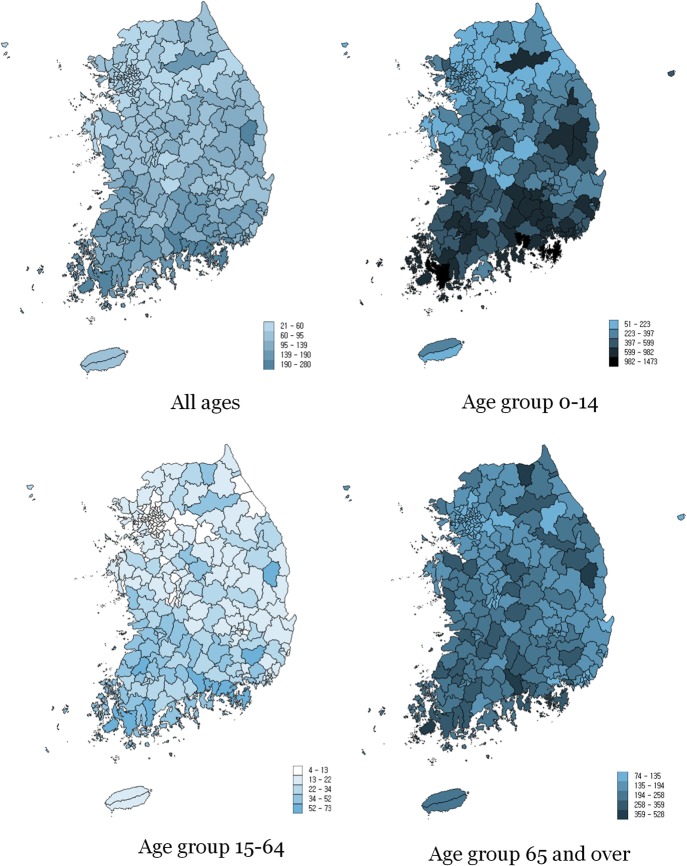
Results: The hospitalization rate for bacterial pneumonia was 79.1 per 10,000 population, and the rate was the highest in the age group 0-14 at 325.3, and it was 161.5 among the elderly. The geographic variation statistics showed high variation with the coefficient variation at 0.6. The deprivation score showed positive associations, and the number of primary care physicians had a negative association with the hospitalization rates across all age groups but the age group 0-14. The number of beds in hospitals with less than 300 beds had a positive association with the hospitalization rates for bacterial pneumonia, and the impact was the strongest in the age group 0-14.
Conclusions: The present study shows that pneumonia can be a major public health issue even in a developed country. Socioeconomic conditions can still be a concern for pneumonia in developed countries, and the role of primary care physicians in preventing hospitalization for bacterial pneumonia needs to be recognized. Most of all, the strong impact of hospital beds on the hospitalization rates for pneumonia, especially for the children, should be addressed. High disease burden of pneumonia in Korea can partly be attributable to oversupply of hospital beds. These factors should be taken into consideration in establishing policy measures for the rise in pneumonia.
Keywords: Bacterial pneumonia; Geographic variation; Hospital bed supply; Hospitalization; Korea; Pneumonia; Primary care; Regional deprivation; Spatial analysis; Spatial autocorrelation; Spatial regression.
Conflict of interest statement
Ethics approval and consent to participate
This study was granted a waiver of informed consent and of its documentation by the Institutional Review Board of Seoul National University Hospital (IRB No: 1504–075-665).
This study was conducted under the approval of the National Health Insurance Service in Korea and the Institutional Review Board of Seoul National University, and no further administrative permission was required.
Consent for publication
Not applicable.
Competing interests
The authors declare that they have no competing interests.
Publisher’s Note
Springer Nature remains neutral with regard to jurisdictional claims in published maps and institutional affiliations.
Figures
References
-
- Choi MJ, Song JY, Noh JY, Yoon JG, Lee SN, Heo JY, Yoon JW, Jo YM, Cheong HJ, Kim WJ. Disease burden of hospitalized community-acquired pneumonia in South Korea: analysis based on age and underlying medical conditions. Medicine (Baltimore) 2017;96(44):e8429. doi: 10.1097/MD.0000000000008429. - DOI - PMC - PubMed
-
- World Health Organization. Priority Medicine for Europe and the World Update Report, 2013. Geneva: World Health Organization; 2013.
-
- American Thoracic Society: Top 20 Pneumonia Facts—2015. 2015. https://www.thoracic.org/patients/patient-resources/resources/top-pneumo.... Accessed 2 Sept 2018.
-
- World Health Organization: Pneumonia. 2016. https://www.who.int/news-room/fact-sheets/detail/pneumonia. Accessed 2 Sept 2018.
-
- Troeger C, Forouzanfar M, Rao PC, Khalil I, Brown A, Swartz S, Fullman N, Mosser J, Thompson RL, Reiner RC., Jr Estimates of the global, regional, and national morbidity, mortality, and aetiologies of lower respiratory tract infections in 195 countries: a systematic analysis for the global burden of disease study 2015. Lancet Infect Dis. 2017;17(11):1133–1161. doi: 10.1016/S1473-3099(17)30396-1. - DOI - PMC - PubMed
MeSH terms
LinkOut - more resources
Full Text Sources
