Rapid Emergence, Subsidence, and Molecular Detection of Escherichia coli Sequence Type 1193- fimH64, a New Disseminated Multidrug-Resistant Commensal and Extraintestinal Pathogen
- PMID: 30787145
- PMCID: PMC6498021
- DOI: 10.1128/JCM.01664-18
Rapid Emergence, Subsidence, and Molecular Detection of Escherichia coli Sequence Type 1193- fimH64, a New Disseminated Multidrug-Resistant Commensal and Extraintestinal Pathogen
Abstract
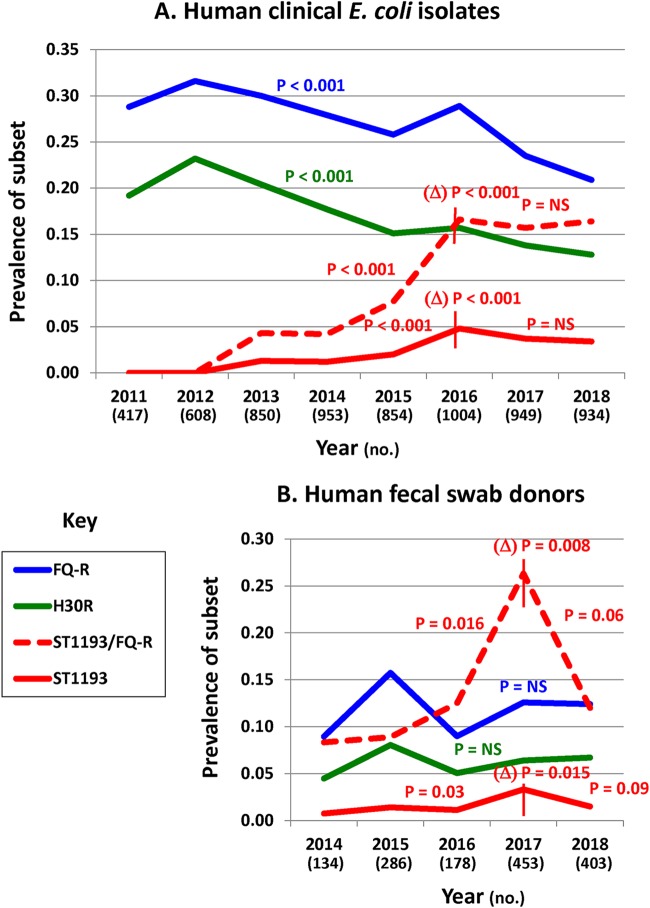
Escherichia coli sequence type 1193 (ST1193) is an emerging multidrug-resistant pathogen. We performed longitudinal and cross-sectional surveillance for ST1193 among clinical and fecal E. coli isolates from Minneapolis Veterans Affairs Medical Center (VAMC) patients and their household members, other Minnesota centers, and national VAMCs and compared these ST1193 isolates with archival human and canine ST1193 isolates from Australia (2008). We also developed and extensively validated a novel multiplex PCR assay for ST1193 and its characteristic fimH64 (type 1 fimbrial adhesin) allele. We found that ST1193-H64 (where "H64" refers to a phylogenetic subdivision within ST1193 that is characterized by the fimH64 allele), which was uniformly fluoroquinolone resistant, appeared to emerge in the United States in a geographically staggered fashion beginning around 2011. Its prevalence among clinical and fecal E. coli isolates at the Minneapolis VAMC rose rapidly beginning in 2013, peaked in early 2017, and then plateaued or declined. In comparison with other ST14 complex (STc14) isolates, ST1193-H64 isolates were more extensively multidrug resistant, whereas their virulence genotypes were less extensive but included (uniquely) K1 capsule and fimH64 Pulsed-field gel electrophoresis separated ST1193-H64 isolates from other STc14 isolates and showed genetic commonality between archival Australian versus recent U.S. isolates, fecal versus clinical isolates, and human versus canine isolates. Three main ST1193 pulsotypes differed significantly in resistance profiles and capsular types; emergent pulsotype 2123 was associated with trimethoprim-sulfamethoxazole resistance and K1 (versus K5) capsule. These findings clarify ST1193-H64's temporal prevalence trends as a fluoroquinolone-resistant pathogen and commensal; document clonal subsets with distinctive geographic, temporal, resistance, and virulence gene associations; and establish a new laboratory tool for rapid and simple detection of ST1193-H64.
Keywords: Escherichia coli; PCR; ST1193; antimicrobial resistance; fluoroquinolone resistance; intestinal colonization; molecular epidemiology; surveillance; veterinary epidemiology; zoonotic infections.
Copyright © 2019 American Society for Microbiology.
Figures
References
-
- Review on Antimicrobial Resistance. 2014. Antimicrobial resistance: tackling a crisis for the health and wealth of nations. Wellcome Trust, London, United Kingdom: https://amr-review.org/sites/default/files/AMR%20Review%20Paper%20-%20Ta....
-
- Croxall G, Hale J, Weston V, Manning G, Cheetham P, Achtman M, McNally A. 2011. Molecular epidemiology of extraintestinal pathogenic Escherichia coli isolates from a regional cohort of elderly patients highlights the prevalence of ST131 strains with increased antimicrobial resistance in both community and hospital care settings. J Antimicrob Chemother 66:2501–2508. doi: 10.1093/jac/dkr349. - DOI - PubMed
Publication types
MeSH terms
Substances
Grants and funding
LinkOut - more resources
Full Text Sources
Medical
Molecular Biology Databases
Research Materials