Recurrent lumbar disc herniation: Is there a correlation with the surgical technique? A multivariate analysis
- PMID: 30787588
- PMCID: PMC6364357
- DOI: 10.4103/jcvjs.JCVJS_94_18
Recurrent lumbar disc herniation: Is there a correlation with the surgical technique? A multivariate analysis
Abstract
Purpose: The recurrence of a lumbar disc herniation (LDH) is a common cause of poor outcome following lumbar discectomy. The aim of this study was to assess a potential relationship between the incidence of recurrent LDH and the surgical technique used. Furthermore, we tried to define the best surgical technique for the treatment of recurrent LDH to limit subsequent recurrences.
Materials and methods: A retrospective study was conducted on 979 consecutive patients treated for LDH. A multivariate analysis tried to identify a possible correlation between (1) the surgical technique used to treat the primary LDH and its recurrence; (2) technique used to treat the recurrence of LDH and the second recurrence; and (3) incidence of recurrence and clinical outcome. Data were analyzed with the Pearson's Chi-square test for its significance.
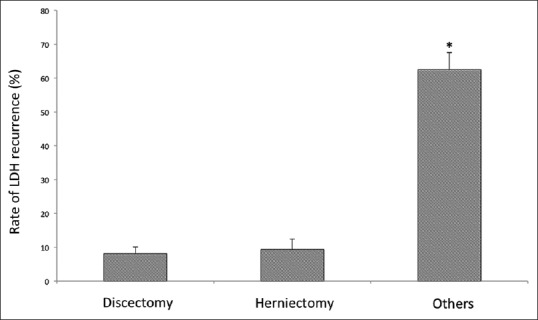
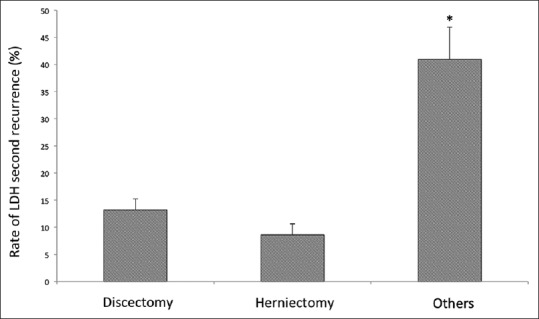
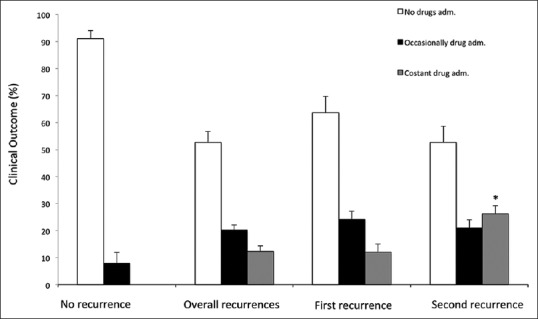
Results: In 582 cases (59.4%), a discectomy was performed, while in 381 (40.6%), a herniectomy was undertaken. In 16 cases, a procedure marked as "other" was performed. Among all patients, 110 (11.2%) had a recurrence. Recurrent LDH was observed in 55 patients following discectomy (9.45%), in 45 following herniectomy (11.8%), and in 10 (62.5%) following other surgery. Our data showed that 90.5% of discectomies and 88.2% of the herniectomies had a good clinical outcome, whereas other surgeries presented a recurrence rate of 62.5% (Pearson's χ2< 0.001). No statistical differences were observed between discectomy or herniectomy, for the treatment of the recurrence, and the incidence for the second recurrences (P > 0.05). A significant statistical correlation emerged between the use of other techniques and the incidence for the second recurrences (P < 0.05).
Conclusions: The recurrence of an LDH is one of the most feared complications following surgery. Although the standard discectomy has been considered more protective toward the recurrence compared to herniectomy, our data suggest that there is no significant correlation between the surgical technique and the risk of LDH recurrence.
Keywords: Degenerative disc disease; low back pain; recurrent lumbar disc herniation; spinal degeneration; spinal instability; surgery.
Conflict of interest statement
There are no conflicts of interest.
Figures
Similar articles
-
Lumbar disc herniation: Prevention and treatment of recurrence: WFNS spine committee recommendations.World Neurosurg X. 2024 Feb 9;22:100275. doi: 10.1016/j.wnsx.2024.100275. eCollection 2024 Apr. World Neurosurg X. 2024. PMID: 38385057 Free PMC article. Review.
-
Adjuvant surgical decision-making system for lumbar intervertebral disc herniation after percutaneous endoscopic lumber discectomy: a retrospective nonlinear multiple logistic regression prediction model based on a large sample.Spine J. 2021 Dec;21(12):2035-2048. doi: 10.1016/j.spinee.2021.07.012. Epub 2021 Jul 20. Spine J. 2021. PMID: 34298160
-
Longitudinal clinical outcomes after full-endoscopic lumbar discectomy for recurrent disc herniation after open discectomy.J Clin Neurosci. 2020 Feb;72:124-129. doi: 10.1016/j.jocn.2019.12.047. Epub 2020 Jan 13. J Clin Neurosci. 2020. PMID: 31948880
-
Prevalence of Recurrent Herniation Following Percutaneous Endoscopic Lumbar Discectomy: A Meta-Analysis.Pain Physician. 2018 Jul;21(4):337-350. Pain Physician. 2018. PMID: 30045591
-
Recurrent disc herniation and long-term back pain after primary lumbar discectomy: review of outcomes reported for limited versus aggressive disc removal.Neurosurgery. 2009 Feb;64(2):338-44; discussion 344-5. doi: 10.1227/01.NEU.0000337574.58662.E2. Neurosurgery. 2009. PMID: 19190461 Review.
Cited by
-
Posterior longitudinal ligament suturation after lumbar discectomy provides postoperative a large intradural area: First report.J Craniovertebr Junction Spine. 2023 Apr-Jun;14(2):181-186. doi: 10.4103/jcvjs.jcvjs_10_23. Epub 2023 Jun 13. J Craniovertebr Junction Spine. 2023. PMID: 37448510 Free PMC article.
-
Prevention of lumbar reherniation by the intraoperative use of a radiofrequency bipolar device: A case-control study.J Craniovertebr Junction Spine. 2019 Apr-Jun;10(2):94-99. doi: 10.4103/jcvjs.JCVJS_47_19. J Craniovertebr Junction Spine. 2019. PMID: 31402829 Free PMC article.
-
Recurrence of lumbar disk herniation after microdiscectomy: a two-center retrospective analysis of 1214 cases and identification of risk factors.Turk J Med Sci. 2023 May 9;53(5):1254-1261. doi: 10.55730/1300-0144.5691. eCollection 2023. Turk J Med Sci. 2023. PMID: 38813020 Free PMC article.
-
Recurrent or junctional lumbar foraminal herniated disc in patients operated with trans pars microscopic approach.Neurosurg Rev. 2023 Aug 29;46(1):211. doi: 10.1007/s10143-023-02109-x. Neurosurg Rev. 2023. PMID: 37642794 Free PMC article.
-
Bone resorption around the annular closure device during a postoperative follow-up of 8 years.Acta Neurochir (Wien). 2024 Jan 27;166(1):40. doi: 10.1007/s00701-024-05930-5. Acta Neurochir (Wien). 2024. PMID: 38280105
References
-
- Shamim MS, Parekh MA, Bari ME, Enam SA, Khursheed F. Microdiscectomy for lumbosacral disc herniation and frequency of failed disc surgery. World Neurosurg. 2010;74:611–6. - PubMed
-
- Ebeling U, Kalbarcyk H, Reulen HJ. Microsurgical reoperation following lumbar disc surgery. Timing, surgical findings, and outcome in 92 patients. J Neurosurg. 1989;70:397–404. - PubMed
-
- Fandiño J, Botana C, Viladrich A, Gomez-Bueno J. Reoperation after lumbar disc surgery: Results in 130 cases. Acta Neurochir (Wien) 1993;122:102–4. - PubMed
-
- Keskimäki I, Seitsalo S, Osterman H, Rissanen P. Reoperations after lumbar disc surgery: A population-based study of regional and interspecialty variations. Spine (Phila Pa 1976) 2000;25:1500–8. - PubMed
-
- Suk KS, Lee HM, Moon SH, Kim NH. Recurrent lumbar disc herniation: Results of operative management. Spine (Phila Pa 1976) 2001;26:672–6. - PubMed