


Effects of Vibration and Non-Vibration Foam Rolling on Recovery after Exercise with Induced Muscle Damage
- PMID: 30787665
- PMCID: PMC6370959
Effects of Vibration and Non-Vibration Foam Rolling on Recovery after Exercise with Induced Muscle Damage
Abstract
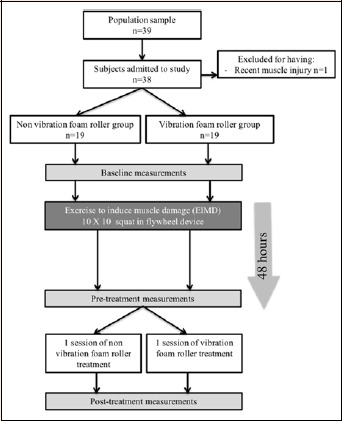
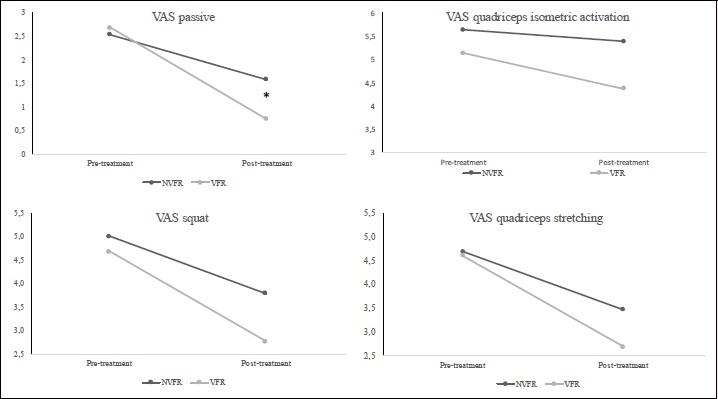
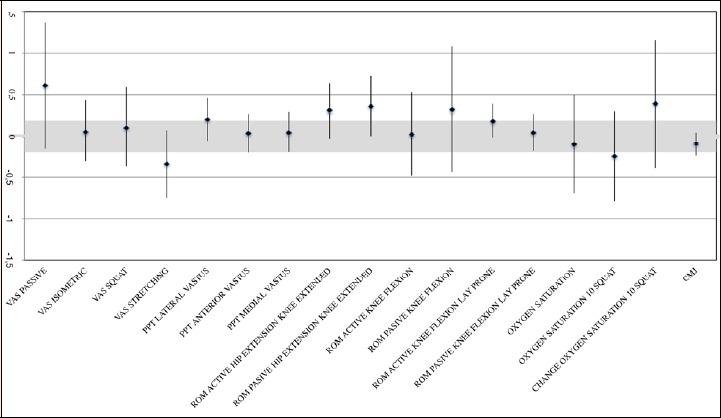
We aimed to compare the effects between non-vibration foam rolling (NVFR) and vibration foam rolling (VFR) on visual analogic scale (VAS), pressure pain threshold (PPT), oxygen saturation (SmO2), countermovement jump (CMJ) and hip and knee range of movement (ROM) after eliciting muscle damage through eccentric acute exercise using an inertial flywheel. Thirty-eight healthy volunteers (32 men, 6 women; aged 22.2±3.2 years) were randomly assigned in a counter-balanced fashion to either a VFR or NVFR protocol group. All participants performed a 10x10 (sets x repetitions) eccentric squat protocol to induce muscle damage. The protocols were administered 48-h post-exercise, measuring VAS, PPT, SmO2, CMJ and ROM, before and immediately post-treatment. The treatment technique was repeated on both legs for 1 minute for a total of five sets, with a 30-s rest between sets. The VFR group showed substantially greater improvements (likely to very likely) in the passive VAS (VFR -30.2%, 90% CI -66.2 to -12.8) with chances for lower, similar or greater VAS compared with the NVFR group of 82%, 14% and 4%, respectively and passive extension hip joint ROM (VFR 9.3%, 90% CI 0.2-19.2) with chances for lower, similar or greater ROM compared with the NVFR group of 78%, 21% and 1%, respectively. For intragroup changes, we observed substantial improvements in VAS (p=.05), lateral vastus, rectus femoris and medial vastus PPT. The results suggest that the VFR group achieved greater short-term benefits in pain perception and passive extension hip joint ROM. Both protocols were effective in improving PPT, SmO2, CMJ and knee joint ROM. The enhanced improvement in VAS and hip ROM measures could have significant implications for VFR treatment.
Keywords: Foam roller; countermovement jump; delayed onset muscle soreness; oxygen saturation; pressure pain threshold; vibration foam roller.
Figures
References
-
- Ayles S., Graven-Nielsen T., Gibson W. (2011) Vibration-induced afferent activity augments delayed onset muscle allodynia. Journal of Pain 12(8), 884-891. - PubMed
-
- Balsalobre-Fernández C., Ma Tejero-González C., Del Campo-Vecino J. (2014) Hormonal and neuromuscular responses to high-level middle- and long-distance competition. International Journal of Sports Physiology and Performance 9(5), 839-844. - PubMed
-
- van Beekvelt M.C., Borghuis M.S., van Engelen B.G., Wevers R.A., Colier W. N. (2001) Adipose tissue thickness affects in vivo quantitative near-IR spectroscopy in human skeletal muscle. Clinical Science (London, England : 1979), 101(1), 21-28. - PubMed
Publication types
MeSH terms
LinkOut - more resources
Full Text Sources
Medical