. 2019 Feb 5:13:12.
doi: 10.3389/fnbeh.2019.00012. eCollection 2019.

Comparative Principles for Next-Generation Neuroscience

Affiliations

Comparative Principles for Next-Generation Neuroscience

Cory T Miller et al. Front Behav Neurosci. .

Abstract

Neuroscience is enjoying a renaissance of discovery due in large part to the implementation of next-generation molecular technologies. The advent of genetically encoded tools has complemented existing methods and provided researchers the opportunity to examine the nervous system with unprecedented precision and to reveal facets of neural function at multiple scales. The weight of these discoveries, however, has been technique-driven from a small number of species amenable to the most advanced gene-editing technologies. To deepen interpretation and build on these breakthroughs, an understanding of nervous system evolution and diversity are critical. Evolutionary change integrates advantageous variants of features into lineages, but is also constrained by pre-existing organization and function. Ultimately, each species' neural architecture comprises both properties that are species-specific and those that are retained and shared. Understanding the evolutionary history of a nervous system provides interpretive power when examining relationships between brain structure and function. The exceptional diversity of nervous systems and their unique or unusual features can also be leveraged to advance research by providing opportunities to ask new questions and interpret findings that are not accessible in individual species. As new genetic and molecular technologies are added to the experimental toolkits utilized in diverse taxa, the field is at a key juncture to revisit the significance of evolutionary and comparative approaches for next-generation neuroscience as a foundational framework for understanding fundamental principles of neural function.

Keywords: brain evolution; evolution; homology (comparative) modeling; molecular-genetics; neuroscience; phylogeny.


Figures
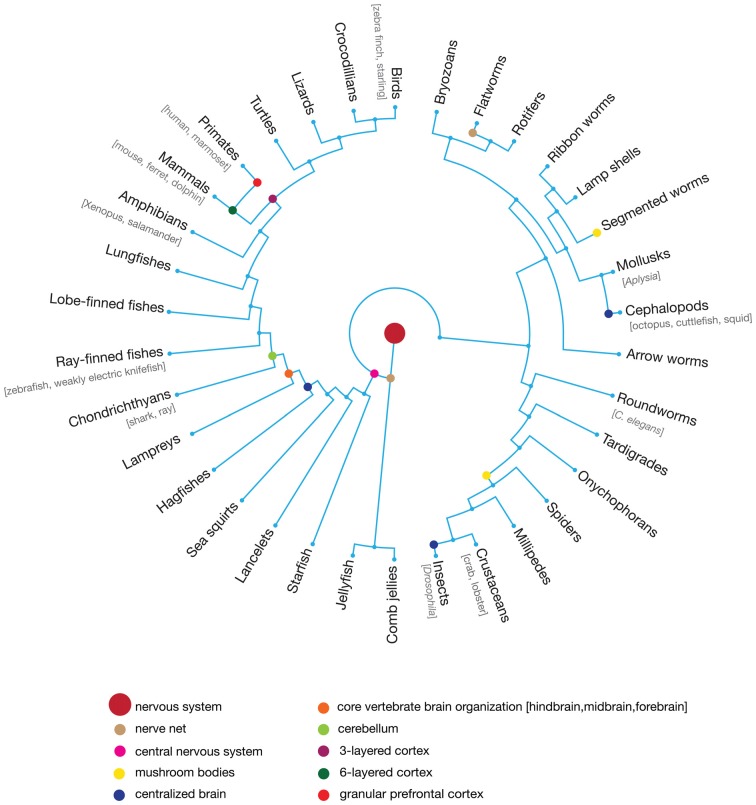
Figure 1
Figure 1
Circular evolutionary tree of representative animal taxa that emerged following the evolution of the nervous and vestibular systems. While junctions of branches represent the degree of phylogenetic relatedness over evolution, distance along the tree does no scale with actual time in natural history. Colored circles indicate last common ancestor for phylogenetic groups that exhibited a particular characteristic of the nervous system which can be used to reconstruct shared, unique and convergent features of nervous systems. The central nervous system emerged early in animal evolution and is homologous across multiple taxa, while granular prefrontal cortex is a unique property of primate brains. Likewise, the independent evolution of centralized brains in vertebrates and multiple invertebrate taxa—insects and cephalopods—represents an example of convergent evolution. The more commonly used “model” organisms in neuroscience are listed in brackets below their taxonomic groups, though this list is not exhaustive.

References

    1. Abe K., Matsui S., Watanabe D. (2015). Transgenic songbirds with suppressed or enhanced activity of CREB transcription factor. Proc. Natl. Acad. Sci. U S A 112, 7599–7604. 10.1073/pnas.1413484112 - DOI - PMC - PubMed
    1. Agrawal A. A. (2001). Phenotypic plasticity in the interactions and evolution of species. Science 294, 321–326. 10.1126/science.1060701 - DOI - PubMed
    1. Ahrens M. B., Li J. M., Orger M. B., Robson D. N., Schier A. F., Engert F., et al. . (2012). Brain-wide neuronal dynamics during motor adaptation in zebrafish. Nature 485, 471–477. 10.1038/nature11057 - DOI - PMC - PubMed
    1. Ahrens M. B., Orger M. B., Robson D. N., Li J. M., Keller P. J. (2013). Whole-brain functional imaging at cellular resolution using light-sheet microscopy. Nat. Methods 10, 413–420. 10.1038/nmeth.2434 - DOI - PubMed
    1. Aiello B. R., Westneat M. W., Hale M. E. (2017). Mechanossensation is evolutionarily tuned to locomotor mechanics. Proc. Natl. Acad. Sci. U S A 114, 4459–4464. 10.1073/pnas.1616839114 - DOI - PMC - PubMed
