. 2019 Feb 6:10:94.
doi: 10.3389/fmicb.2019.00094. eCollection 2019.

Combined Transcriptome and Proteome Analysis of RpoS Regulon Reveals Its Role in Spoilage Potential of Pseudomonas fluorescens

Affiliations

Combined Transcriptome and Proteome Analysis of RpoS Regulon Reveals Its Role in Spoilage Potential of Pseudomonas fluorescens

Xiaoxiang Liu et al. Front Microbiol. .

Abstract

Microbial contamination is considered the main cause of food spoilage. Pseudomonas fluorescens is a typical spoilage bacterium contributing to a large extent to the spoilage process of proteinaceous foods. RpoS is known as an alternative sigma factor controlling stress resistance and virulence in many pathogens. Our previous work revealed that RpoS contributes to the spoilage activities of P. fluorescens by regulating resistance to different stress conditions, extracellular acylated homoserine lactone (AHL) levels, extracellular protease and total volatile basic nitrogen (TVB-N) production. However, RpoS-dependent genes in P. fluorescens remained undefined. RNA-seq transcriptomics analysis combined with quantitative proteomics analysis based on multiplexed isobaric tandem mass tag (TMT) labeling was performed in the P. fluorescens wild-type strain UK4 and its derivative carrying an rpoS mutation. A total of 375 differentially expressed coding sequences (DECs) and 212 differentially expressed proteins (DEPs) were identified. The DECs were further verified by qRT-PCR. The combined transcriptome and proteome analyses revealed the involvement of this regulator in several cellular processes, mainly including polysaccharide metabolism, intracellular secretion, extracellular structures, cell wall biogenesis, stress responses, and amino acid and biogenic amine metabolism, which may contribute to the biofilm formation, stress resistance, and spoilage activities of P. fluorescens. Moreover, we indeed observed that RpoS contributed to the production of the macrocolony biofilm's matrix. Our results provide insights into the regulatory network of RpoS and expand the knowledge about the role of RpoS in the functioning of P. fluorescens in food spoilage.

Keywords: Pseudomonas fluorescens; RpoS; food spoilage; proteome; regulon; transcriptome.


Figures
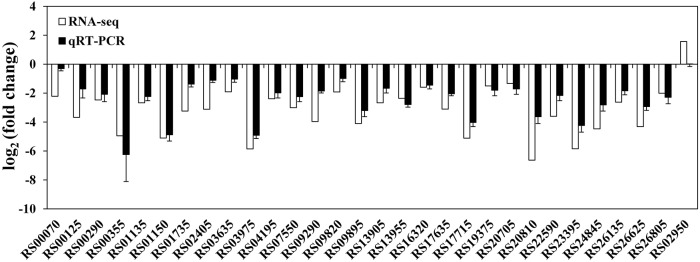
Figure 1
Figure 1
Validation of RNA-seq data using qRT-PCR. White bars represent RNA-seq data, while the black bars represent mean values of log2 (fold change) observed for the rpoS mutant samples vs. the wild-type samples. The qRT-PCR results are the mean of three biological replicates with three technical replicates for each gene. Error bars represent standard deviation.
Figure 2
Figure 2
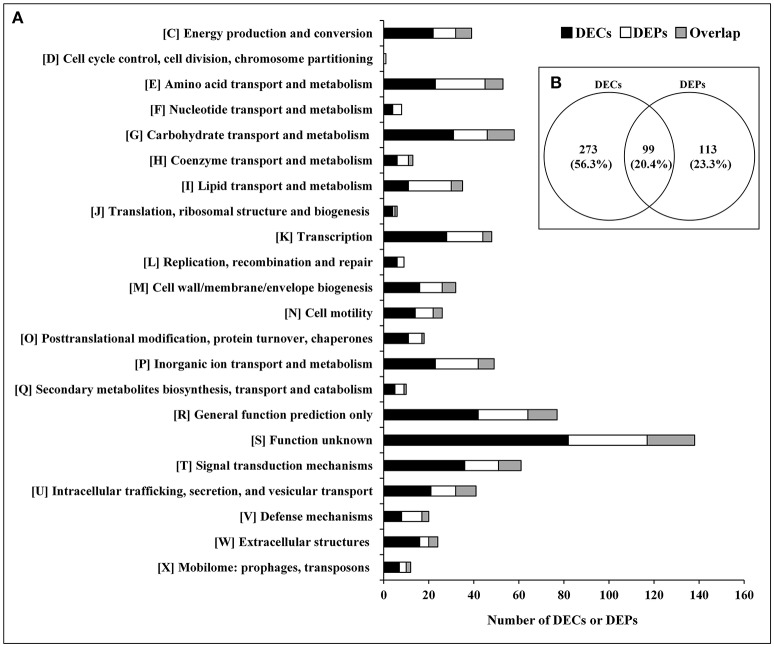
DECs and DEPs in the rpoS mutant in relation to the wild-type strain UK4. (A) Classification of the DECs, DEPs, and their overlap into individual functional groups (COGs C-X). (B) Venn diagram of DECs and DEPs. This figure was drawn using Venny 2.0 (http://bioinfogp.cnb.csic.es/tools/venny/index.html).
Figure 3
Figure 3
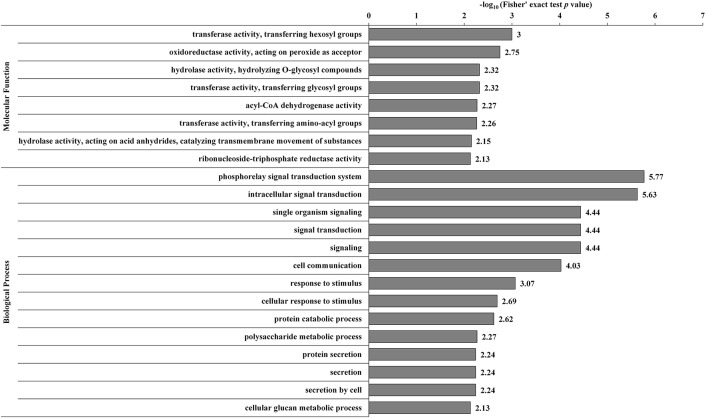
GO-based enrichment analysis of the combined DECs and DEPs. GO categories significantly enriched (p < 0.05) are shown in the figure.
Figure 4
Figure 4
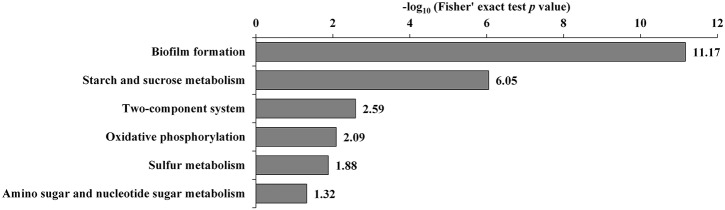
KEGG pathway enrichment analysis of the combined DECs and DEPs. KEGG pathways significantly enriched (p < 0.05) are shown in the figure.
Figure 5
Figure 5
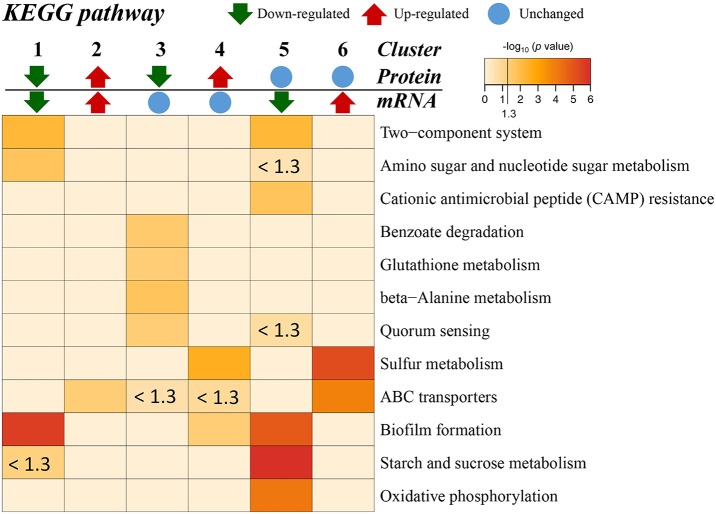
KEGG pathway enrichment for different categories based on protein-mRNA regulation types. 1, the cluster with protein and mRNA both downregulated in the mutant; 2, the cluster with protein and mRNA both upregulated in the mutant; 3, the cluster with only protein downregulated in the mutant; 4, the cluster with only protein upregulated in the mutant; 5, the cluster with only mRNA downregulated in the mutant; 6, the cluster with only mRNA upregulated in the mutant. The pathways with p < 0.05 [–log10 (p) > 1.3] are considered significant. The color intensity presents the enrichment level as shown in the bar of –log10 (p). The deep red color codes represent the remarkable enriched pathways. The pale yellow in background represents there is no enrichment in the corresponding pathway.
Figure 6
Figure 6
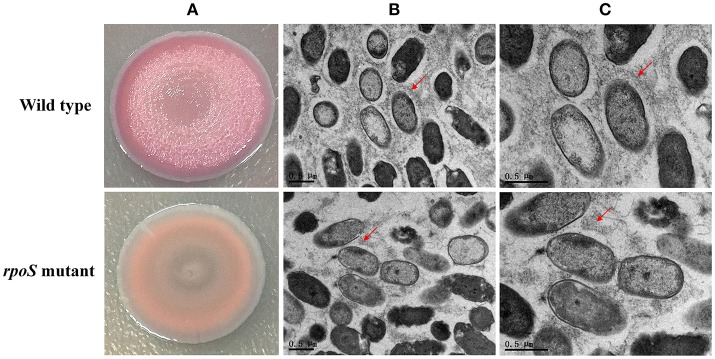
Macrocolony biofilm properties of the rpoS mutant in comparison to the wild-type. (A) Macrocolony morphology of the wild-type and the rpoS mutant grown on Congo red and Coomassie brilliant blue plates for 7 days. (B,C) Transmission electron micrographs of the macrocolony biofilms at ×11,500 and ×20,500 magnification. Matrix materials surrounding the cells are marked with red arrows.

References

    1. Ahrné E., Glatter T., Viganò C., Schubert C.v., Nigg E. A., Schmidt A. (2016). Evaluation and improvement of quantification accuracy in isobaric mass tag-based protein quantification experiments. J. Proteome Res. 15, 2537–2547. 10.1021/acs.jproteome.6b00066 - DOI - PubMed
    1. Andreani N. A., Carraro L., Martino M. E., Fondi M., Fasolato L., Miotto G., et al. (2015). A genomic and transcriptomic approach to investigate the blue pigment phenotype in Pseudomonas fluorescens. Int. J. Food Microbiol. 213, 88–98. 10.1016/j.ijfoodmicro.2015.05.024 - DOI - PubMed
    1. Andreani N. A., Martino M. E., Fasolato L., Carraro L., Montemurro F., Mioni R., et al. (2014). Tracking the blue: a MLST approach to characterise the Pseudomonas fluorescens group. Food Microbiol. 39, 116–126. 10.1016/j.fm.2013.11.012 - DOI - PubMed
    1. Aswathanarayan J. B., Vittal R. R. (2014). Attachment and biofilm formation of Pseudomonas fluorescens, PSD4 isolated from a dairy processing line. Food Sci. Biotechnol. 23, 1903–1910. 10.1007/s10068-014-0260-8 - DOI
    1. Borodina T., Adjaye J., Sultan M. (2011). A strand-specific library preparation protocol for RNA sequencing. Meth. Enzymol. 500, 79–98. 10.1016/B978-0-12-385118-5.00005-0 - DOI - PubMed