


Can meditation improve attention in older adults? Study protocol for a 4-week proof-of-concept intervention
- PMID: 30788136
- PMCID: PMC6369542
- DOI: 10.1186/s40814-019-0413-x
Can meditation improve attention in older adults? Study protocol for a 4-week proof-of-concept intervention
Abstract
Background: Falls are a major health care concern for our aging population. Previous research has identified impaired sustained attention as a risk factor for falls. Recently, meditation has been shown to improve different types of attention in various populations. However, there are no studies to date examining whether meditation training can improve sustained attention and mobility in older adults.
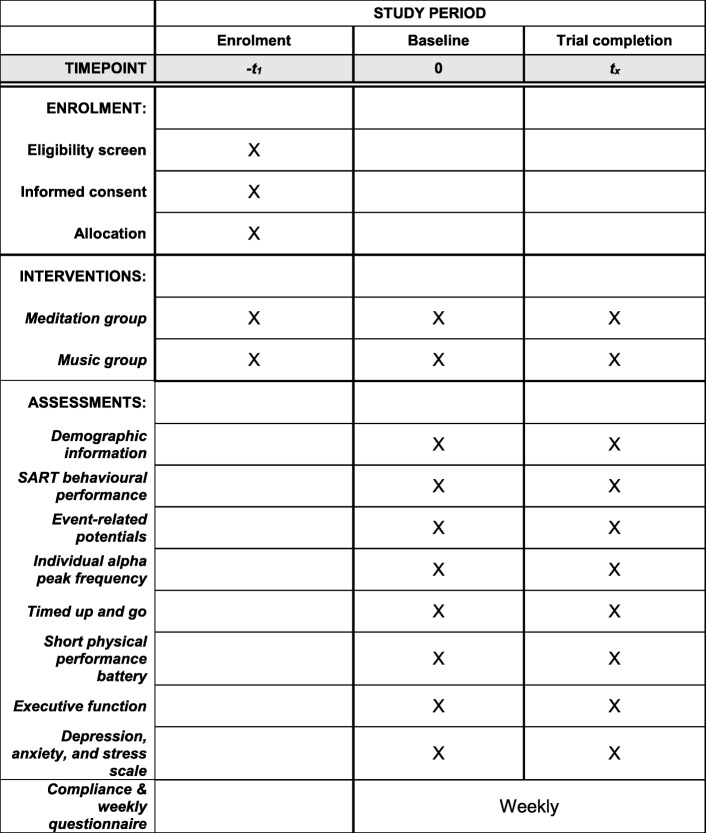
Methods: We are conducting a 4-week proof-of-concept meditation intervention. We will recruit community-dwelling older adults. Participants will be randomized into one of two groups: (1) meditation training or (2) music listening (control). All participants will complete three 20-min group sessions per week and will be encouraged to continue their practice independently on the remaining days each week. Our primary outcome measure is behavioral performance on the Sustained Attention to Response Task (SART). Our secondary and tertiary outcomes include electroencephalograms (EEG) to assess attention and cognitive processing, mobility, and executive function.
Discussion: Our proof-of-concept intervention aims to examine whether meditation training can improve sustained attention in older adults, who are known to be susceptible to falls. Importantly, our research has the potential to inform future clinical trials aimed at improving mobility and reducing falls risk in our aging population.
Trial registration: Clinicaltrials.gov ID NCT03417635.
Keywords: Attention; EEG; Falls risk; Intervention; Meditation; Mobility.
Conflict of interest statement
Ethics approval for this study was obtained from the Health Sciences Research Ethics Board at Western University, Project ID 110598 (approval attached).Not applicable.The authors declare that they have no competing interests.Springer Nature remains neutral with regard to jurisdictional claims in published maps and institutional affiliations.
Figures
References
Associated data
LinkOut - more resources
Full Text Sources
Other Literature Sources
Medical
