


Pretreatment with glucose-insulin-potassium improves ventricular performances after coronary artery bypass surgery: a randomized controlled trial
- PMID: 30788810
- PMCID: PMC7223403
- DOI: 10.1007/s10877-019-00280-5
Pretreatment with glucose-insulin-potassium improves ventricular performances after coronary artery bypass surgery: a randomized controlled trial
Abstract
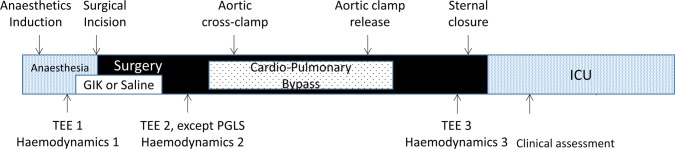
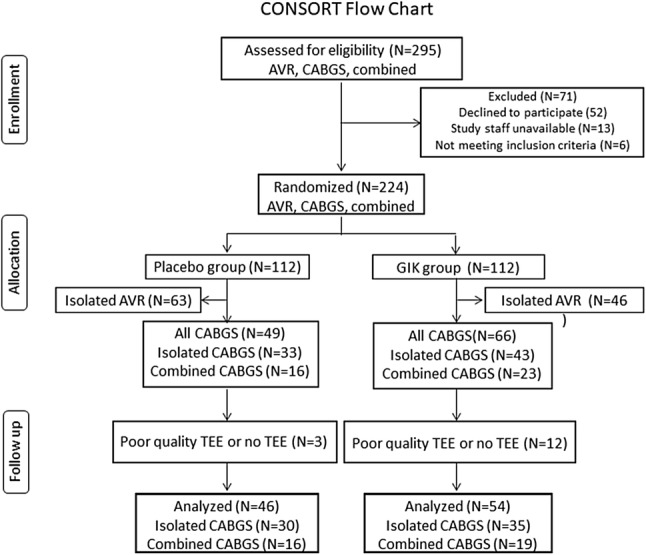
Heart failure is the main cause of poor outcome following open heart surgery and experimental studies have demonstrated that glucose-insulin-potassium (GIK) infusion exerts cardioprotective effects by reducing myocardial ischemia-reperfusion injuries. This randomized controlled trial was designed to assess the effects of GIK on left ventricular function in moderate-to-high risk patients undergoing on-pump isolated coronary artery bypass surgery (CABGS), or combined with aortic valve replacement. The primary outcomes were the effects of GIK on two- and three-dimensional left ventricular ejection fraction (2D and 3D-LVEF), and on transmitral flow propagation velocity (Vp), that occurred between the pre- and post-CPB periods. GIK administration was associated with favorable interaction effects (p < 0.001) on 2D-LVEF, 3D-LVEF and Vp changes over the study periods. In GIK pretreated patients (N = 54), 2-D and 3D-LVEF and Vp increased slightly during surgery (mean difference [MD] + 3.5%, 95% confidence interval [95% CI] - 0.2 to 7.1%, MD + 4.0%, 95% CI 0.6-7.4%, and MD + 22.2%, 95% CI 16.0-28.4%, respectively). In contrast, in the Placebo group (N = 46), 2D-and 3D-LVEF, as well as Vp all decreased after CPB (MD - 7.5% [- 11.6 to - 3.4%], MD - 12.0% [- 15.2 to - 8.8%] and MD - 21.3% [- 25.7 to - 16.9%], respectively). In conclusion, the administration of GIK resulted in better preservation of systolic and diastolic ventricular function in the early period following weaning from CPB.
Keywords: Cardiopulmonary bypass management; Diagnosis; Diagnosis and treatment post-CPB; Effects; Hypotension; LV failure; Peri-operative insulin; TEE.
Conflict of interest statement
The authors have no conflict of interest to disclose.
Figures


Comment in
-
Pre-specified outcomes must be followed.J Clin Monit Comput. 2020 Feb;34(1):187-188. doi: 10.1007/s10877-019-00312-0. Epub 2019 Apr 11. J Clin Monit Comput. 2020. PMID: 30976953 No abstract available.
-
Answer to the letter: Research transparency, preplanned study endpoints and availability of results.J Clin Monit Comput. 2020 Feb;34(1):189-190. doi: 10.1007/s10877-019-00316-w. Epub 2019 Apr 27. J Clin Monit Comput. 2020. PMID: 31030331 No abstract available.
References
-
- Writing Group M, Mozaffarian D, Benjamin EJ, et al. Heart disease and stroke statistics-2016 update: a report from the American Heart Association. Circulation. 2016;133:e38–e60. - PubMed
-
- McNeely C, Markwell S, Vassileva C. Trends in patient characteristics and outcomes of coronary artery bypass grafting in the 2000 to 2012 medicare population. Ann Thorac Surg. 2016;102:132–138. - PubMed
-
- ElBardissi AW, Aranki SF, Sheng S, O’Brien SM, Greenberg CC, Gammie JS. Trends in isolated coronary artery bypass grafting: an analysis of the Society of Thoracic Surgeons adult cardiac surgery database. J Thorac Cardiovasc Surg. 2012;143:273–281. - PubMed
-
- Likosky DS, Goldberg JB, DiScipio AW, et al. Variability in surgeons’ perioperative practices may influence the incidence of low-output failure after coronary artery bypass grafting surgery. Circ Cardiovasc Qual Outcomes. 2012;5:638–644. - PubMed
Publication types
MeSH terms
Substances
LinkOut - more resources
Full Text Sources
Medical
