


Believing Is Seeing: A Proof-of-Concept Semiexperimental Study on Using Mobile Virtual Reality to Boost the Effects of Interpretation Bias Modification for Anxiety
- PMID: 30789353
- PMCID: PMC6403526
- DOI: 10.2196/11517
Believing Is Seeing: A Proof-of-Concept Semiexperimental Study on Using Mobile Virtual Reality to Boost the Effects of Interpretation Bias Modification for Anxiety
Abstract
Background: Cognitive Bias Modification of Interpretations (CBM-I) is a computerized intervention designed to change negatively biased interpretations of ambiguous information, which underlie and reinforce anxiety. The repetitive and monotonous features of CBM-I can negatively impact training adherence and learning processes.
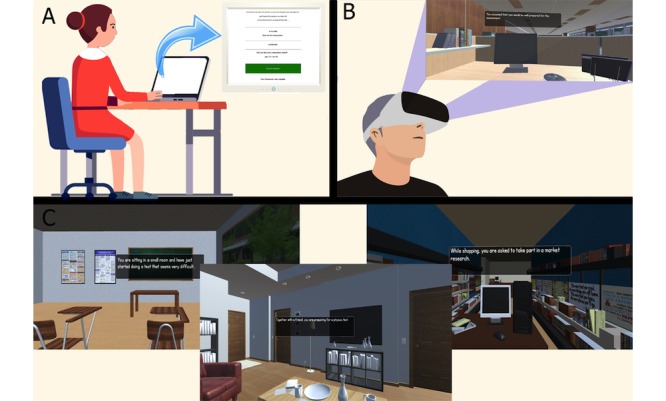
Objective: This proof-of-concept study aimed to examine whether performing a CBM-I training using mobile virtual reality technology (virtual reality Cognitive Bias Modification of Interpretations [VR-CBM-I]) improves training experience and effectiveness.
Methods: A total of 42 students high in trait anxiety completed 1 session of either VR-CBM-I or standard CBM-I training for performance anxiety. Participants' feelings of immersion and presence, emotional reactivity to a stressor, and changes in interpretation bias and state anxiety, were assessed.
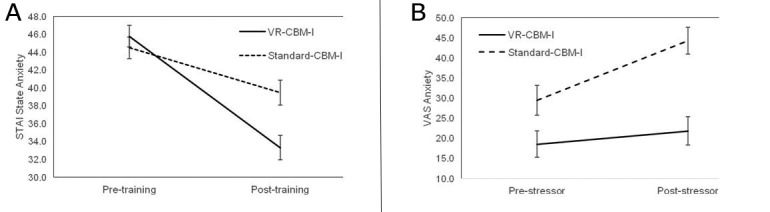
Results: The VR-CBM-I resulted in greater feelings of presence (P<.001, d=1.47) and immersion (P<.001, ηp2=0.74) in the training scenarios and outperformed the standard training in effects on state anxiety (P<.001, ηp2=0.3) and emotional reactivity to a stressor (P=.03, ηp2=0.12). Both training varieties successfully increased the endorsement of positive interpretations (P<.001, drepeated measures [drm]=0.79) and decreased negative ones. (P<.001, drm=0.72). In addition, changes in the emotional outcomes were correlated with greater feelings of immersion and presence.
Conclusions: This study provided first evidence that (1) the putative working principles underlying CBM-I trainings can be translated into a virtual environment and (2) virtual reality holds promise as a tool to boost the effects of CMB-I training for highly anxious individuals while increasing users' experience with the training application.
Keywords: anxiety; cognitive bias modification; emotional reactivity; head mounted display; immersion; interpretation bias; presence; virtual reality.
©Boris Otkhmezuri, Marilisa Boffo, Panote Siriaraya, Maria Matsangidou, Reinout W Wiers, Bundy Mackintosh, Chee Siang Ang, Elske Salemink. Originally published in JMIR Mental Health (http://mental.jmir.org), 21.02.2019.
Conflict of interest statement
Conflicts of Interest: None declared.
Figures
References
-
- Hirsch C R, Mathews A. Impaired positive inferential bias in social phobia. J Abnorm Psychol. 2000 Nov;109(4):705–12. - PubMed
LinkOut - more resources
Full Text Sources
