Review
. 2019 Feb 19;20(4):903.
doi: 10.3390/ijms20040903.

Activated Protein C in Cutaneous Wound Healing: From Bench to Bedside

Affiliations
Review

Activated Protein C in Cutaneous Wound Healing: From Bench to Bedside

Ruilong Zhao et al. Int J Mol Sci. .

Abstract

Independent of its well-known anticoagulation effects, activated protein C (APC) exhibits pleiotropic cytoprotective properties. These include anti-inflammatory actions, anti-apoptosis, and endothelial and epithelial barrier stabilisation. Such beneficial effects have made APC an attractive target of research in a plethora of physiological and pathophysiological processes. Of note, the past decade or so has seen the emergence of its roles in cutaneous wound healing-a complex process involving inflammation, proliferation and remodelling. This review will highlight APC's functions and mechanisms, and detail its pre-clinical and clinical studies on cutaneous wound healing.

Keywords: activated protein C; animal models; cell culture; clinical trials; cytoprotection; wound healing.


Conflict of interest statement

Chris Jackson and Meilang Xue are the inventors of patents and have commercial interests in APC-related drugs.

Figures
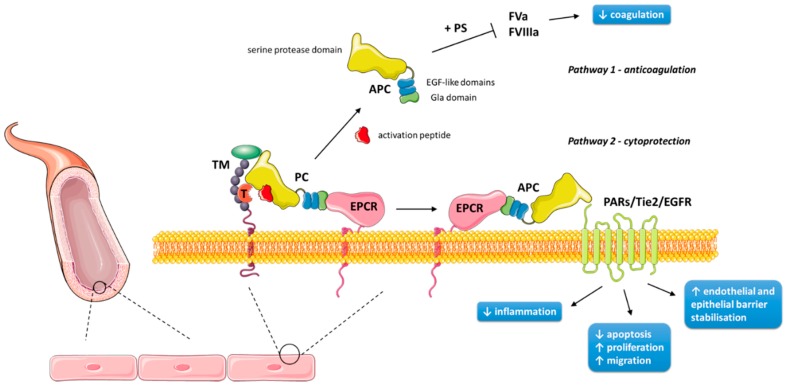
Figure 1
Figure 1
Mechanism of protein C activation and actions on the surface of human endothelial cells. Protein C (PC) is bound to an endothelial protein C receptor (EPCR) on the surface of endothelial cells, where it is activated by thrombin (complexed with thrombomodulin) cleavage of its activation peptide. Activated protein C (APC) is then either released, where it participates in negative feedback of the coagulation cascade (pathway 1), or presented to cleave PARs/Tie2/EGFR in order to exert its cytoprotective effects (pathway 2). Pathway 2 also occurs on the surface of keratinocytes. EGFR: endothelial growth factor receptor; FVa: activated factor V; FVIIIa: activated factor VIII; PAR: protease-activated receptor; PS: protein S; T: thrombin; TM: thrombomodulin. Figure was produced using Servier Medical Art (https://smart.servier.com).
Figure 2
Figure 2
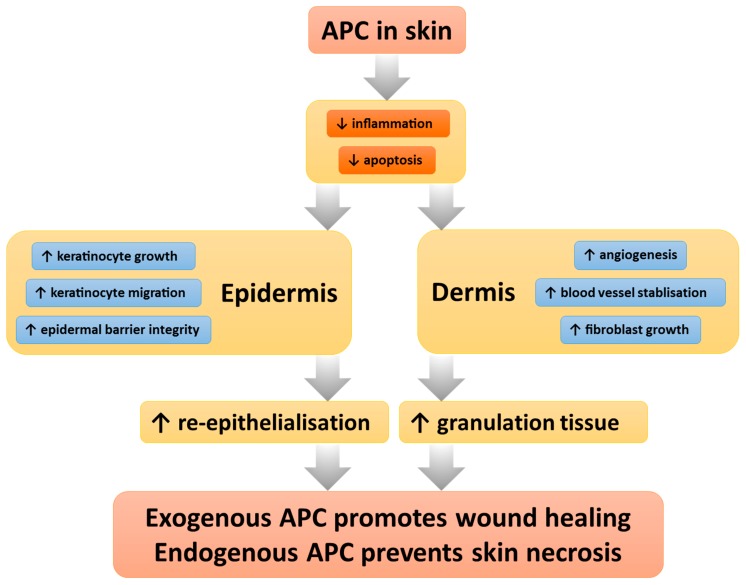
APC exerts its protective actions on major cellular components of the skin to ensure normal homeostasis.
Figure 3
Figure 3
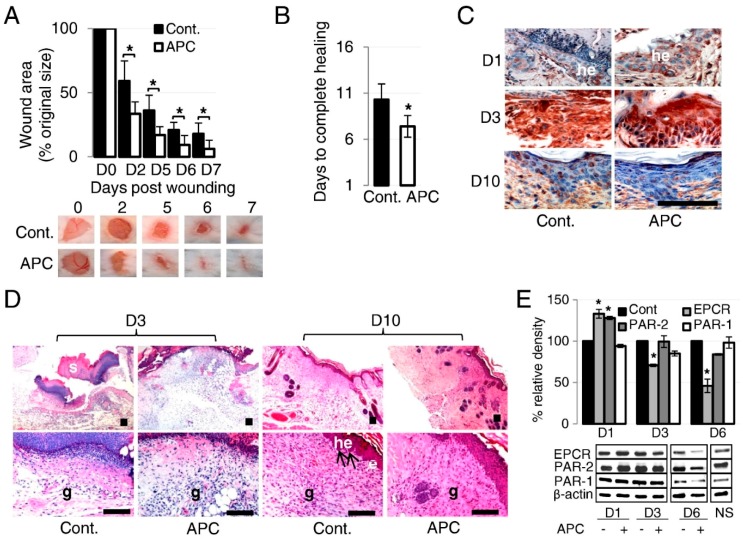
APC accelerates wound healing in wild-type (WT) mice. (A) and (B) Full-thickness 6-mm diameter wounds were made and treated topically with 20 μL of phosphate-buffered saline or APC (10 μg) once a day for three consecutive days. (A) Representative photographs of skin wounds on days after APC treatment. The percentage of wound area/initial area was calculated from tracing the wounds, measured with Visitrak. Values are mean ± SD; n = 10 wounds. * p < 0.05 by paired t-test. (B) Time to complete wound closure. Values are mean ± SD; n = 10 wounds. * p < 0.05 by t-test. (C) Expression of PAR-2 by immunohistochemistry on wounded skin in WT mice (he: hyperproliferative epithelium). Scale bar = 100 μm. (D) Hematoxylin and eosin -stained paraffin sections from day 3 and day 10 wounds from WT mice. Arrows indicate the leading edge of the migrating epithelial tongue (e: epithelium; g: granulation tissue; he: hyperproliferative epithelium; s: scab). Scale bar = 100 μm. (E) Expression of EPCR, PAR-1, and PAR-2 detected by immunoblotting from homogenate supernatants of wounded skin (NS: normal skin). The band intensity of the protein was normalized with β-actin, and each control was defined as 100%. Values are mean ± SD; n = 3. * p < 0.05 versus each control on each day by paired t-test. Copyright © 2011 American Society for Investigative Pathology. Published by Elsevier Inc. All rights reserved. Reproduced with permission. License number 4526191003342.
Figure 4
Figure 4
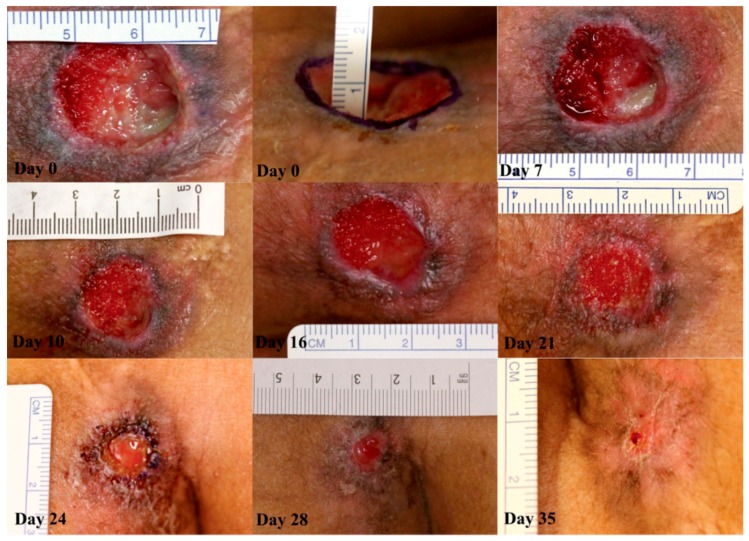
Case 1: sacral pressure ulcer progression through healing after activated protein C (APC) administration. On day 0, the wound had a central depth of 10 mm. At day 7, the wound was 20 mm in diameter. Rapid growth of granulation tissue is apparent from day 7 to day 16. At day 16, the diameter was 18 mm. On day 21, the diameter was 14 mm, and by day 24 the wound was 6 mm in diameter. Therapy was stopped at this point. At day 28, the diameter was 5 mm. Final follow-up at day 35 showed that the wound had healed completely. No images of the follow-up. © 2014 The Authors. International Wound Journal © 2014 Medicalhelplines.com Inc and John Wiley & Sons Ltd. Reproduced with permission. License number 4525880595450.
Figure 5
Figure 5
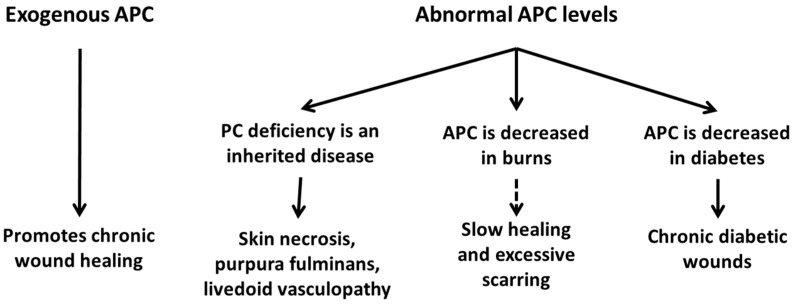
In humans, low APC levels are associated with chronic diabetic wounds, severe burn injuries, and skin necrosis secondary to purpura fulminans. Exogenous APC has been shown to promote the healing of chronic wounds of varying aetiologies.

References

    1. Mammen E.F., Thomas W.R., Seegers W.H. Activation of purified prothrombin to autoprothrombin I or autoprothrombin II (platelet cofactor II or autoprothrombin II-A) Thromb. Diath Haemorrh. 1960;5:218–249. doi: 10.1055/s-0038-1654921. - DOI - PubMed
    1. Stenflo J. A new vitamin K-dependent protein. Purification from bovine plasma and preliminary characterization. J. Biol. Chem. 1976;251:355–363. - PubMed
    1. Griffin J.H., Fernandez J.A., Gale A.J., Mosnier L.O. Activated protein C. J. Thromb. Haemost. 2007;5:73–80. doi: 10.1111/j.1538-7836.2007.02491.x. - DOI - PubMed
    1. D’Ursi P., Marino F., Caprera A., Milanesi L., Faioni E.M., Rovida E. ProCMD: A database and 3D web resource for protein C mutants. BMC Bioinform. 2007;8:S11. doi: 10.1186/1471-2105-8-S1-S11. - DOI - PMC - PubMed
    1. Mosnier L.O., Griffin J.H. Protein C anticoagulant activity in relation to anti-inflammatory and anti-apoptotic activities. Front. Biosci. 2006;11:2381–2399. doi: 10.2741/1977. - DOI - PubMed

MeSH terms

LinkOut - more resources