


Involvement of CXCR4 in Normal and Abnormal Development
- PMID: 30791675
- PMCID: PMC6406665
- DOI: 10.3390/cells8020185
Involvement of CXCR4 in Normal and Abnormal Development
Abstract
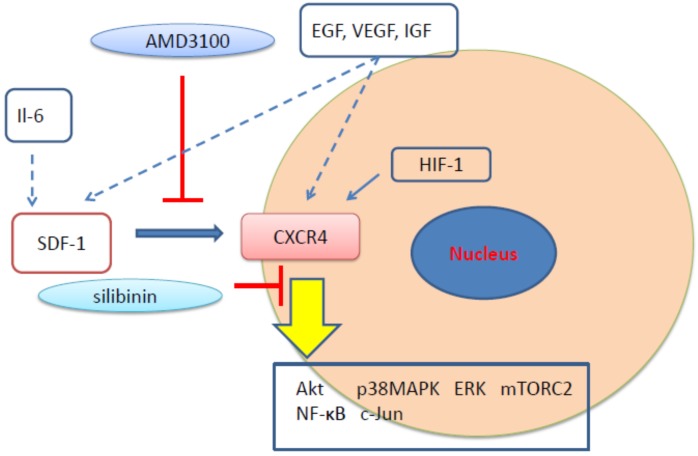
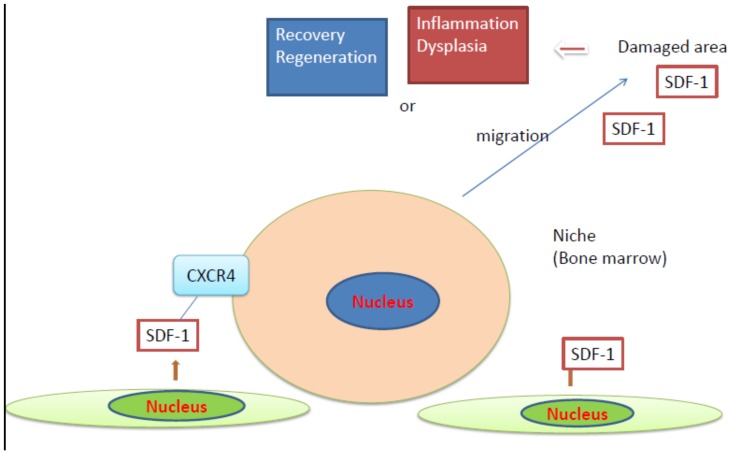
CXC motif chemokine receptor type 4 (CXCR4) is associated with normal and abnormal development, including oncogenesis. The ligand of CXCR4 is stromal cell-derived factor (SDF), also known as CXC motif ligand (CXCL) 12. Through the SDF-1/CXCR4 axis, both homing and migration of hematopoietic (stem) cells are regulated through niches in the bone marrow. Outside of the bone marrow, however, SDF-1 can recruit CXCR4-positive cells from the bone marrow. SDF/CXCR4 has been implicated in the maintenance and/or differentiation of stemness, and tissue-derived stem cells can be associated with SDF-1 and CXCR4 activity. CXCR4 plays a role in multiple pathways involved in carcinogenesis and other pathologies. Here, we summarize reports detailing the functions of CXCR4. We address the molecular signature of CXCR4 and how this molecule and cells expressing it are involved in either normal (maintaining stemness or inducing differentiation) or abnormal (developing cancer and other pathologies) events. As a constituent of stem cells, the SDF-1/CXCR4 axis influences downstream signal transduction and the cell microenvironment.
Keywords: CXCL12; CXCR4; SDF-1; cancer; pulmonary hypertension; stem cell.
Conflict of interest statement
The authors confirm that there are no conflicts of interest. We confirm that this manuscript has not been published elsewhere and is not under consideration by another journal. All authors have approved the manuscript and agree with its submission to Cells.
Figures
References
-
- Imitola J., Raddassi K., Park K.I., Mueller F.J., Nieto M., Teng Y.D., Frenkel D., Li J., Sidman R.L., Walsh C.A., et al. Directed migration of neural stem cells to sites of cns injury by the stromal cell-derived factor 1alpha/cxc chemokine receptor 4 pathway. Proc. Natl. Acad. Sci. USA. 2004;101:18117–18122. doi: 10.1073/pnas.0408258102. - DOI - PMC - PubMed
-
- Askari A.T., Unzek S., Popovic Z.B., Goldman C.K., Forudi F., Kiedrowski M., Rovner A., Ellis S.G., Thomas J.D., DiCorleto P.E., et al. Effect of stromal-cell-derived factor 1 on stem-cell homing and tissue regeneration in ischaemic cardiomyopathy. Lancet. 2003;362:697–703. doi: 10.1016/S0140-6736(03)14232-8. - DOI - PubMed
Publication types
MeSH terms
Substances
LinkOut - more resources
Full Text Sources
Research Materials
