


Review
doi: 10.1016/j.tibs.2019.01.004.
Epub 2019 Feb 18.
Trefoil Factor Family: Unresolved Questions and Clinical Perspectives
Affiliations
- PMID: 30792027
- PMCID: PMC6557713
- DOI: 10.1016/j.tibs.2019.01.004
Item in Clipboard
Review
Trefoil Factor Family: Unresolved Questions and Clinical Perspectives
Trends Biochem Sci.
2019 May.
Abstract
The trefoil factor family of peptides (TFF1, TFF2, TFF3) with their lectin activities play important roles in mucosal protection and repair. However, major gaps in understanding their molecular function have hampered therapeutic development for gastrointestinal disorders. We provide here a critical overview of the status quo.
Keywords: cell migration; gastrointestinal wound healing; lectin; mucins; mucosal protection; mucositis.
Copyright © 2019 Elsevier Ltd. All rights reserved.
Figures
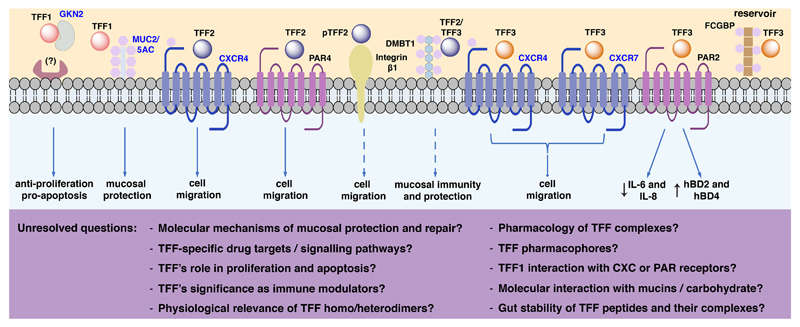
The figure includes validated and hypothetical interactions, potential associated physiological functions, and unresolved questions. Targets highlighted in blue are supported by independent research groups. Dashed arrows and ? denotes functions that have not been experimentally validated. The TFF1-GKN2 heterodimer displays synergistic anti-proliferative and pro-apoptotic effects, yet its mechanism of action remains unknown. TFF1-MUC2/5AC interaction might enhance mucosal protection. TFF2 interaction with CXCR4 or PAR4 accelerates cell migration. TFF2 binds specifically to the GlcNAcα1→4Galβ1→R moiety of MUC6. Interaction of TFF2 and β integrin is supposed to have motogenic effects. TFF2/3 interaction with DMBT1 might play a role in mucosal immunity and protection. TFF3 interaction with PAR2 downregulates the levels of IL-6 and IL-8 and upregulates hBD2 and hBD4. The TFF3-FCGBP complex is considered to act as a reservoir for continuous TFF3 release. CXCR: C-X-C chemokine receptor; DMBT1: deleted in malignant brain tumour 1; FCGBP: IgG Fc binding protein; GKN2, gastrokine 2; PAR: protease-activated receptor; MUC: mucin; hBD human beta defensin.
References
-
- Hoffmann W. TFF2, a MUC6-binding lectin stabilizing the gastric mucus barrier and more. Int J Oncol. 2015;47:806–816. - PubMed
-
- Roa B, Tortolero S. Trefoil factor 3 (TFF3) from human breast milk activates PAR-2 receptors, of the intestinal epithelial cells HT-29, regulating cytokines and defensins. Bratisl Med J. 2016;117:332–339. - PubMed
-
- Hoffmann W. Trefoil Factor Family (TFF) peptides and chemokine receptors: a promising relationship. J Med Chem. 2009;52:6505–6510. - PubMed
-
- Peterso DE, et al. Phase II, randomized, double-blind, placebo-controlled study of recombinant human intestinal trefoil factor oral spray for prevention of oral mucositis in patients with colorectal cancer who are receiving fluorouracil-based chemotherapy. J Clin Oncol. 2009;27:4333–4338. - PubMed
Publication types
MeSH terms
Substances
Grants and funding
LinkOut - more resources
Full Text Sources
