. 2019 Feb 26;3(4):588-595.
doi: 10.1182/bloodadvances.2018028340.

Frequent germline mutations of HAVCR2 in sporadic subcutaneous panniculitis-like T-cell lymphoma

Affiliations

Frequent germline mutations of HAVCR2 in sporadic subcutaneous panniculitis-like T-cell lymphoma

Chantana Polprasert et al. Blood Adv. .

Abstract

Subcutaneous panniculitis-like T-cell lymphoma (SPTCL) is a rare subtype of peripheral T-cell lymphoma affecting younger patients and associated with hemophagocytic lymphohistiocytosis. To clarify the molecular pathogenesis of SPTCL, we analyzed paired tumor and germline DNAs from 13 patients by whole-exome sequencing. All cases were Asians and were phenotypically sporadic with no family history of SPTCL. Consistent with a recent report, germline mutations in HAVCR2, encoding T-cell immunoglobulin mucin 3 (TIM3), were identified in 11 of 13 (85%) cases. All mutated cases were primary SPTCL, whereas the 2 cases without mutation were secondary SPTCL associated with underlying diseases, including viral infection and autoimmune disease. Ten patients harbored homozygous p.Y82C mutations, and 1 showed compound heterozygous mutations (p.Y82C and p.T101I). Both missense mutations altered highly conserved residues located in the extracellular immunoglobulin variable-like domain. According to the Genome Aggregation Database of >138 500 general individuals, both mutations were documented with minor allele frequencies < 0.007, indicating remarkable enrichment of these HAVCR2 alleles in SPTCL. SPTCL cells also harbored somatic mutations (6.2 per patient) that are frequently identified in genes associated with epigenetic regulation and signal transduction. In conclusion, individuals harboring biallelic HAVCR2 (TIM3) germline mutations were highly susceptible to sporadic SPTCL, which was also associated with clonal somatic mutations.


Conflict of interest statement

Conflict-of-interest disclosure: The authors declare no competing financial interests.

Figures
None
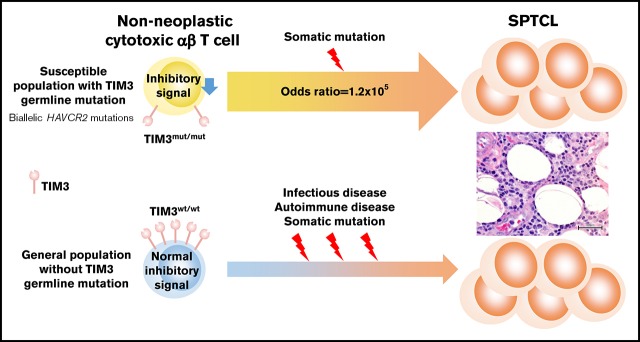
Graphical abstract
Figure 1.
Figure 1.
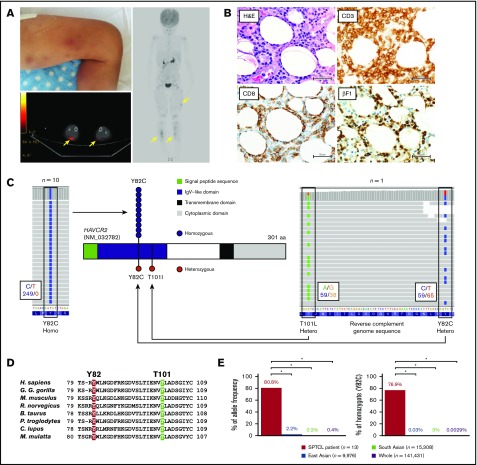
Individuals with biallelic HAVCR2 germline mutations are highly susceptible to SPTCL. (A) Representative images of a case with SPTCL. Multiple subcutaneous nodules with erythema diffusely involved lower legs (upper left panel). A positron emission tomography/computed tomography scan showed multiple regions with 18 fluorodeoxyglucose (FDG) uptake in subcutaneous soft tissue (yellow arrows). (B) Representative pathological images of SPTCL. On hematoxylin and eosin staining, infiltrating lymphocytes with cellular atypia-rimmed adipocytes (upper left panel). On immunohistochemical staining, these atypical cells were positive for CD3, CD8, and βF1 (TCRβF1) (lower left and right panels). Scale bars, 50 µm. (C) Germline mutations in HAVCR2 (NM_032782), encoding TIM3 protein, detected by WES. Representative images from IGV software showed homozygous p.Y82C mutation in UPN3 (left panel) and compound heterozygous p.Y82C and p.T101I mutations in UPN2 (right panel). In these images, mutated nucleotides (c.245A>G and c.302C>T as shown by reverse complementary DNA sequence) are highlighted in blue and green on sequence reads (horizontal gray bars), respectively. Larger black boxes outline the codons affected by mutations, and the smaller black boxes contain the number of bases with/without substitution, as indicated by the corresponding colors. Functional domains of TIM3, together with sites and zygosities of HAVCR2 mutations, are also shown (middle panel). Among 13 patients, 10 harbored homozygous p.Y82C (blue circles), and 1 patient harbored heterozygous p.Y82C and p.T101I (red circles). (D) Homology of the mutated residues in TIM3 protein. Alignment of amino acid sequences in immunoglobulin variable–like domain of TIM3 among different species is shown (Homo sapiens, Gorilla gorilla gorilla, Mus musculus, Rattus norvegicus, Bos taurus, Pan troglodytes, Canis lupus, and Macaca mulatta). Two residues of TIM3 mutated in SPTCL were highly conserved, as highlighted in red (Y82) and green (T101). (E) Enrichment of HAVCR2 germline mutations (p.Y82C) in SPTCL. Allele frequencies (left panel) and homozygote ratios (right panel) of p.Y82C (c.245A>G) are shown in SPTCL patients from our study, as well as from general populations from the gnomAD dataset. SPTCL patients, East Asians, South Asians, and the whole general population are indicated in red, blue, green, and purple, respectively. *P < .001, Fisher’s exact test.
Figure 2.
Figure 2.
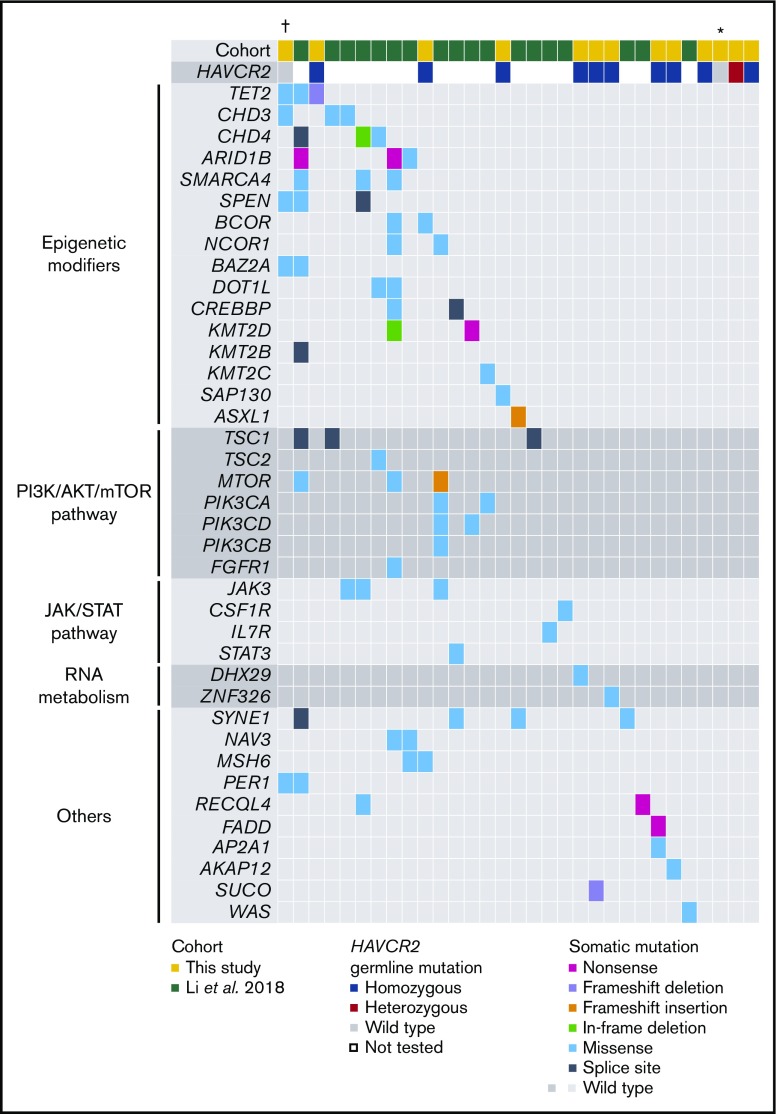
Landscape of somatic and germline mutations in SPTCL. On the basis of combined results from a previous study and this study (supplemental Table 1), the spectrum of somatic and germline mutations in SPTCL is shown. Each column represents an individual case, and each row represents the indicated mutated gene. Genes were assigned to the functional categories shown on the left. The types and status of the mutations are shown by the indicated colors. †Case with HIV infection. *Case with SLE.
Figure 3.
Figure 3.
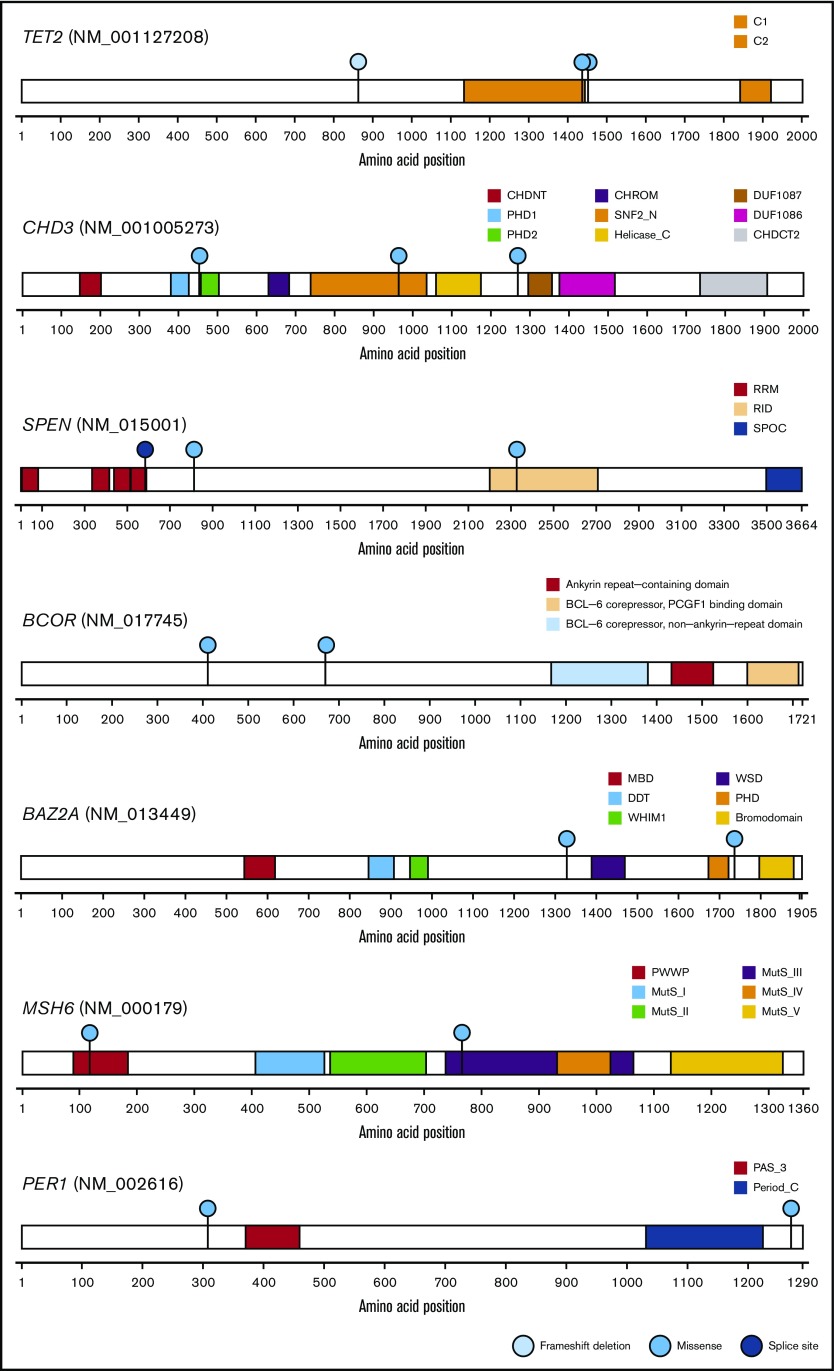
Genes mutated in common between the independent cohorts of SPTCL. Among the entire spectrum of mutations (Figure 2; supplemental Table 1), mutations in TET2, CHD3, BCOR, BAZ2A, SPEN, MSH6, and PER1 are shown, because mutations in these genes were identified in a previous study and in this study. Functional domains of the mutated genes and the types of mutations are indicated by the corresponding colors.

References

    1. Gonzalez CL, Medeiros LJ, Braziel RM, Jaffe ES. T-cell lymphoma involving subcutaneous tissue. A clinicopathologic entity commonly associated with hemophagocytic syndrome. Am J Surg Pathol. 1991;15(1):17-27. - PubMed
    1. Willemze R, Jansen PM, Cerroni L, et al. ; EORTC Cutaneous Lymphoma Group. Subcutaneous panniculitis-like T-cell lymphoma: definition, classification, and prognostic factors: an EORTC Cutaneous Lymphoma Group Study of 83 cases. Blood. 2008;111(2):838-845. - PubMed
    1. Swerdlow SH, Campo E, Pileri SA, et al. The 2016 revision of the World Health Organization classification of lymphoid neoplasms. Blood. 2016;127(20):2375-2390. - PMC - PubMed
    1. Li Z, Lu L, Zhou Z, et al. Recurrent mutations in epigenetic modifiers and the PI3K/AKT/mTOR pathway in subcutaneous panniculitis-like T-cell lymphoma. Br J Haematol. 2018;181(3):406-410. - PubMed
    1. van Dongen JJ, Langerak AW, Brüggemann M, et al. Design and standardization of PCR primers and protocols for detection of clonal immunoglobulin and T-cell receptor gene recombinations in suspect lymphoproliferations: report of the BIOMED-2 Concerted Action BMH4-CT98-3936. Leukemia. 2003;17(12):2257-2317. - PubMed

Publication types

Substances

Supplementary concepts