


Scalable and safe synthetic organic electroreduction inspired by Li-ion battery chemistry
- PMID: 30792297
- PMCID: PMC7001862
- DOI: 10.1126/science.aav5606
Scalable and safe synthetic organic electroreduction inspired by Li-ion battery chemistry
Abstract
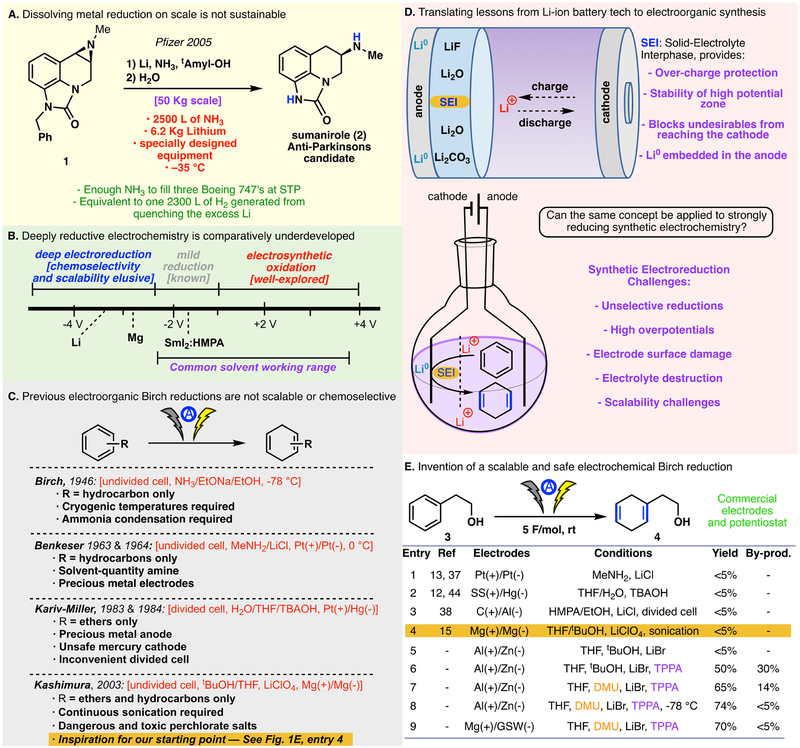
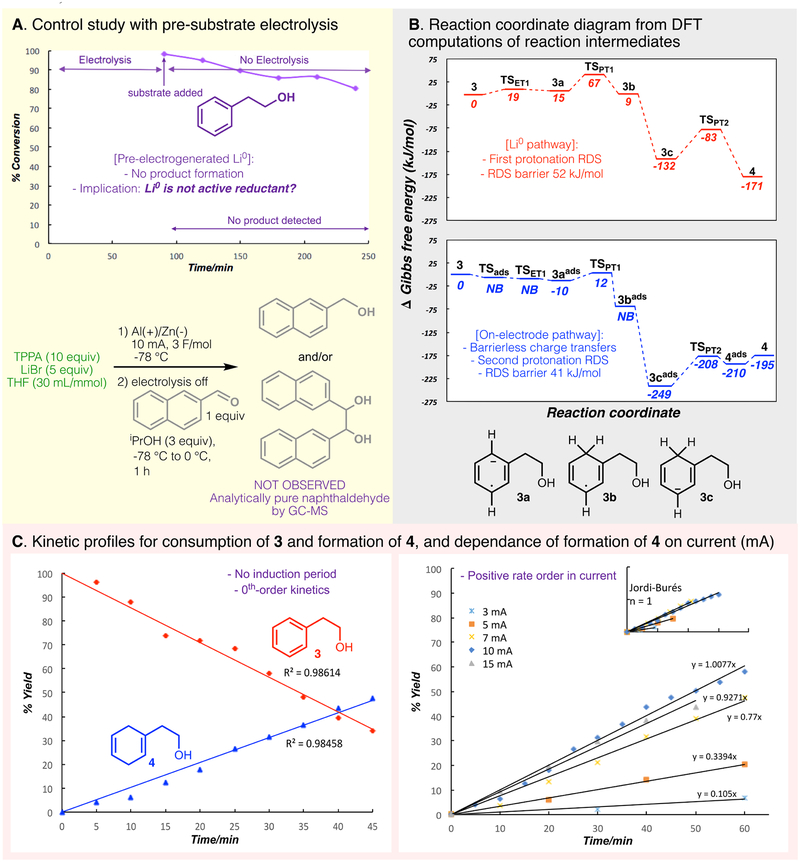
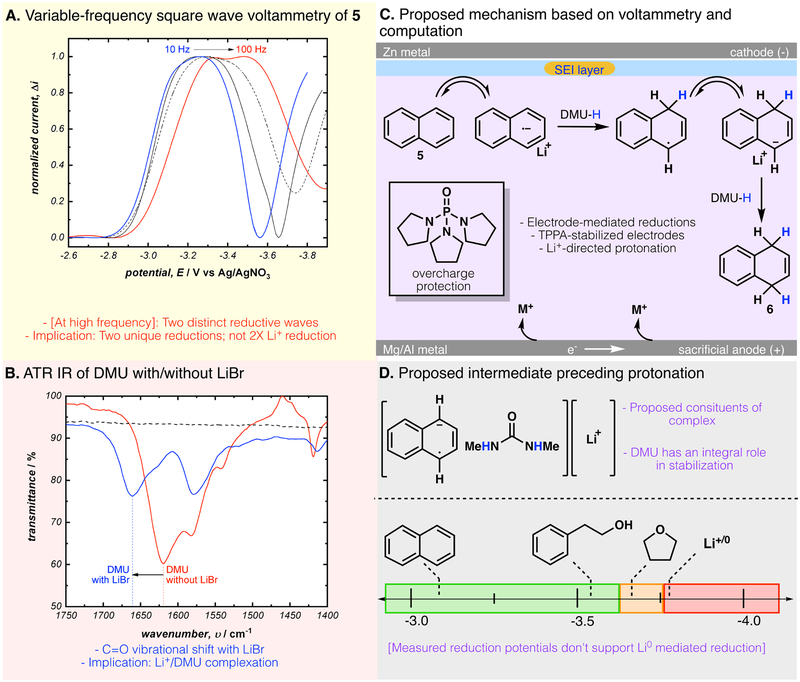
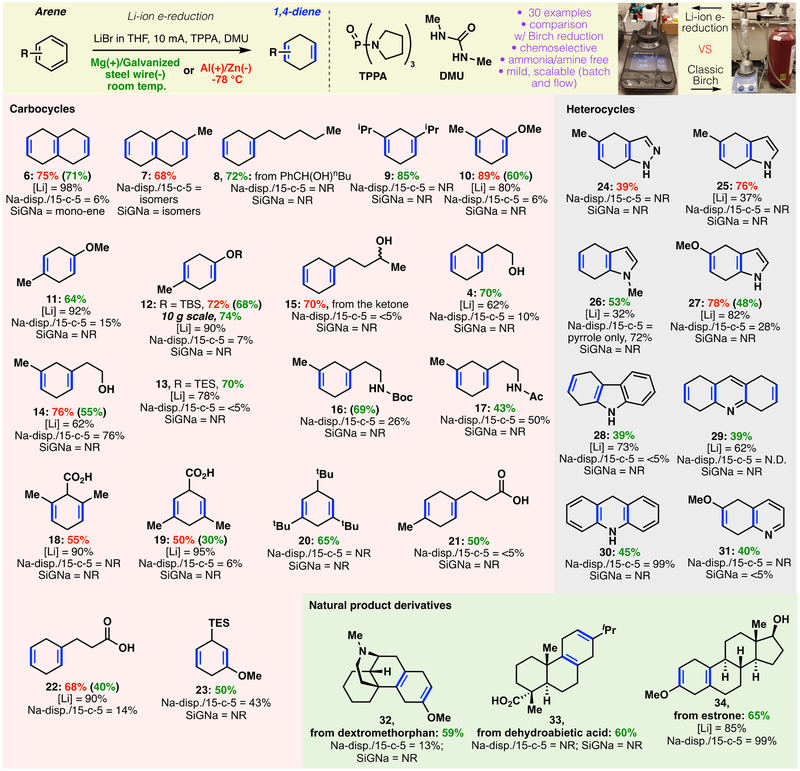
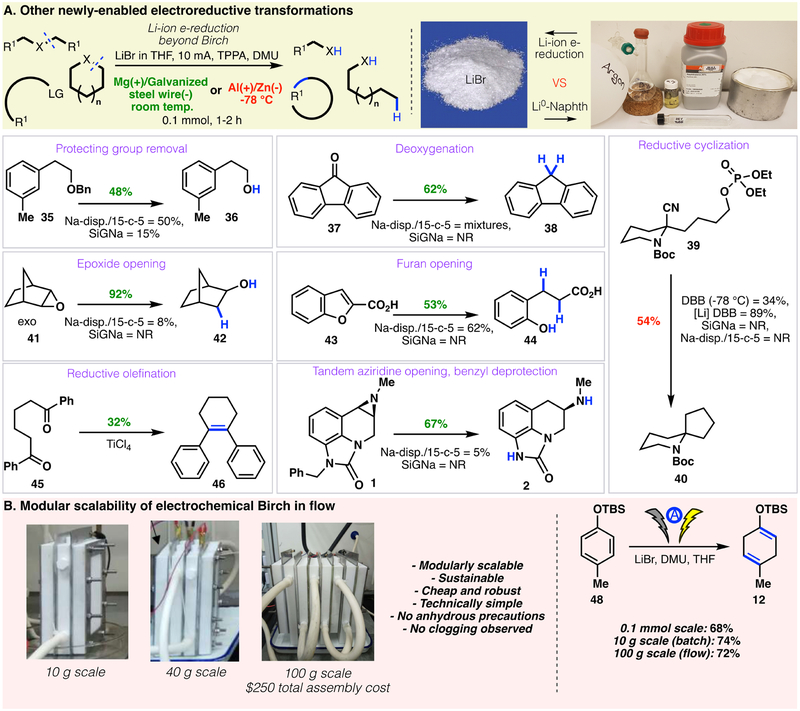
Reductive electrosynthesis has faced long-standing challenges in applications to complex organic substrates at scale. Here, we show how decades of research in lithium-ion battery materials, electrolytes, and additives can serve as an inspiration for achieving practically scalable reductive electrosynthetic conditions for the Birch reduction. Specifically, we demonstrate that using a sacrificial anode material (magnesium or aluminum), combined with a cheap, nontoxic, and water-soluble proton source (dimethylurea), and an overcharge protectant inspired by battery technology [tris(pyrrolidino)phosphoramide] can allow for multigram-scale synthesis of pharmaceutically relevant building blocks. We show how these conditions have a very high level of functional-group tolerance relative to classical electrochemical and chemical dissolving-metal reductions. Finally, we demonstrate that the same electrochemical conditions can be applied to other dissolving metal-type reductive transformations, including McMurry couplings, reductive ketone deoxygenations, and epoxide openings.
Copyright © 2019 The Authors, some rights reserved; exclusive licensee American Association for the Advancement of Science. No claim to original U.S. Government Works.
Conflict of interest statement
Figures
References
-
- Rabideau PW, Marcinow Z, The Birch reduction of aromatic compounds. Org. React. (Hoboken, NJ, U. S.) 42, 222 pp (1992).
-
- Rabten W, Margarita C, Eriksson L, Andersson PG, Ir-Catalyzed Asymmetric and Regioselective Hydrogenation of Cyclic Allylsilanes and Generation of Quaternary Stereocenters via the Hosomi-Sakurai Allylation. Chem. - Eur. J 24, 1681–1685 (2018). - PubMed
-
- Peters BK et al., Enantio- and Regioselective Ir-Catalyzed Hydrogenation of Di- and Trisubstituted Cycloalkenes. J. Am. Chem. Soc 138, 11930–11935 (2016). - PubMed
-
- Liu J et al., Regioselective Iridium-Catalyzed Asymmetric Monohydrogenation of 1,4-Dienes. J. Am. Chem. Soc 139, 14470–14475 (2017). - PubMed
-
- Paptchikhine A, Itto K, Andersson PG, Sequential Birch reaction and asymmetric Ircatalyzed hydrogenation as a route to chiral building blocks. Chem. Commun. (Cambridge, U. K.) 47, 3989–3991 (2011). - PubMed
Publication types
Grants and funding
LinkOut - more resources
Full Text Sources
Other Literature Sources
