


Concentration Levels, Biological Enrichment Capacities and Potential Health Risk Assessment of Trace Elements in Eichhornia crassipes from Honghu Lake, China
- PMID: 30792406
- PMCID: PMC6385497
- DOI: 10.1038/s41598-018-36511-z
Concentration Levels, Biological Enrichment Capacities and Potential Health Risk Assessment of Trace Elements in Eichhornia crassipes from Honghu Lake, China
Abstract
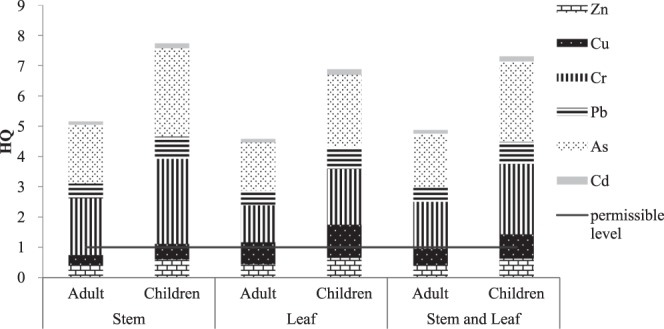
This study investigated the concentrations of Zn, Cu, Cr, Pb, As and Cd in different tissues of E. crassipes from Honghu Lake. The total concentrations of trace elements in E. crassipes were observed in descending order: Zn (111.6162) > Cu (15.7494) > Cr (7.0466) > Pb (5.6251) > As (3.6831) > Cd (0.1941) mg/kg. The order of the bioconcentration factor (BCF) measured in E. crassipes was Zn > As > Cr > Cu > Pb > Cd > 1, indicating that E. crassipes possessed a strong biological enrichment ability to accumulate a variety of trace elements. The translocation factor (TF) values decreased in the order of Cu > Zn > Cr > As > Pb > Cd, all of which were lower than 1, which showed that the absorption of the trace elements by E. crassipes was mainly accomplished in the roots. Moreover, the health risk assessments showed that the carcinogenic and noncarcinogenic risks of the edible parts of E. crassipes were 26.1 and 4.6 times higher than the maximum acceptable value recommended by the USEPA for adults and children of approximately 39.2- and 6.9-fold, respectively. Children were more sensitive than adults. The main trace elements that led to noncarcinogenic risks were As, Cr and Cu, while Cr and As led to carcinogenic risks. The results of the Pearson correlation showed positive correlations with the concentrations of Zn, Cr and As between E. crassipes and the water as well as negative correlations of the contents of all six trace elements between E. crassipes and the sediment.
Conflict of interest statement
The authors declare no competing interests.
Figures



References
-
- Li F, Cai Y, Zhang J. Spatial Characteristics, Health Risk Assessment and Sustainable Management of Heavy Metals and Metalloids in Soils from Central China. Sustainability-Basel. 2018;10:91. doi: 10.3390/su10010091. - DOI
-
- Harguinteguy CA, Cirelli AF, Pignata ML. Heavy metal accumulation in leaves of aquatic plant Stuckenia filiformis and its relationship with sediment and water in the Suquía river (Argentina) Microchemical Journal. 2014;114:111–118. doi: 10.1016/j.microc.2013.12.010. - DOI
-
- Benedict, L. Invasive Aquatic Weeds in Louisiana (2010).
-
- Mangas-RamÃ-rez E, ElÃ-as-Gutiérrez M. Effect of mechanical removal of water hyacinth (Eichhornia crassipes) on the water quality and biological communities in a Mexican reservoir. Aquatic Ecosystem Health & Management. 2004;7:161–168. doi: 10.1080/14634980490281597. - DOI
Publication types
MeSH terms
Substances
LinkOut - more resources
Full Text Sources
Research Materials
Miscellaneous
