


Regional Homogeneity Abnormalities in Early-Onset and Adolescent-Onset Conduct Disorder in Boys: A Resting-State fMRI Study
- PMID: 30792633
- PMCID: PMC6374554
- DOI: 10.3389/fnhum.2019.00026
Regional Homogeneity Abnormalities in Early-Onset and Adolescent-Onset Conduct Disorder in Boys: A Resting-State fMRI Study
Abstract
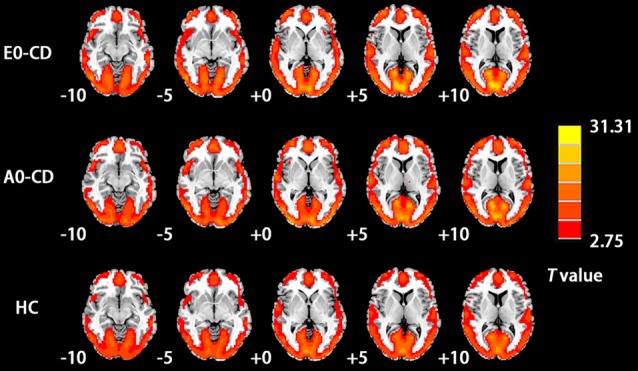
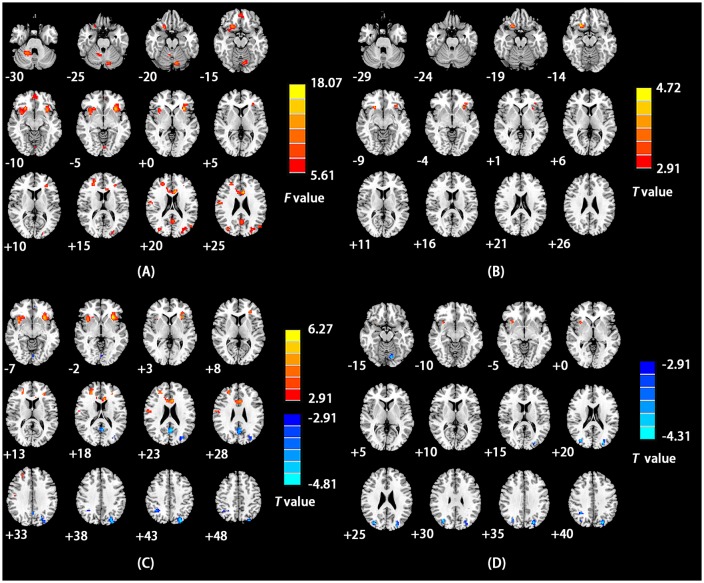
Purpose: Developmental taxonomic theory posits that formation of early-onset conduct disorder (EO-CD), is considered to have a neurodevelopmental etiology and have more severe psychosocial and neuropsychological dysfunction than adolescent-onset CD (AO-CD), which is thought to stem largely from social mimicry of deviant peers. The purpose of the current study was to investigate whether regional homogeneity (ReHo), denoting the spontaneous brain activity, supports developmental taxonomic theory in a resting state (rs). Materials and Methods: Rs-functional magnetic resonance imaging (fMRI) examinations were administered to 36 EO-CD patients, 32 AO-CD patients, and 30 healthy controls (HCs). All participants were male adolescents, aged between 12 and 17 years old. A one-way analysis of covariance (ANCOVA), with age and IQ as covariates, was performed to identify regions with significant group differences in ReHo values, followed by a post hoc analyses. Results: Compared with the AO-CD groups, EO-CD had higher ReHo values in the right middle/inferior frontal gyrus. Compared with the HCs, the EO-CD group exhibited lower ReHo values in the left precuneus, left middle occipital gyrus, left cerebellum posterior lobe and the right inferior parietal lobule, as well as higher ReHo values in the right middle frontal gyrus, left insula/inferior frontal gyrus, right postcentral gyrus, and the left anterior cingulate gyrus. Compared with the HCs, the AO-CD group showed lower ReHo values in the bilateral precuneus, left cerebellum posterior lobe, and the right inferior parietal lobule. Conclusion: Significant differences in ReHo were observed between the EO-CD and AO-CD groups, implying distinct neuropathological mechanisms of the two CD subtypes, consistent with developmental taxonomic theory. CD-associated abnormalities in ReHo may be related to high-order cognitive and low-level perceptual system impairments in CD.
Keywords: adolescent-onset conduct disorder; developmental taxonomic theory; early-onset conduct disorder; regional homogeneity; resting-state functional magnetic resonance imaging.
Figures
References
LinkOut - more resources
Full Text Sources
