. 2019 Feb 11:10:5.
doi: 10.1186/s13229-019-0257-5. eCollection 2019.

Haploinsufficiency of autism causative gene Tbr1 impairs olfactory discrimination and neuronal activation of the olfactory system in mice

Affiliations

Haploinsufficiency of autism causative gene Tbr1 impairs olfactory discrimination and neuronal activation of the olfactory system in mice

Tzyy-Nan Huang et al. Mol Autism. .

Abstract

Background: Autism spectrum disorders (ASD) exhibit two clusters of core symptoms, i.e., social and communication impairment, and repetitive behaviors and sensory abnormalities. Our previous study demonstrated that TBR1, a causative gene of ASD, controls axonal projection and neuronal activation of amygdala and regulates social interaction and vocal communication in a mouse model. Behavioral defects caused by Tbr1 haploinsufficiency can be ameliorated by increasing neural activity via D-cycloserine treatment, an N-methyl-D-aspartate receptor (NMDAR) coagonist. In this report, we investigate the role of TBR1 in regulating olfaction and test whether D-cycloserine can also improve olfactory defects in Tbr1 mutant mice.

Methods: We used Tbr1+/- mice as a model to investigate the function of TBR1 in olfactory sensation and discrimination of non-social odors. We employed a behavioral assay to characterize the olfactory defects of Tbr1+/- mice. Magnetic resonance imaging (MRI) and histological analysis were applied to characterize anatomical features. Immunostaining was performed to further analyze differences in expression of TBR1 subfamily members (namely TBR1, TBR2, and TBX21), interneuron populations, and dendritic abnormalities in olfactory bulbs. Finally, C-FOS staining was used to monitor neuronal activation of the olfactory system upon odor stimulation.

Results: Tbr1+/- mice exhibited smaller olfactory bulbs and anterior commissures, reduced interneuron populations, and an abnormal dendritic morphology of mitral cells in the olfactory bulbs. Tbr1 haploinsufficiency specifically impaired olfactory discrimination but not olfactory sensation. Neuronal activation upon odorant stimulation was reduced in the glomerular layer of Tbr1+/- olfactory bulbs. Furthermore, although the sizes of piriform and perirhinal cortices were not affected by Tbr1 deficiency, neuronal activation was reduced in these two cortical regions in response to odorant stimulation. These results suggest an impairment of neuronal activation in olfactory bulbs and defective connectivity from olfactory bulbs to the upper olfactory system in Tbr1+/- mice. Systemic administration of D-cycloserine, an NMDAR co-agonist, ameliorated olfactory discrimination in Tbr1+/- mice, suggesting that increased neuronal activity has a beneficial effect on Tbr1 deficiency.

Conclusions: Tbr1 regulates neural circuits and activity in the olfactory system to control olfaction. Tbr1+/- mice can serve as a suitable model for revealing how an autism causative gene controls neuronal circuits, neural activity, and autism-related behaviors.

Keywords: Autism spectrum disorders; C-FOS; D-cycloserine; Neuronal activation; Olfactory bulb; Olfactory discrimination; T-brain-1.


Conflict of interest statement

Not applicable.Not applicable.The authors declare that they have no competing interests.Springer Nature remains neutral with regard to jurisdictional claims in published maps and institutional affiliations.

Figures
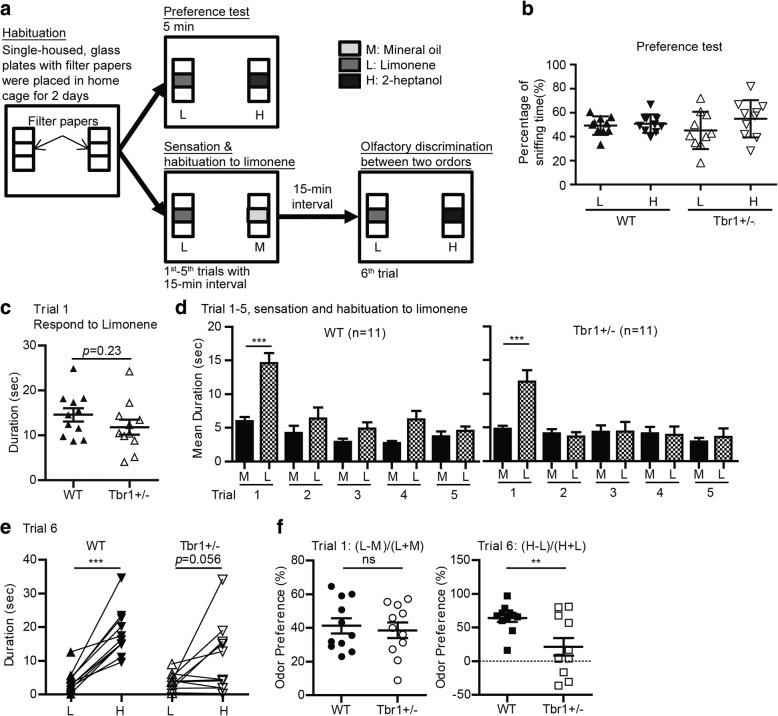
Fig. 1
Fig. 1
Olfactory discrimination deficiency in Tbr1+/− mice. a Flow chart of our odor preference test (upper panel) and olfactory sensation-habituation-dishabituation test (lower panel). b The results of the preference test. Wild-type (WT) and Tbr1+/− mice spend similar amounts of time sniffing limonene (L) and 2-heptanol (H). c The results of olfactory sensation. Sniffing time of limonene by WT and Tbr1+/− mice is comparable in the first trial of our olfactory discrimination test. d The results of trials 1–5 of the sensation-habituation-dishabituation test. Olfactory habituation to limonene (L) is similar between WT and Tbr1+/− mice. But Tbr1+/− mice exhibit an olfactory discrimination deficiency in distinguishing 2-heptanol and limonene in trial 6. e Sniffing time of limonene (L) and 2-heptanol (H) by WT and Tbr1+/− mice during trial 6. f Odor preference index from trials 1 and 6. The equations to calculate the odor preference index are indicated. Data are presented as mean plus SEM in (b), (c), (d), and (f). Data from individual mice are also indicated in (b), (c), (e), and (f). **p < 0.01; ***p < 0.001
Fig. 2
Fig. 2
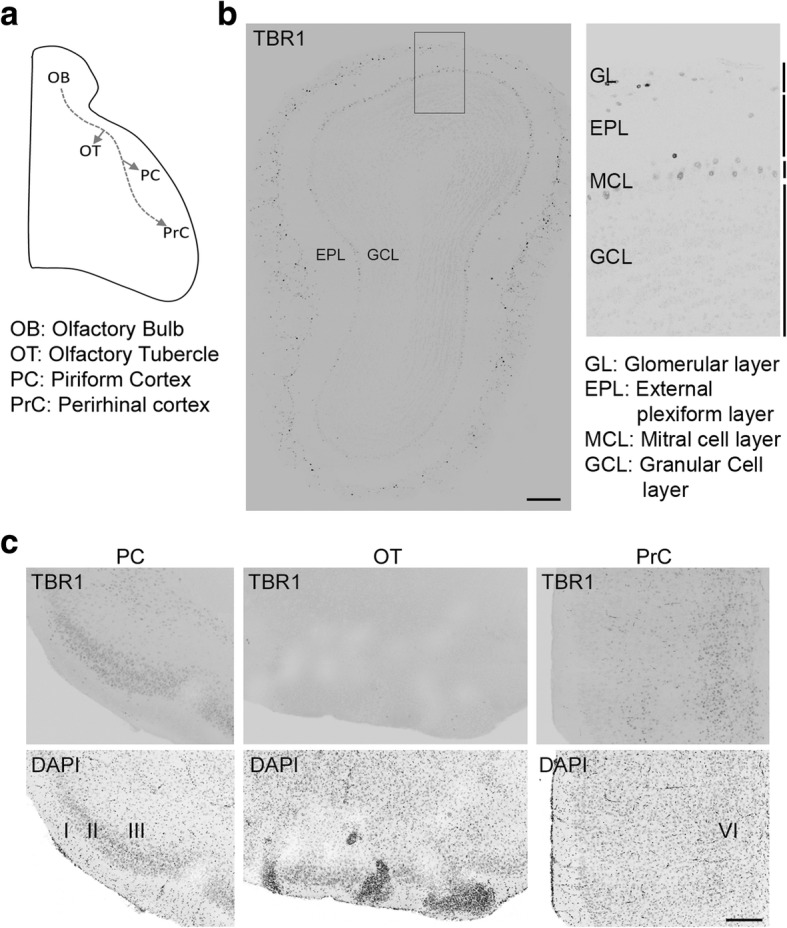
TBR1 expression pattern in the olfactory system of wild-type mouse brain. a Schematic of the four brain regions associated with olfaction. (b)–(c) Immunofluorescence staining using TBR1 antibody and DAPI counter-staining were performed to examine the expression of TBR1 in adult mouse brains. b TBR1 expression in the mitral cell layer and glomerular layer of the olfactory bulb. c TBR1 is expressed in the piriform and perirhinal cortices, but not in the olfactory tubercle. Scale bar 200 μm (b), (c)
Fig. 3
Fig. 3
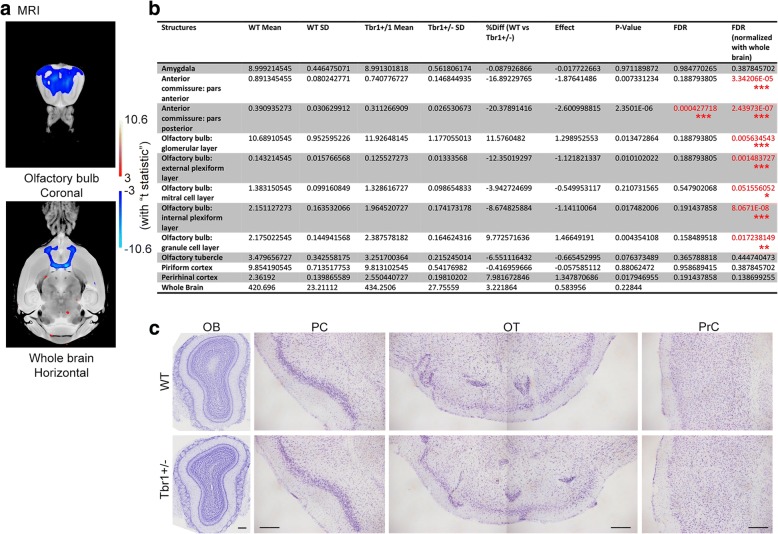
MRI reveals that Tbr1+/− mice have a smaller anterior commissure and olfactory bulbs. a MRI brain images showing the reduced size of the olfactory bulbs and anterior commissure of Tbr1+/− mice compared to WT littermates. Upper, coronal section of olfactory bulbs; lower, horizontal section. Pseudocolor indicates regions that are either enlarged or reduced in Tbr1+/− mice. b Quantification of the sizes of brain regions associated with olfaction. Before normalization with whole-brain size, only the posterior part of the anterior commissure is different (red, FDR < 0.1). After normalization with whole-brain size, more regions exhibit differences (indicated in red). * FDR < 0.1; ** FDR < 0.05; *** FDR < 0.01. c Normal lamination and organization of the olfactory system in Tbr1+/− mice, as revealed by Nissl stain. Scale bars 200 μm, (c)
Fig. 4
Fig. 4
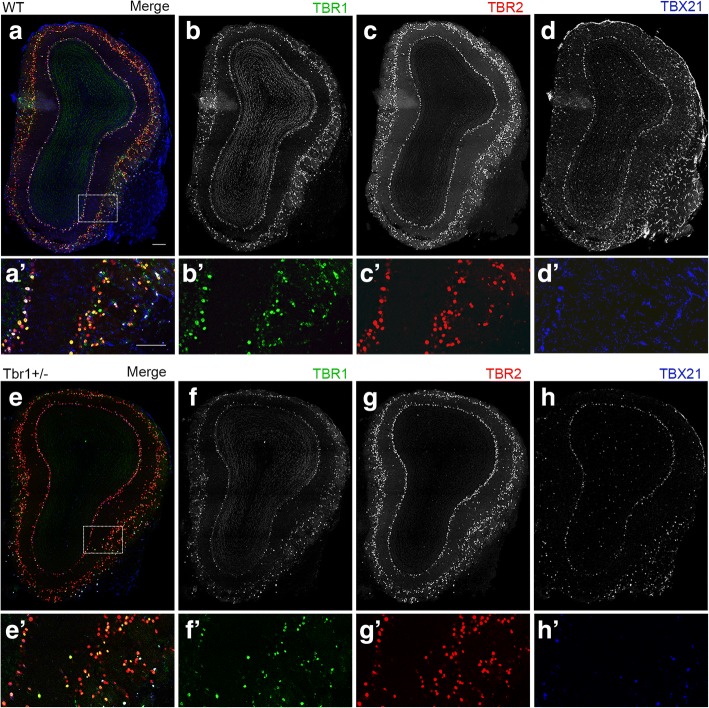
Expression of TBR1 subfamily members in Tbr1+/− olfactory bulbs. Triple immunofluorescence labeling of TBR1, TBR2, and TBX21 was performed using adult WT littermates (a, b, c, d) and Tbr1+/− mice (e, f, g, h). merged views (a, A′, e, E′); TBR1, green (b, B′, f, F′); TBR2, red (c, C′, g, G′); TBX21, blue (d, D′, h, H′). ah whole olfactory bulb; A′ –H′ higher magnification of insets. Scale bars 200 μm, (a)–(h); 100 μm, (A′)–(H′)
Fig. 5
Fig. 5
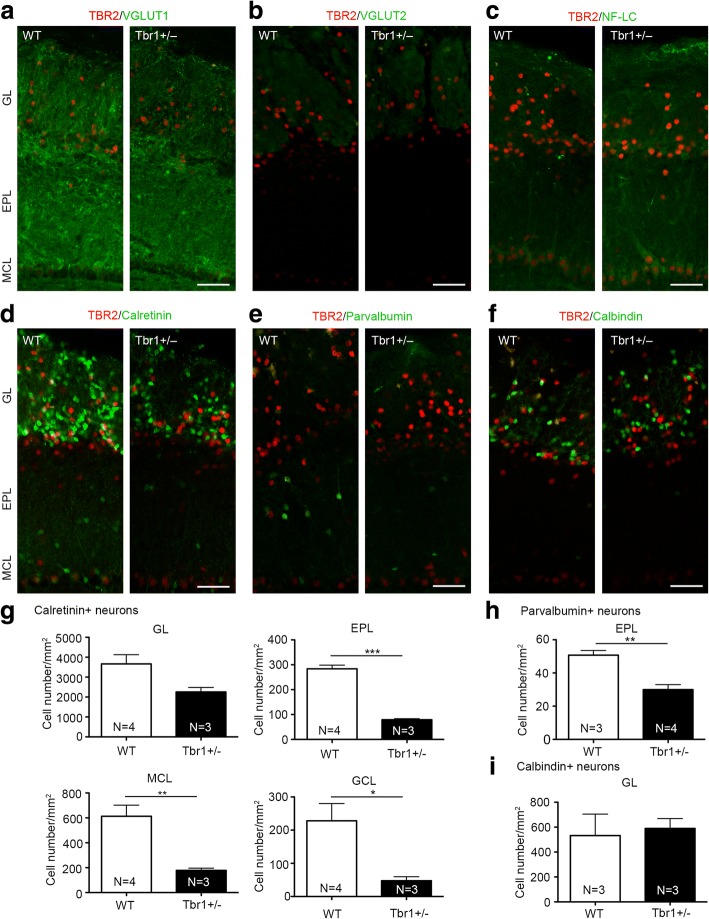
Reduction of inhibitory interneurons and morphological alteration of the mitral cell layer in Tbr1+/− olfactory bulbs. Double immunostaining of TBR2 and a VGLUT1, b VGLUT2, c Neurofilament-light chain (NF-LC), d Calretinin, e Parvalbumin, and f Calbindin was performed to compare olfactory bulbs of Tbr1+/− and WT mice. g Quantification of Calretinin+ interneurons at the glomerular layer (GL), external plexiform layer (EPL), mitral cell layer (MCL), and granular cell layer (GCL). h Quantification of parvalbumin+ interneurons at the external plexiform layer (EPL). i Quantification of calbindin+ interneurons at the glomerular layer (GL). Data represent mean plus SEM and the results of individual mice are shown. *p < 0.05; **p < 0.01; ***p < 0.001. Scale bars: 50 μm
Fig. 6
Fig. 6
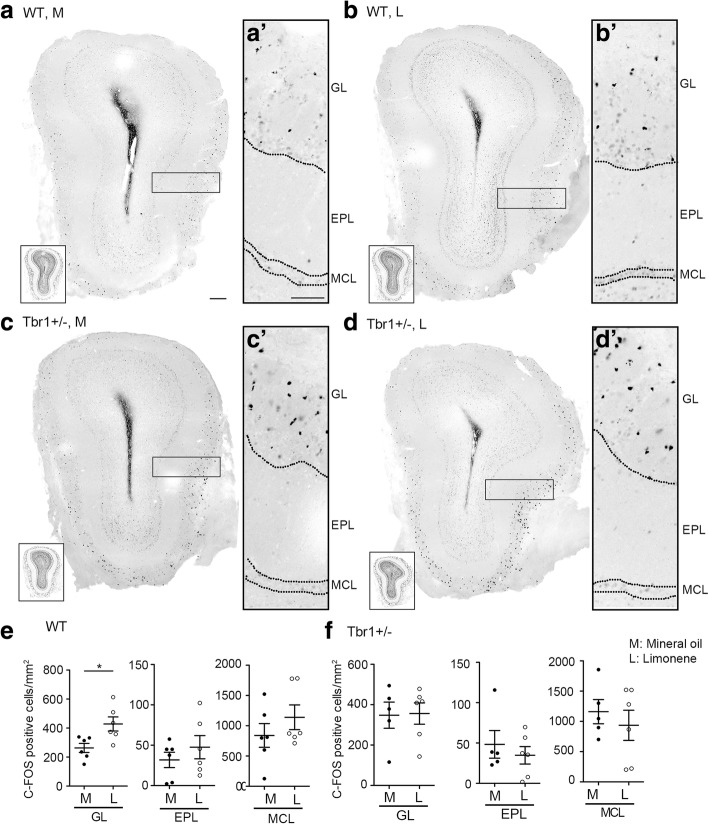
Increased neuronal activation in the glomerular layer of WT littermates but not Tbr1+/− mice. a-d Two hours after exposure to limonene or mineral oil, Tbr1+/− mice and WT littermates were subjected to C-FOS staining to monitor neuronal activation. a’–d’ High magnification images of insets in (a)–(d). ef Quantification of C-FOS-positive cell number in the glomerular layer (GL), external plexiform layer (EPL), and mitral cell layer (MCL). Data represent mean plus SEM and the results of individual mice are shown. * p < 0.05. Scale bars 200 μm (original images); 100 μm (enlarged images)
Fig. 7
Fig. 7
Impaired neuronal activation in the piriform and perirhinal cortices due to Tbr1 haploinsufficiency. ac Two hours after exposure to limonene (L) or mineral oil (M), mouse brains were harvested for C-FOS staining. Insets are DAPI images to outline the structure of different brain regions (the piriform (PC) and perirhinal (PrC) cortices and the olfactory tubercle (OT)). de. Quantitative data showing the numbers of C-FOS-positive cells in WT (d) and Tbr1+/− mice (e). Data represent mean plus SEM and the results of individual mice are shown. **p < 0.01, ***p < 0.001. Scale bars 200 μm (a); 100 μm (b); 100 μm (c)
Fig. 8
Fig. 8
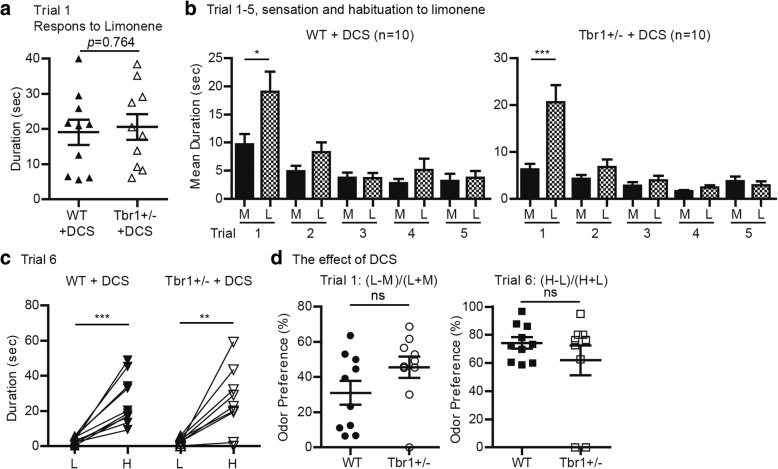
Rescue effect of D-cycloserine on olfactory discrimination in Tbr1+/− mice. ab Thirty minutes after D-cycloserine (DCS) treatment, mice were subjected to the sensation-habituation-dishabituation test, as indicated in the lower panel of Fig. 1a. a Time spent sniffing limonene in the first trial and b olfactory habituation are comparable between WT and Tbr1+/− mice. cd D-cycloserine improves olfactory discrimination of Tbr1+/− mice in trial 6. Data represent mean plus SEM and the results of individual mice are shown. *p < 0.05; **p < 0.01; ***p < 0.001

References

    1. Courchesne E, Pierce K, Schumann CM, Redcay E, Buckwalter JA, Kennedy DP, et al. Mapping early brain development in autism. Neuron. 2007;56(2):399–413. - PubMed
    1. Ziats MN, Edmonson C, Rennert OM. The autistic brain in the context of normal neurodevelopment. Front Neuroanat. 2015;9:115. - PMC - PubMed
    1. Frazier TW, Youngstrom EA, Speer L, Embacher R, Law P, Constantino J, et al. Validation of proposed DSM-5 criteria for autism spectrum disorder. J Am Acad Child Adolesc Psychiatry. 2012;51(1):28–40.e3. - PMC - PubMed
    1. Mandy WP, Charman T, Skuse DH. Testing the construct validity of proposed criteria for DSM-5 autism spectrum disorder. J Am Acad Child Adolesc Psychiatry. 2012;51(1):41–50. - PubMed
    1. Sztainberg Y, Zoghbi HY. Lessons learned from studying syndromic autism spectrum disorders. Nat Neurosci. 2016;19(11):1408–1417. - PubMed

Publication types