. 2019 Feb 15:2:66.
doi: 10.1038/s42003-019-0310-0. eCollection 2019.

Oxylipins mediate cell-to-cell communication in Pseudomonas aeruginosa

Affiliations

Oxylipins mediate cell-to-cell communication in Pseudomonas aeruginosa

Eriel Martínez et al. Commun Biol. .

Abstract

Oxygenated unsaturated fatty acids, known as oxylipins, are signaling molecules commonly used for cell-to-cell communication in eukaryotes. However, a role for oxylipins in mediating communication in prokaryotes has not previously been described. Bacteria mainly communicate via quorum sensing, which involves the production and detection of diverse small molecules termed autoinducers. Here we show that oleic acid-derived oxylipins produced by Pseudomonas aeruginosa function as autoinducers of a novel quorum sensing system. We found that this system controls the cell density-dependent expression of a gene subset independently of the quorum sensing systems thus far described in this bacterium. We identified a LysR-type transcriptional regulator as the primary receptor of the oxylipin signal. The discovery of this oxylipin-dependent quorum sensing system reveals that prokaryote-derived oxylipins also mediate cell-to-cell communication in bacteria.


Conflict of interest statement

The authors declare no competing interests.

Figures
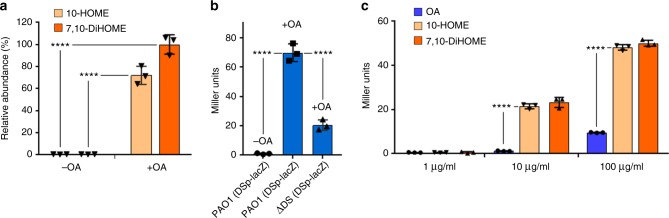
Fig. 1
Fig. 1
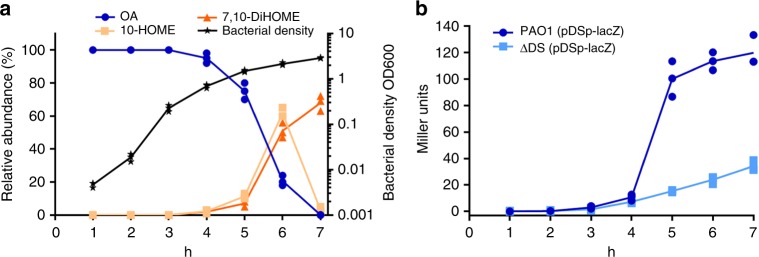
10-HOME and 7,10-DiHOME induce the expression of the diol synthase operon. a In vitro bioconversion of oleic acid (OA) into 10-HOME and 7,10-DiHOME oxylipins using the periplasmic fraction isolated from PAO1. The expression of the diol synthase enzymes was dependent on culturing PAO1 in the presence of OA. b Expression of β-galactosidase (β-gal) activity in PAO1 (pDSp-lacZ) and ΔDS (pDSp-lacZ) treated with OA (1 mg mL−1). No β-gal activity was detected in PAO1 (pDSp-lacZ) in the absence of OA. OA induced at least threefold more β-gal activity in PAO1 (pDSp-lacZ) than ΔDS (pDSp-lacZ). c Expression of β-gal activity in ΔDS (DSp-lacZ) treated with OA or oxylipins at the shown concentrations. ΔDS (pDSp-lacZ) showed fivefold more β-gal activity when treated with 10-HOME or 7,10-DiHOME than with OA and the increase in β-gal expression was dose dependent. Means and s.d. are from three independent experiments. 10-HOME (10S)-hydroxy-(8E)-octadecenoic acid, 7,10-DiHOME 7S,10S-dihydroxy-(8E)-octadecenoic acid. ****Significantly different, unpaired two-tailed t-test, P < 0.0001
Fig. 2
Fig. 2
Cell density-dependent expression of the diol synthase operon. a Time course of oxylipin production during the culture growth. Oxylipins started to be produced at the late exponential phase (4 h, OD~0.6). Then, the amount of oxylipins increased around 50 times in approximately 2 h. b Time course of β-galactosidase (β-gal) activity in PAO1 (pDSp-lacZ) and ΔDS (pDSp-lacZ) grown in the presence of 1 mg mL−1 of oleic acid (OA). The diol synthase operon was poorly induced in ΔDS (pDSp-lacZ). Means and s.d. are from three independent experiments
Fig. 3
Fig. 3
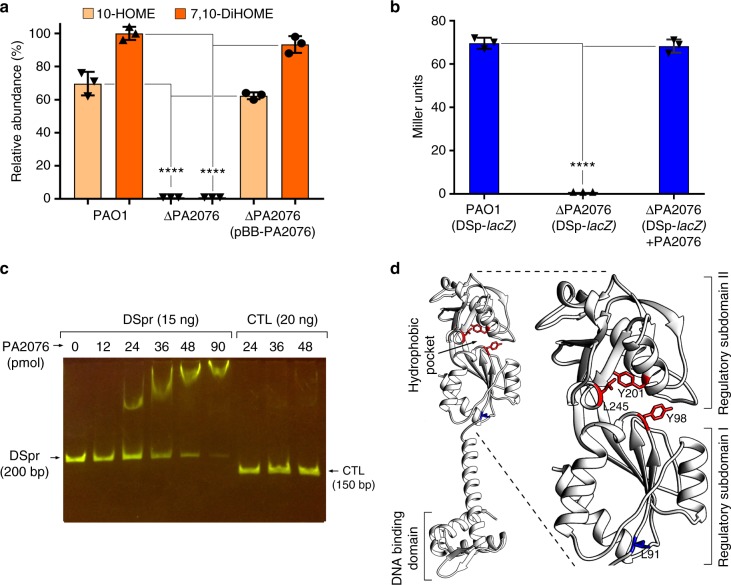
OdsR (oxylipin-dependent diol synthase regulator) is an oxylipin-dependent inducer of the diol synthase operon. a Production of oxylipins in the supernatant of PAO1, ΔPA2076 and ΔPA2076 complemented with a copy of odsR gene (ΔPA2076/pBB-odsR-His). ΔPA2076 failed to produce oxylipins. b β-Galactosidase (β-gal) expression in PAO1 (pDSp-lacZ), ΔPA2076 (pDSp-lacZ) and ΔPA2076 complemented with PA2076PA2076 (pDSp-lacZ+pBB-odsR-His)]. ΔPA2076 (pDSp-lacZ) did not express detectable β-gal activity in the presence of oleic acid (OA; 1 mg mL−1) (t-test, P < 0.0001). c Electrophoretic mobility shift assay (EMSA) gel showing specific binding of OdsR protein to the diol synthase promoter probe (DSpr, 200 bp), but not to a control unrelated DNA probe (CTL, 150 bp). d I-TASSER predicted model of OdsR three-dimensional (3D) structure. The hydrophobic pocket localized in between the two regulatory subdomains is indicated. The hydrophobic amino acids in the pocket that were replaced by hydrophilic counterparts are represented in red. These changes abolished the ability of OdsR to induce the β-gal activity of the DS-lacZ genetic fusion. The amino acid L91 (in blue) outside of the pocket had no effect on OdsR function. Data from a, b are the means and s.d. of three independent experiments. ****Significantly different, unpaired two-tailed t-test, P < 0.0001
Fig. 4
Fig. 4
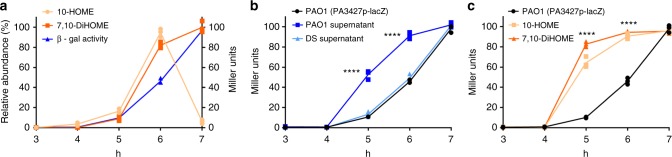
The oxylipin-dependent quorum sensing system (ODS) regulates cell density-dependent expression of PA3427. a Time course of β-galactosidase (β-gal) activity in PAO1 (PA3427p-lacZ) during culture growth. The β-gal activity is expressed in a cell density-dependent manner which correlated with the kinetics of oxylipin production. b The β-gal activity is prematurely expressed at earlier time points of growth when treated with free-cell supernatants of PAO1 stationary phase cultures (oxylipin rich supernatants) or c with purified 10-HOME or 7,10-DiHOME. Means and s.d. are from three independent experiments. 10-HOME (10S)-hydroxy-(8E)-octadecenoic acid, 7,10-DiHOME 7S,10S-dihydroxy-(8E)-octadecenoic acid. ****Significantly different to control [PAO1 (PA3427p-lacZ)] at time points 4 and 5 h, per time point unpaired two-tailed t-test, P < 0.0001
Fig. 5
Fig. 5
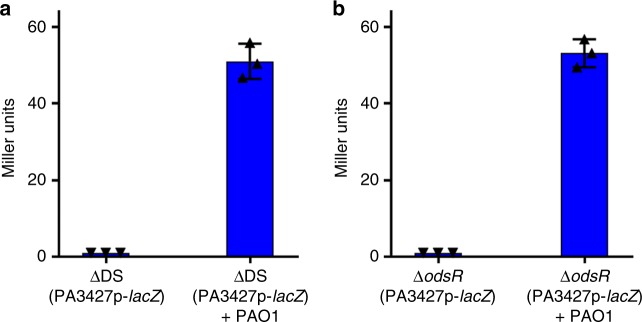
Oxylipin-deficient P. aeruginosa profit from oxylipins produced by PAO1 wild-type strain. a Graph showing the β-galactosidase (β-gal) activity of ΔDS (PA3427p-lacZ) grown alone or in co-culture with PAO1. b Graph of the same experiment, but using ΔodsR (PA3427p-lacZ)
Fig. 6
Fig. 6
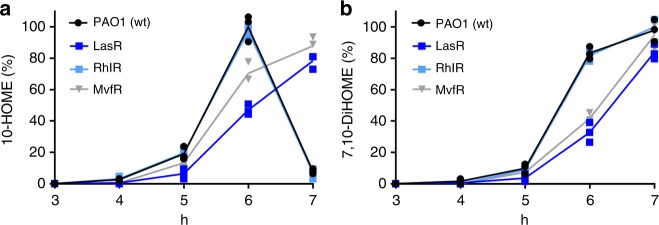
Oxylipin-dependent quorum sensing system (ODS) is self-regulated. a Time course of 10-HOME and b 7,10-DiHOME production in the supernatants of PAO1 and the transposon mutants lasR::tn, rhlR::tn and mvfR::tn. The mutants rhlR::tn and mvfR::tn showed a slower kinetics of 10-HOME and 7,10-DiHOME production. Means and s.d. are from three independent experiments. 10-HOME (10S)-hydroxy-(8E)-octadecenoic acid, 7,10-DiHOME 7S,10S-dihydroxy-(8E)-octadecenoic acid
Fig. 7
Fig. 7
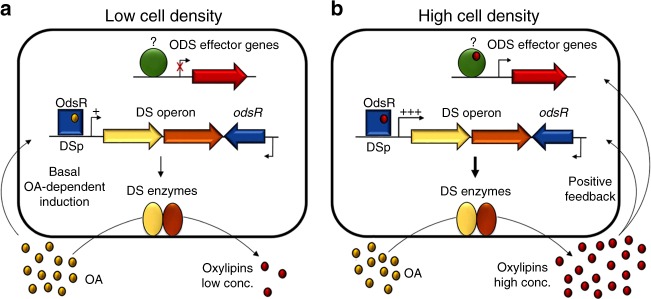
Model of the oxylipin-dependent quorum sensing system (ODS). a The OdsR (oxylipin-dependent diol synthase regulator) receptor (represented as a blue square) is expressed constitutively. At low cell density in the presence of oleic acid (OA), this molecule (or an unknown derivative molecule) binds OdsR inducing a basal expression of the ODS operon, shown with a single plus symbol above the DS promoter (DSp). P. aeruginosa grown under these conditions produces a small amount of oxylipins. b When the cell density increases, the oxylipins reach a threshold concentration at which they bind to OdsR. OdsR in turn induces the expression of the DS enzymes at a higher rate than that induced by OA (shown with a triple plus symbol), creating a positive regulatory feedback that further increases the extracellular concentration of oxylipins. Subsequently, the oxylipins are sensed by other as yet unidentified secondary receptor(s) (shown as a green circle) that ultimately regulate the expression of the ODS effector genes
Fig. 8
Fig. 8
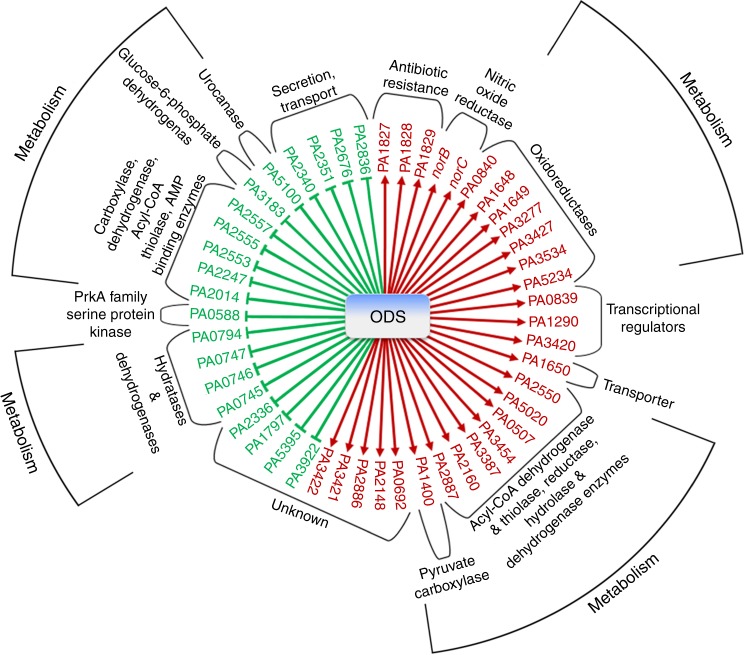
The oxylipin-dependent quorum sensing system (ODS) regulon. Categorization of genes regulated by the oleic acid (OA)-derived oxylipins in P. aeruginosa according to their hypothetical assigned functions in the Pseudomonas Genome Database (http://www.pseudomonas.com). Positive regulation is indicated using red arrows and negative regulation by green flat bars

References

    1. Whiteley M, Diggle SP, Greenberg EP. Progress in and promise of bacterial quorum sensing research. Nature. 2017;551:313–320. doi: 10.1038/nature24624. - DOI - PMC - PubMed
    1. Williams P, Winzer K, Chan WC, Cámara M. Look who’s talking: communication and quorum sensing in the bacterial world. Philos. Trans. R. Soc. Lond. B Biol. Sci. 2007;362:1119–1134. doi: 10.1098/rstb.2007.2039. - DOI - PMC - PubMed
    1. Kaplan HB, Greenberg EP. Diffusion of autoinducer is involved in regulation of the Vibrio fischeri luminescence system. J. Bacteriol. 1985;163:1210–1214. - PMC - PubMed
    1. Papenfort K, Bassler BL. Quorum sensing signal-response systems in Gram-negative bacteria. Nat. Rev. Microbiol. 2016;14:576–588. doi: 10.1038/nrmicro.2016.89. - DOI - PMC - PubMed
    1. Fuqua WC, Winans SC, Greenberg EP. Quorum sensing in bacteria: the LuxR-LuxI family of cell density-responsive transcriptional regulators. J. Bacteriol. 1994;176:269–275. doi: 10.1128/jb.176.2.269-275.1994. - DOI - PMC - PubMed

Publication types

MeSH terms