


Structural isomers of the S2 state in photosystem II: do they exist at room temperature and are they important for function?
- PMID: 30793319
- PMCID: PMC6478542
- DOI: 10.1111/ppl.12947
Structural isomers of the S2 state in photosystem II: do they exist at room temperature and are they important for function?
Abstract
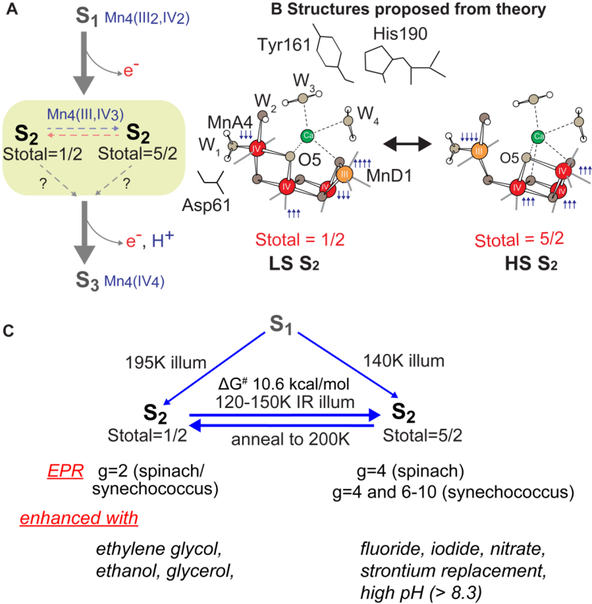
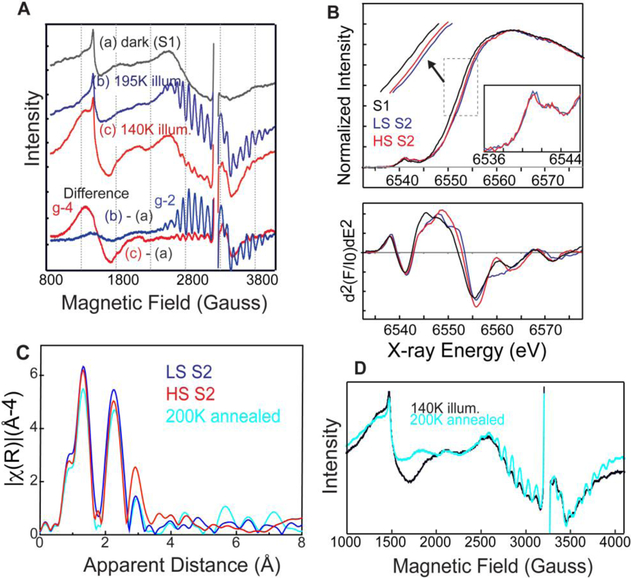
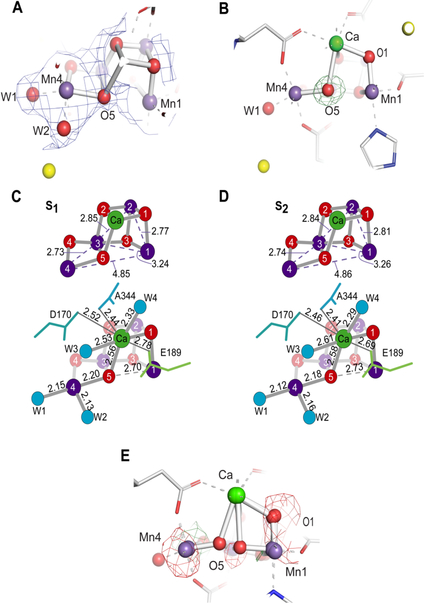
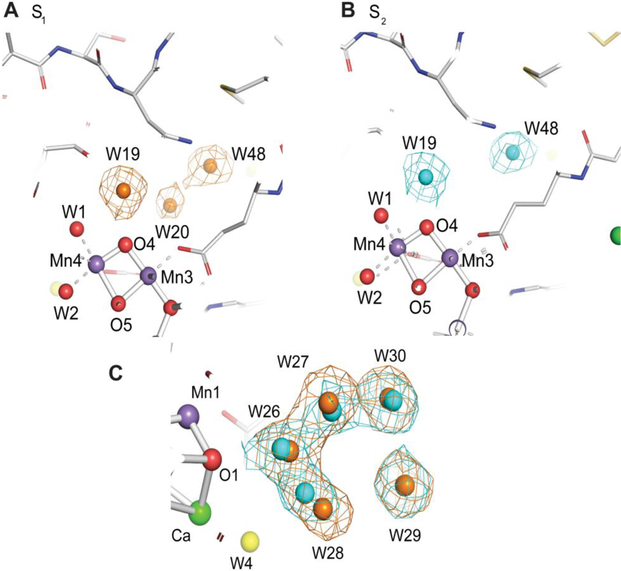
In nature, an oxo-bridged Mn4 CaO5 cluster embedded in photosystem II (PSII), a membrane-bound multi-subunit pigment protein complex, catalyzes the water oxidation reaction that is driven by light-induced charge separations in the reaction center of PSII. The Mn4 CaO5 cluster accumulates four oxidizing equivalents to enable the four-electron four-proton catalysis of two water molecules to one dioxygen molecule and cycles through five intermediate S-states, S0 - S4 in the Kok cycle. One important question related to the catalytic mechanism of the oxygen-evolving complex (OEC) that remains is, whether structural isomers are present in some of the intermediate S-states and if such equilibria are essential for the mechanism of the O-O bond formation. Here we compare results from electron paramagnetic resonance (EPR) and X-ray absorption spectroscopy (XAS) obtained at cryogenic temperatures for the S2 state of PSII with structural data collected of the S1 , S2 and S3 states by serial crystallography at neutral pH (∼6.5) using an X-ray free electron laser at room temperature. While the cryogenic data show the presence of at least two structural forms of the S2 state, the room temperature crystallography data can be well-described by just one S2 structure. We discuss the deviating results and outline experimental strategies for clarifying this mechanistically important question.
© 2019 Scandinavian Plant Physiology Society.
Figures
References
-
- Beck WF, Brudvig GW (1986) Binding of amines to the O2-evolving center of photosystem-II. Biochemistry 25: 6479–6486 - PubMed
-
- Boussac A, Rutherford AW (1988) Nature of the inhibition of the oxygen-evolving enzyme of photosystem II Induced by NaCl washing and reversed by the addition of Ca2+ or Sr2+. Biochemistry 27: 3476–3483
-
- Boussac A, Girerd J-J, Rutherford AW (1996) Conversion of the spin state of the manganese complex in photosystem II induced by near-infrared light. Biochemistry 35: 6984–6989 - PubMed
-
- Boussac A, Rutherford AW, Sugiura M (2015) Electron transfer pathways from the S-2-states to the S-3-states either after a Ca2+/Sr2+ or a Cl-/I- exchange in photosystem II from. Biochim Et Biophys Acta-Bioenergetics 1847: 576–586 - PubMed
-
- Boussac A, Un S, Horner O, Rutherford AW (1998a) High-spin states (S >= 5/2) of the photosystem II manganese complex. Biochemistry 37: 4001–4007 - PubMed
MeSH terms
Substances
Grants and funding
- GM126289/GF/NIH HHS/United States
- GM116423-02/Ruth L. Kirschstein National Research Service Award
- 2011.0055/K&A Wallenberg Foundation
- Deutsche Forschungsgemeinschaft (DFG)
- DE-AC02-76SF00515/U.S. DOE, Office of Science
- R01 GM126289/GM/NIGMS NIH HHS/United States
- Division of Chemical Sciences, Geosciences, and Biosciences of the Department of Energy (DOE)
- R56 GM055302/GM/NIGMS NIH HHS/United States
- R01 GM110501/GM/NIGMS NIH HHS/United States
- F32 GM116423/GM/NIGMS NIH HHS/United States
- Director, Office of Science, Office of Basic Energy Sciences (OBES)
- GM110501/GF/NIH HHS/United States
- 2016-05183/Vetenskapsrådet
- R01 GM055302/GM/NIGMS NIH HHS/United States
