


Patient-reported scar quality of adults after burn injuries: A five-year multicenter follow-up study
- PMID: 30793408
- PMCID: PMC6850449
- DOI: 10.1111/wrr.12709
Patient-reported scar quality of adults after burn injuries: A five-year multicenter follow-up study
Abstract
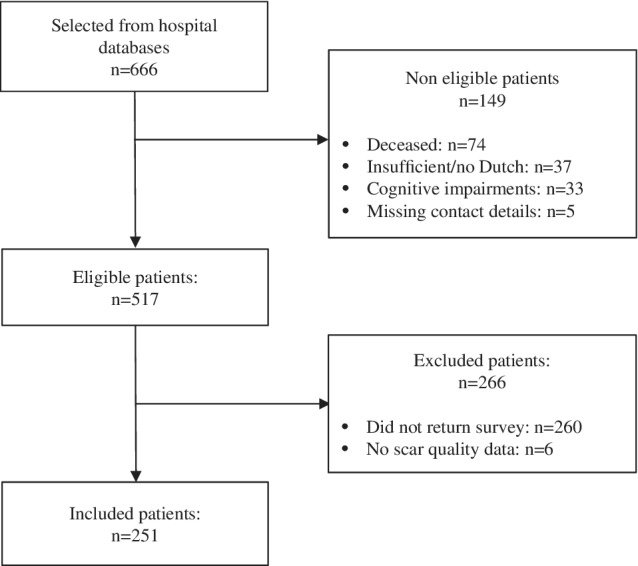
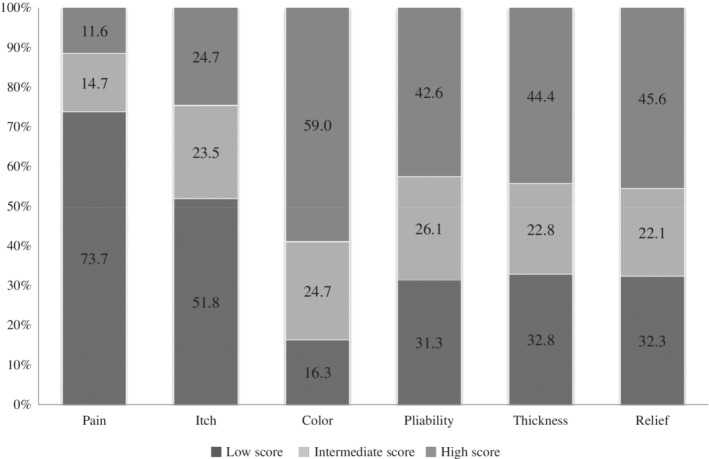
Scar formation is an important adverse consequence of burns. How patients appraise their scar quality is often studied shortly after sustaining the injury, but information in the long-term is scarce. Our aim was, therefore, to evaluate long-term patient-reported quality of burn scars. Adults with a burn center admission of ≥1 day between August 2011 and September 2012 were invited to complete a questionnaire on long-term consequences of burns. We enriched this sample with patients with severe burns (>20% total body surface area [TBSA] burned or TBSA full thickness >5%) treated between January 2010 and March 2013. Self-reported scar quality was assessed with the Patient Scale of the Patient and Observer Scar Assessment Scale (POSAS). Patients completed this scale for their-in their opinion-most severe scar ≥5 years after burns. This study included 251 patients with a mean %TBSA burned of 10%. The vast majority (91.4%) reported at least minor differences with normal skin (POSAS item score ≥2) on one or more scar characteristics and 78.9% of the patients' overall opinion was that their scar deviated from normal skin. Patients with severe burns had higher POSAS scores, representing worse scar quality, than patients with mild/intermediate burns, except for color, which was high in both groups. A longer hospital stay predicted reduced scar quality (both mean POSAS and mean overall opinion of the scar) in multivariate analyses. In addition, female gender was also associated with a poorer overall opinion of the scar. In conclusion, this study provides new insights in long-term scar quality. Scars differed from normal skin in a large part of the burn population more than 5 years after burns, especially in those with severe burns. Female gender is associated with a poorer patients' overall opinion of their scar, which may be an indication of gender differences in perception of scar quality after burns.
© 2019 The Authors. Wound Repair and Regeneration published by Wiley Periodicals, Inc. on behalf of by the Wound Healing Society.
Figures
References
-
- Bloemsma GC, Dokter J, Boxma H, Oen I. Mortality and causes of death in a burn centre. Burns 2008; 34: 1103–7. - PubMed
-
- Brusselaers N, Hoste EA, Monstrey S, Colpaert KE, De Waele JJ, Vandewoude KH, et al. Outcome and changes over time in survival following severe burns from 1985 to 2004. Intensive Care Med 2005; 31: 1648–53. - PubMed
-
- Van den Kerckhove E, Stappaerts K, Boeckx W, Van den Hof B, Monstrey S, Van der Kelen A, et al. Silicones in the rehabilitation of burns: a review and overview. Burns 2001; 27: 205–14. - PubMed
-
- Mustoe TA, Cooter RD, Gold MH, Hobbs F, Ramelet A‐A, Shakespeare PG, et al. International clinical recommendations on scar management. Plast Reconstr Surg 2002; 110: 560–71. - PubMed
-
- Reish RG, Eriksson E. Scars: a review of emerging and currently available therapies. Plast Reconstr Surg 2008; 122: 1068–78. - PubMed
Publication types
MeSH terms
LinkOut - more resources
Full Text Sources
Medical
