


Inclusion of sprints in moderate intensity continuous training leads to muscle oxidative adaptations in trained individuals
- PMID: 30793541
- PMCID: PMC6384299
- DOI: 10.14814/phy2.13976
Inclusion of sprints in moderate intensity continuous training leads to muscle oxidative adaptations in trained individuals
Abstract
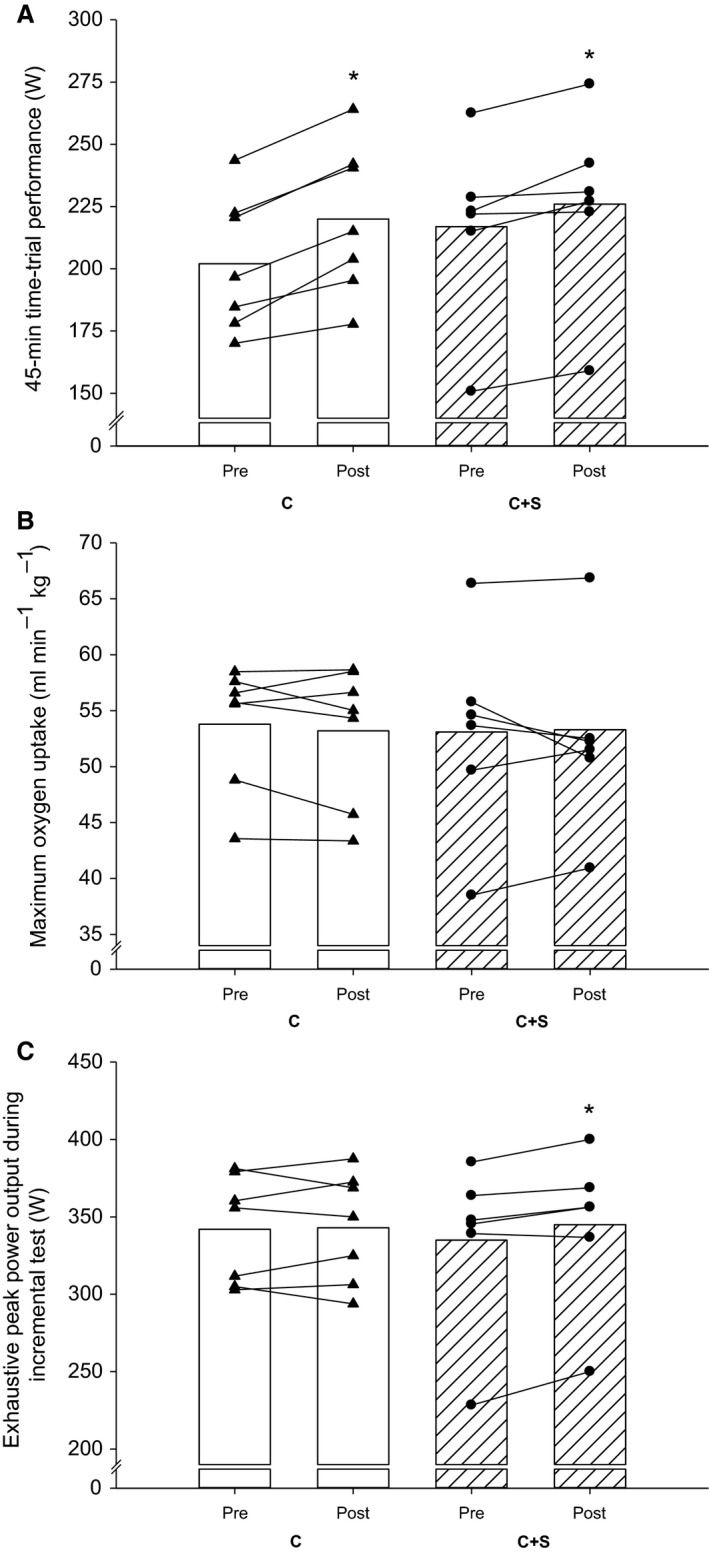
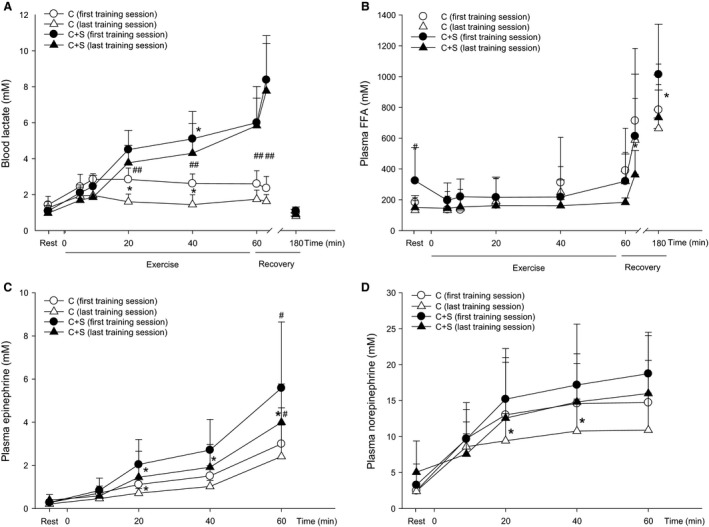
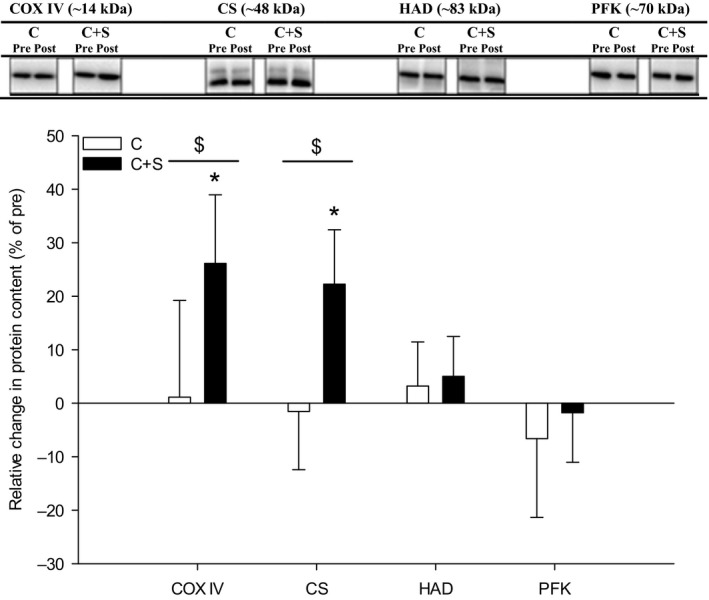
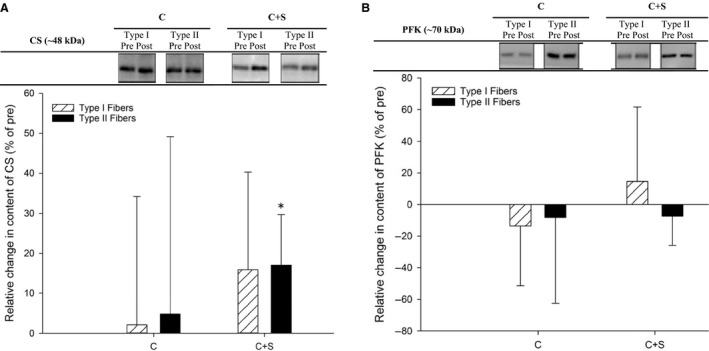
This study examined adaptations in muscle oxidative capacity and exercise performance induced by two work- and duration-matched exercise protocols eliciting different muscle metabolic perturbations in trained individuals. Thirteen male subjects ( O2 -max 53.5 ± 7.0 mL·kg-1 ·min-1 ) (means ± SD) performed 8 weeks (three sessions/week) of training consisting of 60 min of moderate intensity continuous cycling (157 ± 20 W) either without (C) or with (C+S) inclusion of 30-s sprints (473 ± 79 W) every 10 min. Total work performed during training was matched between groups. Muscle biopsies and arm venous blood were collected before as well as immediately and 2 h after exercise during the first and last training session. Plasma epinephrine and lactate concentrations after the first and last training session were 2-3-fold higher in C+S than in C. After the first and last training session, muscle phosphocreatine and pH were lower (12-25 mmol·kg d.w.-1 and 0.2-0.4 units, respectively) and muscle lactate higher (48-64 mmol·kg d.w.-1 ) in C+S than in C, whereas exercise-induced changes in muscle PGC-1α mRNA levels were similar within- and between-groups. Muscle content of cytochrome c oxidase IV and citrate synthase (CS) increased more in C+S than in C, and content of CS in type II muscle fibers increased in C+S only (9-17%), with no difference between groups. Performance during a 45-min time-trial improved by 4 ± 3 and 9 ± 3% in C+S and C, respectively, whereas peak power output at exhaustion during an incremental test increased by 3 ± 3% in C+S only, with no difference between groups. In conclusion, addition of sprints in moderate intensity continuous exercise causes muscle oxidative adaptations in trained male individuals which appear to be independent of the exercise-induced PGC-1α mRNA response. Interestingly, time-trial performance improved similarly between groups, suggesting that changes in content of mitochondrial proteins are of less importance for endurance performance in trained males.
Keywords: High-intensity interval training (HIIT); PGC-1a mRNA; human performance; metabolic stress; skeletal muscle single fibers.
© 2019 The Authors. Physiological Reports published by Wiley Periodicals, Inc. on behalf of The Physiological Society and the American Physiological Society.
Conflict of interest statement
No conflict of interests.
Figures

References
-
- Bangsbo, J. , Gunnarsson T. P., Wendell J., Nybo L., and Thomassen M.. 2009. Reduced volume and increased training intensity elevate muscle Na+‐K+ pump alpha2‐subunit expression as well as short‐ and long‐term work capacity in humans. J. Appl. Physiol. 107:1771–1780. - PubMed
-
- Bartlett, J. D. , Hwa J. C., Jeong T. S., Louhelainen J., Cochran A. J., Gibala M. J., et al. 2012. Matched work high‐intensity interval and continuous running induce similar increases in PGC‐1alpha mRNA, AMPK, p38, and p53 phosphorylation in human skeletal muscle. J. Appl. Physiol. 1985 112(1135–1143):. - PubMed
-
- Burgomaster, K. A. , Hughes S. C., Heigenhauser G. J., Bradwell S. N., and Gibala M. J.. 2005. Six sessions of sprint interval training increases muscle oxidative potential and cycle endurance capacity in humans. J. Appl. Physiol. 98:1985–1990. - PubMed
Publication types
MeSH terms
Substances
LinkOut - more resources
Full Text Sources
Medical
Miscellaneous
