


Pore Space Partition within a Metal-Organic Framework for Highly Efficient C2H2/CO2 Separation
- PMID: 30793890
- PMCID: PMC11061855
- DOI: 10.1021/jacs.9b00232
Pore Space Partition within a Metal-Organic Framework for Highly Efficient C2H2/CO2 Separation
Abstract
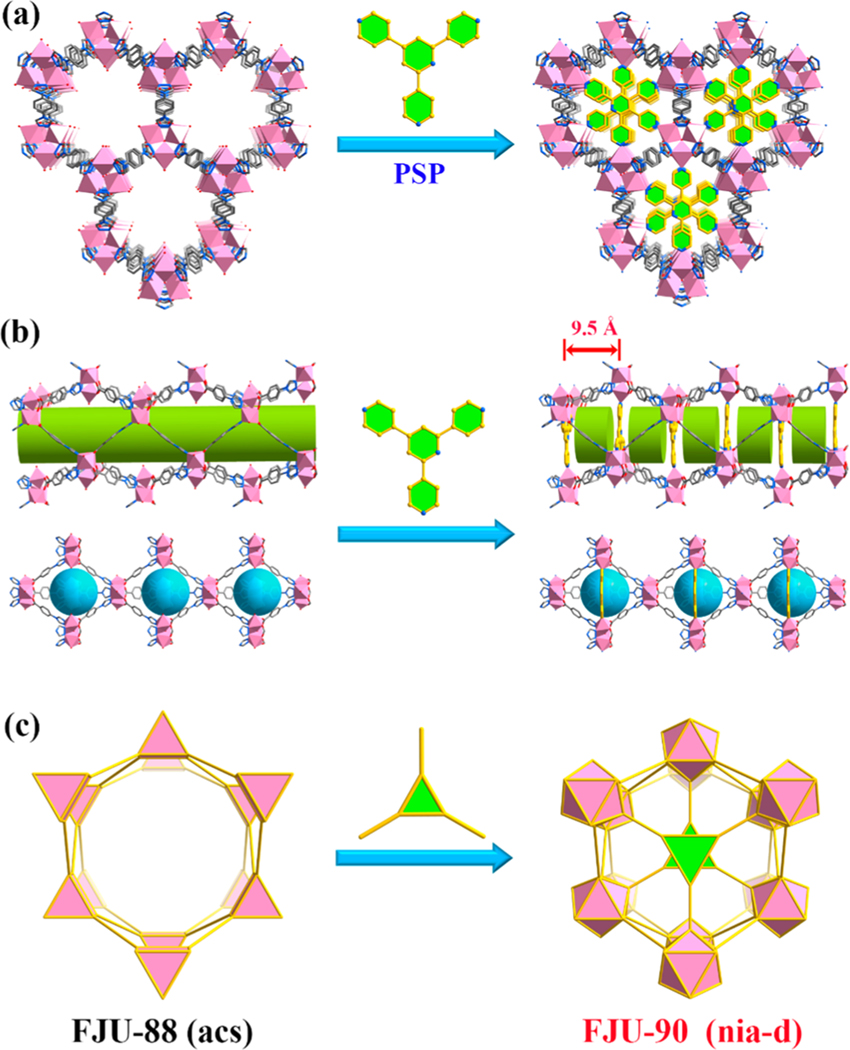
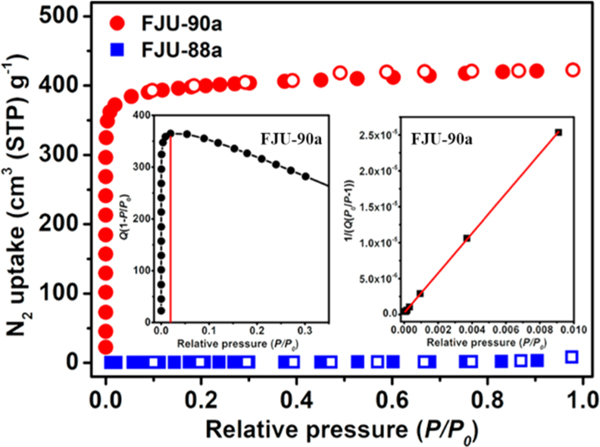
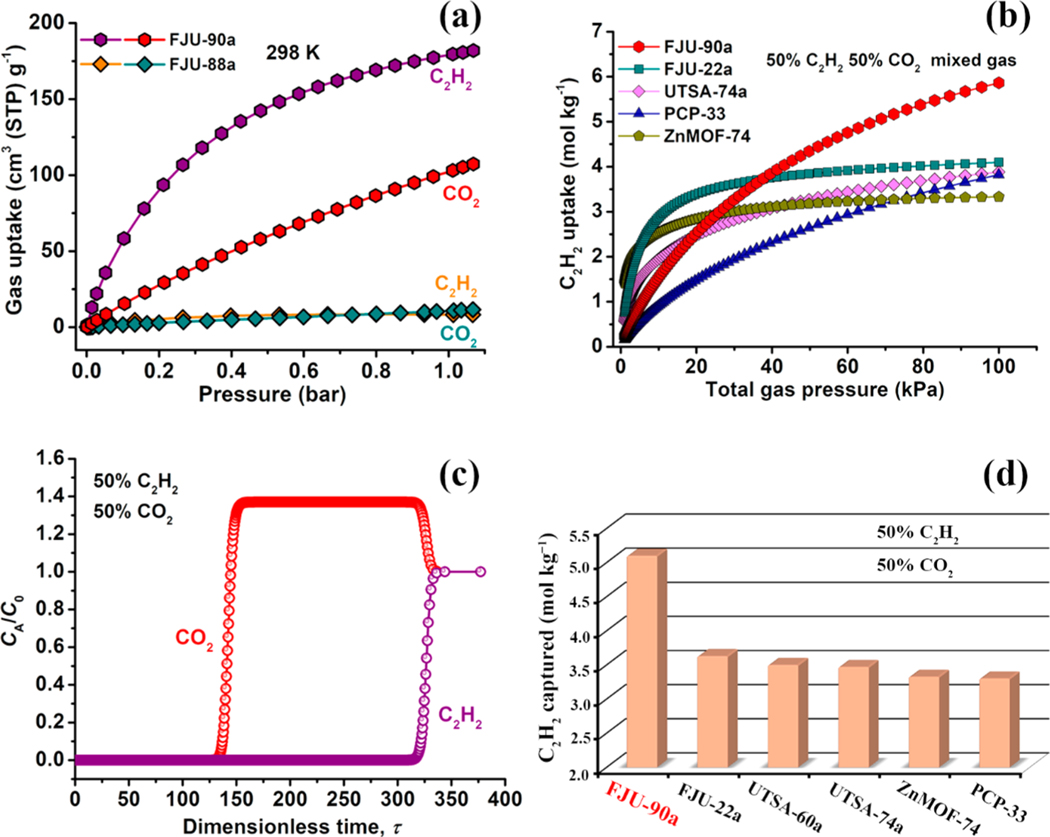
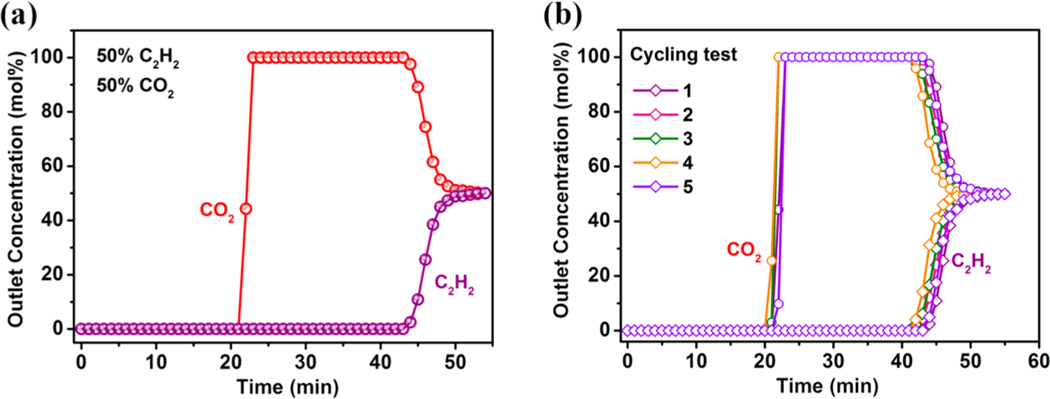
The pore space partition (PSP) approach has been employed to realize a novel porous MOF (FJU-90) with dual functionalities for the challenging C2H2/CO2 separation under ambient conditions. By virtue of a triangular ligand (Tripp = 2,4,6-tris(4-pyridyl)pyridine), the cylindrical channels in the original FJU-88 have been partitioned into uniformly interconnected pore cavities, leading to the dramatically reduced pore apertures from 12.0 × 9.4 to 5.4 × 5.1 Å2. Narrowing down the pore sizes, the resulting activated FJU-90a takes up a very large amount of C2H2 (180 cm3 g-1) but much less of CO2 (103 cm3 g-1) at 298 K and 1 bar, demonstrating it to be the best porous MOF material for this C2H2/CO2 (50%:50%) separation in terms of the C2H2 gravimetric productivity. IAST calculations, molecular modeling studies, and simulated and experimental breakthrough experiments comprehensively demonstrate that the pore space partition strategy is a very powerful approach to constructing MOFs with dual functionality for challenging gas separation.
Conflict of interest statement
The authors declare no competing financial interest.
Figures
References
-
- Furukawa H; Cordova KE; O’Keeffe M; Yaghi OM The Chemistry and Applications of Metal-Organic Frameworks. Science 2013, 341, 1230444. - PubMed
-
- Li JR; Kuppler RJ; Zhou HC Selective gas adsorption and separation in metal-organic frameworks. Chem. Soc. Rev. 2009, 38, 1477. - PubMed
-
- Bao Z; Chang G; Xing H; Krishna R; Ren Q; Chen B. Potential of microporous metal−organic frameworks for separation of hydrocarbon mixtures. Energy Environ. Sci. 2016, 9, 3612.
-
- Zhao X; Wang Y; Li D-S; Bu X; Feng P. Metal−Organic Frameworks for Separation. Adv. Mater. 2018, 30, 1705189. - PubMed
-
- Cui Y; Li B; He H; Zhou W; Chen B; Qian G. Metal−Organic Frameworks as Platforms for Functional Materials. Acc. Chem. Res. 2016, 49, 483. - PubMed
Grants and funding
LinkOut - more resources
Full Text Sources
Miscellaneous
