Portable System for Time-Domain Diffuse Correlation Spectroscopy
- PMID: 30794161
- PMCID: PMC7216142
- DOI: 10.1109/TBME.2019.2899762
Portable System for Time-Domain Diffuse Correlation Spectroscopy
Erratum in
-
Corrections to "Portable System for Time-Domain Diffuse Correlation Spectroscopy".IEEE Trans Biomed Eng. 2020 Apr;67(4):1229. doi: 10.1109/TBME.2020.2974136. IEEE Trans Biomed Eng. 2020. PMID: 32203016 No abstract available.
Abstract
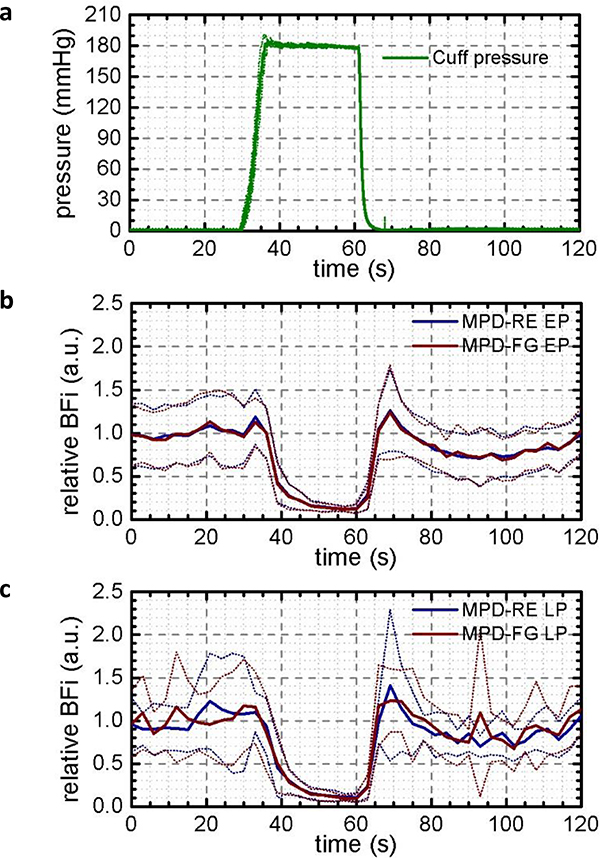
We introduce a portable system for clinical studies based on time-domain diffuse correlation spectroscopy (DCS). After evaluating different lasers and detectors, the final system is based on a pulsed laser with about 550 ps pulsewidth, a coherence length of 38 mm, and two types of single-photon avalanche diodes (SPAD). The higher efficiency of the red-enhanced SPAD maximizes detection of the collected light, increasing the signal-to-noise ratio, while the better timing response of the CMOS SPAD optimizes the selection of late photons and increases spatial resolution. We discuss component selection and performance, and we present a full characterization of the system, measurement stability, a phantom-based validation study, and preliminary in vivo results collected from the forearms and the foreheads of four healthy subjects. With this system, we are able to resolve blood flow changes 1 cm below the skin surface with improved depth sensitivity and spatial resolution with respect to continuous wave DCS.
Figures



References
-
- Dagal A and Lam AM, “Cerebral blood flow and the injured brain: how should we monitor and manipulate it?,” Current Opinion in Anaesthesiology, vol. 24, no. 2, pp. 131–137 (2011). - PubMed
-
- Yoxall CW and Weindling AM, “Measurement of cerebral oxygen consumption in the human neonate using near infrared spectroscopy: cerebral oxygen consumption increases with advancing gestational age,” Pediatric Research, vol. 44, pp. 283–290 (1998). - PubMed
-
- Grubb RL, Raichle ME, Eichling JO et al. , “The effects of changes in PaCO2 on cerebral blood volume, blood flow, and vascular mean transit time,” Stroke, vol. 5, no. 5, pp. 630–639 (1974). - PubMed
-
- Jones M, Berwick J and Mayhew J, “Changes in blood flow, oxygenation, and volume following extended stimulation of rodent barrel cortex,” Neuroimage, vol. 15, no. 3, pp. 474–487 (2002). - PubMed
Publication types
MeSH terms
Grants and funding
LinkOut - more resources
Full Text Sources
Other Literature Sources