. 2019 Feb 22;14(2):e0211705.
doi: 10.1371/journal.pone.0211705. eCollection 2019.

Little cigars and cigarillos harbor diverse bacterial communities that differ between the tobacco and the wrapper

Affiliations

Little cigars and cigarillos harbor diverse bacterial communities that differ between the tobacco and the wrapper

Suhana Chattopadhyay et al. PLoS One. .

Abstract

Despite their potential importance with regard to infectious and chronic diseases among tobacco users, microbial constituents of tobacco products lack characterization. Specifically, to our knowledge, there are no data describing the bacterial diversity of little cigars or cigarillos. To address this knowledge gap, we tested four brands of little cigars and cigarillos. Tobacco and wrapper subsamples (n = 132) were separately subjected to DNA extraction, followed by PCR amplification of the V3V4 hypervariable region of the 16S rRNA gene, and sequencing using Illumina HiSeq. Sequences were analyzed using QIIME and Phyloseq implemented in R. We identified 2,681 operational taxonomic units across all products. Significant differences in alpha and beta diversity were observed between Swisher Sweets and Cheyenne products. Alpha and beta diversity was also significantly different between tobacco and wrapper subsamples within the same product. Beta diversity analyses of only tobacco samples identified no significant differences in the bacterial microbiota of different lots of the same products; however, the microbiota in the wrapper differed significantly across lots for all brands. Overall, Firmicutes were found to dominate in the wrapper, whereas Proteobacteria were most abundant in the tobacco. At the genus level, Bacillus and Lactobacillus dominated in the wrappers, and Staphylococcus and Pseudomonas dominated in the tobacco. Our findings suggest that the bacterial microbiota of little cigars and cigarillos is diverse and differs significantly between the tobacco and the wrapper, and across brands. Future work is necessary to evaluate the potential public health implications of these findings.


Conflict of interest statement

The authors have declared that no competing interests exist.

Figures
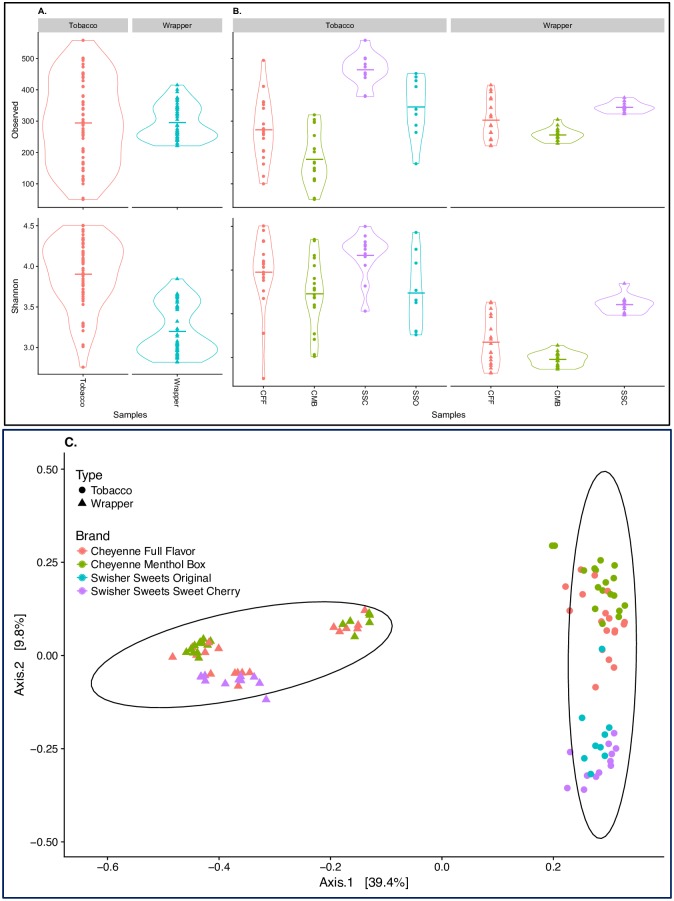
Fig 1
Fig 1. Bacterial diversity between tobacco and wrapper samples.
Violin plots showing alpha diversity (Observed number of species and Shannon Index) [A] across all samples using rarefied data to minimum sampling depth (red, tobacco; and blue; wrappers); and [B] by product (red, Cheyenne Full Flavor (CFF); green, Cheyenne Menthol Box (CMB); purple, Swisher sweets cherry (SSC); and blue, Swisher sweets original (SSO). [C] PCoA analysis plots of Bray-Curtis computed distances between tobacco products. Sample type is denoted by shapes: triangle, wrapper; and circle, tobacco. Ellipses are drawn at 95% confidence intervals for product brand.
Fig 2
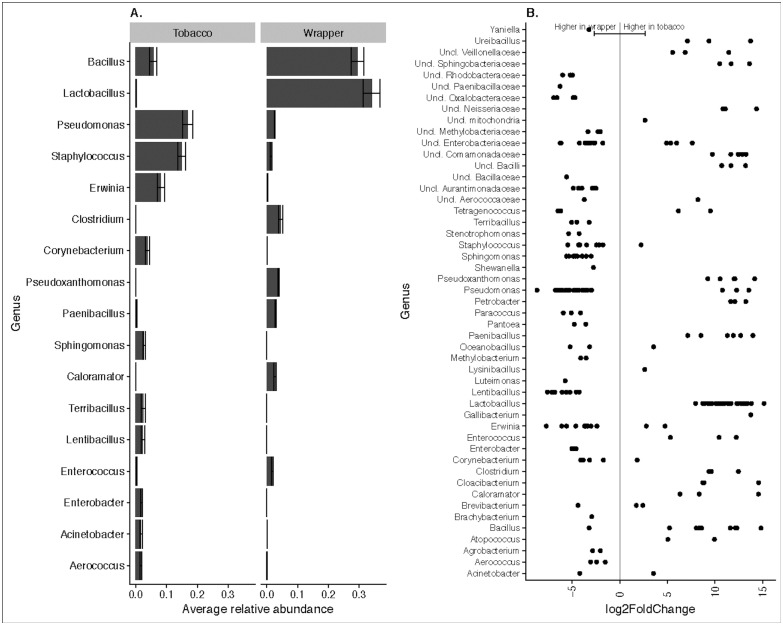
Fig 2. Overview of bacterial genera present in tobacco and wrappers.
[A] Relative abundance of top 20 bacterial genera present in tobacco and wrapper samples. [B] Differential abundances of bacterial genera that were statistically significantly different (p < 0.05) between tobacco and wrapper samples. A positive log2-fold change value denotes an OTU that is significantly higher in tobacco, while a negative log2-fold change indicates an OTU that is significantly higher in wrapper. The grey line and arrows highlight the conversion in log2-fold change from negative to positive values.
Fig 3
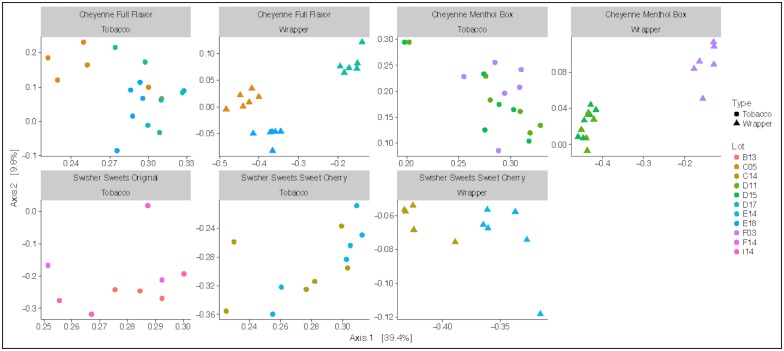
Fig 3. Microbial diversity between lots of different brands.
PCoA analysis plots of Bray- Curtis computed distances between the lots of each brand and type. Type of product is denoted by shapes: triangle- wrapper and circle- tobacco. Colors denote the different lot numbers within each brand.
Fig 4
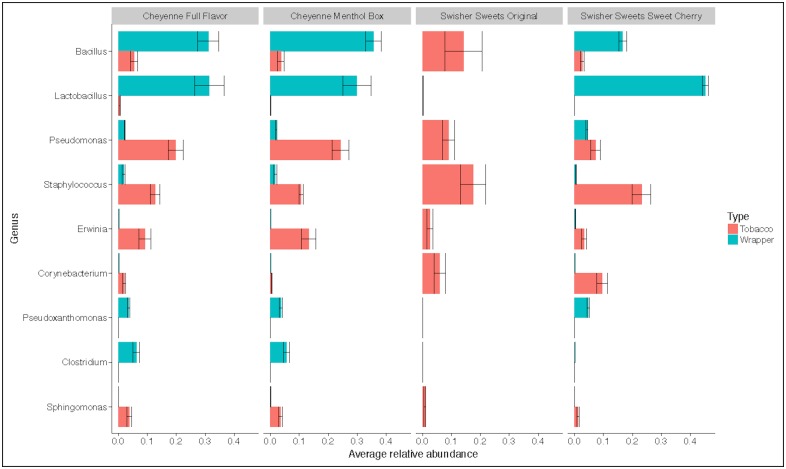
Fig 4. Box plots showing the top 10 bacterial genera that were found among all the four brands.
Colors denotes the type of products: red- tobacco and blue- wrapper.
Fig 5
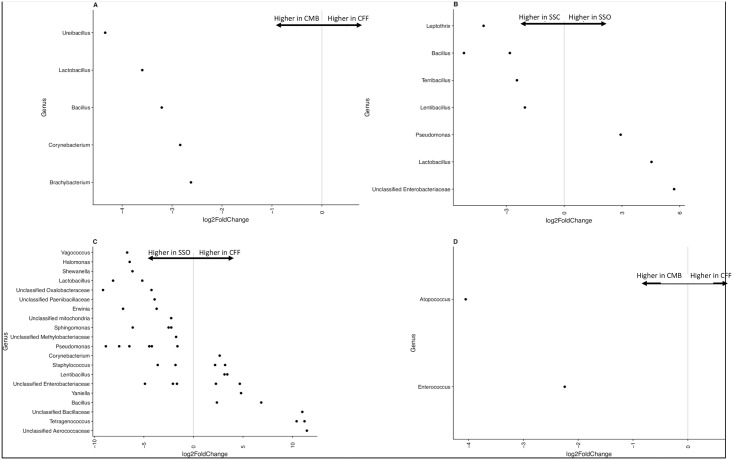
Fig 5. Differential abundance plots of bacterial genera that were statistically significantly different (p< 0.05) between the brands.
The bacterial OTUs that could not be assigned to a genus are represented as “Unclassified” and are assigned to their family level. The grey line and arrows highlight the conversion in log2-fold change from negative to positive values. [A] Comparing Cheyenne Menthol Box (CMB) to Cheyenne Full Flavor (CFF) tobacco samples. A positive log2-fold change value denotes an OTU that is significantly higher in CFF, while a negative log2-fold change indicates an OTU that is significantly higher in CMB. [B] Comparing Swisher sweets cherry (SSC) to Swisher sweets original (SSO) tobacco samples. A positive log2-fold change value denotes an OTU that is significantly higher in SSO, while a negative log2-fold change indicates an OTU that is significantly higher in SSC. [C] Comparing Swisher sweets original (SSO) to Cheyenne Full Flavor (CFF) tobacco samples. A positive log2-fold change value denotes an OTU that is significantly higher in CFF, while a negative log2-fold change indicates an OTU that is significantly higher in SSO. [D] Comparing Cheyenne Menthol Box (CMB) to Cheyenne Full Flavor (CFF) wrapper samples. A positive log2-fold change value denotes an OTU that is significantly higher in CFF, while a negative log2-fold change indicates an OTU that is significantly higher in CMB.

References

    1. O’Connor RJ. Non-cigarette tobacco products: what have we learnt and where are we headed? Tob Control. 2012. March;21(2):181–90. 10.1136/tobaccocontrol-2011-050281 - DOI - PMC - PubMed
    1. Milam AJ, Bone L, Furr-Holden D, Coylewright M, Dachille K, Owings K, et al. Mobilizing for Policy: Using Community-Based Participatory Research to Impose Minimum Packaging Requirements on Small Cigars. Prog Community Health Partnersh Res Educ Action. 2012;6(2):205–12. - PMC - PubMed
    1. Cullen J, Mowery P, Delnevo C, Allen JA, Sokol N, Byron MJ, et al. Seven-Year Patterns in US Cigar Use Epidemiology Among Young Adults Aged 18–25 Years: A Focus on Race/Ethnicity and Brand. Am J Public Health. 2011. October;101(10):1955–62. 10.2105/AJPH.2011.300209 - DOI - PMC - PubMed
    1. Delnevo CD, Hrywna M, Foulds J, Steinberg MB. Cigar use before and after a cigarette excise tax increase in New Jersey. Addict Behav. 2004. December;29(9):1799–807. 10.1016/j.addbeh.2004.04.024 - DOI - PubMed
    1. Cantrell J, Kreslake JM, Ganz O, Pearson JL, Vallone D, Anesetti-Rothermel A, et al. Marketing Little Cigars and Cigarillos: Advertising, Price, and Associations With Neighborhood Demographics. Am J Public Health. 2013. August 15;103(10):1902–9. 10.2105/AJPH.2013.301362 - DOI - PMC - PubMed

Publication types

MeSH terms

Substances