


Evaluation of soybean [Glycine max (L.) Merr.] genotypes for yield, water use efficiency, and root traits
- PMID: 30794664
- PMCID: PMC6386299
- DOI: 10.1371/journal.pone.0212700
Evaluation of soybean [Glycine max (L.) Merr.] genotypes for yield, water use efficiency, and root traits
Abstract
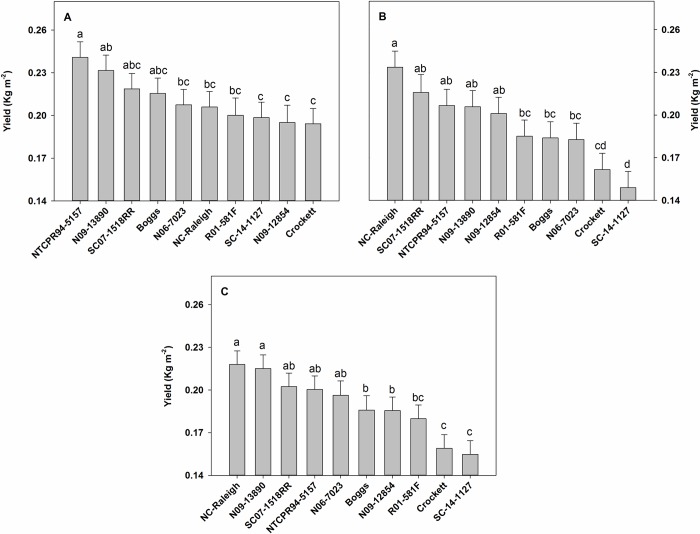
Drought stress has been identified as the major environmental factor limiting soybean [Glycine max (L.) Merr.] yield worldwide. Current breeding efforts in soybean largely focus on identifying genotypes with high seed yield and drought tolerance. Water use efficiency (WUE) that results in greater yield per unit rainfall is an important parameter in determining crop yields in many production systems, and is often related with crop drought tolerance. Even though roots are major plant organs that perceive and respond to drought stress, their utility in improving soybean yield and WUE under different environmental and management conditions are largely unclear. The objectives of this research was to evaluate soybean cultivars and breeding and germplasm lines for yield, WUE, root penetrability of hardpan, and root morphology. Field experiments were conducted at two locations in South Carolina (southeastern United States) during the 2017 cropping season to test the genotypes for yield and root morphology under irrigated and non-irrigated conditions. Two independent controlled-environmental experiments were conducted to test the genotypes for WUE and root penetrability of synthetic hardpans. The slow wilting lines NTCPR94-5157 and N09-13890 had equal or greater yield than the checks- cultivar NC-Raleigh and the elite South Carolina breeding line SC07-1518RR, under irrigated and non-irrigated conditions. The high yielding genotypes NTCPR94-5157, N09-13890, and SC07-1518RR exhibited root parsimony (reduced root development). This supported the recent hypothesis in literature that root parsimony would have adaptational advantage to improve yield under high input field conditions. The high yielding genotypes NTCPR94-5157, N09-13890, NC-Raleigh, and SC07-1518RR and a cultivar Boggs (intermediate in yield) possessed high WUE and had increased root penetrability of hardpans. These genotypes offer useful genetic materials for soybean breeding programs for improving yield, drought tolerance, and/or hardpan penetrability.
Conflict of interest statement
The authors have declared that no competing interests exist.
Figures
References
-
- FAO FAOSTAT; 2018 [cited 18 October 2018]. [Internet] Available at http://www.fao.org/faostat/en/#data/QC.
-
- SoyStats A reference guide to important soybean facts and figures. American Soybean Association. 2018 [cited 18 October 2018] [Internet] Available from: http://soystats.com/.
-
- Zipper SC, Qiu J, Kucharik CJ. Drought effects on US maize and soybean production: spatiotemporal patterns and historical changes. Environ. Res. Lett. 2016; 11: 094021
-
- Specht JE, Hume DJ, Kumudini SV. Soybean yield potential—a genetic and physiological perspective. Crop Sci. 1999; 39: 1560–1570.
Publication types
MeSH terms
Substances
LinkOut - more resources
Full Text Sources
