Review
. 2019 Feb 21;8(2):48.
doi: 10.3390/plants8020048.

S-Nitrosoglutathione Reductase-The Master Regulator of Protein S-Nitrosation in Plant NO Signaling

Affiliations
Review

S-Nitrosoglutathione Reductase-The Master Regulator of Protein S-Nitrosation in Plant NO Signaling

Jana Jahnová et al. Plants (Basel). .

Abstract

S-nitrosation has been recognized as an important mechanism of protein posttranslational regulations, based on the attachment of a nitroso group to cysteine thiols. Reversible S-nitrosation, similarly to other redox-base modifications of protein thiols, has a profound effect on protein structure and activity and is considered as a convergence of signaling pathways of reactive nitrogen and oxygen species. In plant, S-nitrosation is involved in a wide array of cellular processes during normal development and stress responses. This review summarizes current knowledge on S-nitrosoglutathione reductase (GSNOR), a key enzyme which regulates intracellular levels of S-nitrosoglutathione (GSNO) and indirectly also of protein S-nitrosothiols. GSNOR functions are mediated by its enzymatic activity, which catalyzes irreversible GSNO conversion to oxidized glutathione within the cellular catabolism of nitric oxide. GSNOR is involved in the maintenance of balanced levels of reactive nitrogen species and in the control of cellular redox state. Multiple functions of GSNOR in plant development via NO-dependent and -independent signaling mechanisms and in plant defense responses to abiotic and biotic stress conditions have been uncovered. Extensive studies of plants with down- and upregulated GSNOR, together with application of transcriptomics and proteomics approaches, seem promising for new insights into plant S-nitrosothiol metabolism and its regulation.

Keywords: S-(hydroxymethyl)glutathione; S-nitrosation; S-nitrosoglutathione reductase; S-nitrosothiols; nitric oxide.


Conflict of interest statement

The authors declare no conflict of interest.

Figures
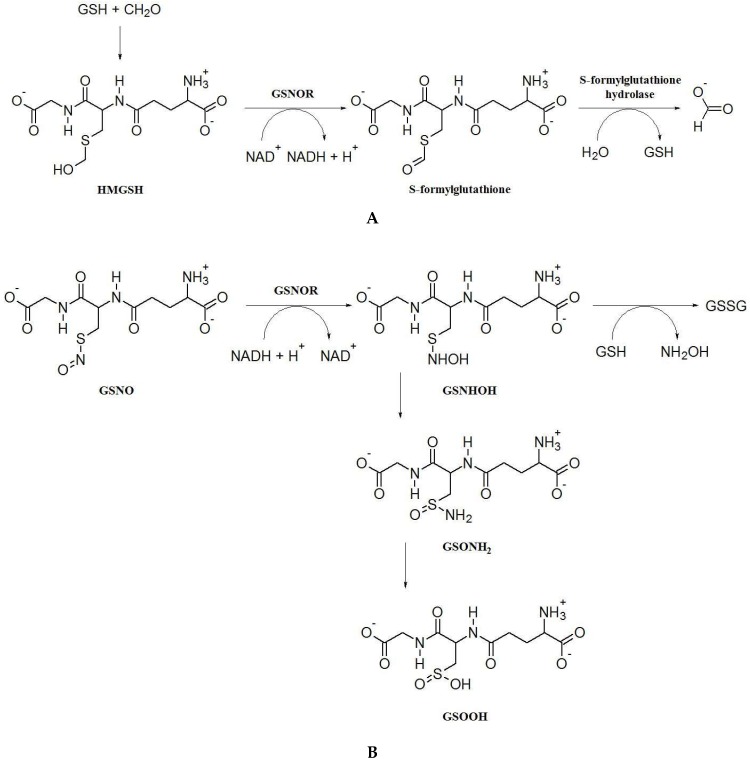
Figure 1
Figure 1
Reaction mechanisms of alcohol dehydrogenase/S-nitrosoglutathione reductase (ADH3/GSNOR) in formaldehyde and S-nitrosoglutathione catabolism. (A) In the dehydrogenase mode, GSNOR using NAD+ as a coenzyme catalyzes the oxidation of S-hydroxymethylglutathione (HMGSH), spontaneously formed from formaldehyde and glutathione to S-formylglutathione, which was further hydrolyzed to glutathione and formate by S-formylglutathione hydrolase. (B) In the reductase mode, GSNOR catalyzes the reduction of S-nitrosoglutathione (GSNO) using NADH to an unstable intermediate N-hydroxysulfinamide (GSNHOH). Depending on the local concentration of GSH, GSNHOH is either decomposed to glutathione disulfide (GSSG) and hydroxylamine at high GSH levels, or at low GSH levels spontaneously converts to glutathione sulfinamid (GSONH2), which can be hydrolyzed to glutathione sulfinic acid (GSOOH) and ammonia.
Figure 2
Figure 2
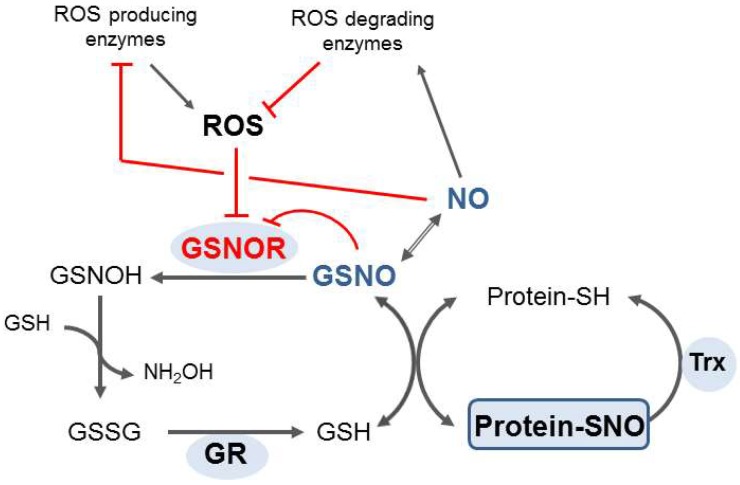
Regulatory mechanisms of GSNOR in protein denitrosation on the intersection of signaling pathways of ROSs and RNSs. Trans-nitrosation reactions of S-nitrosated proteins and reduced glutathione (GSH) can be shifted by the GSNOR activity through irreversible NADH-dependent reduction of S-nitrosoglutathione. GSH can be eventually regenerated by an NADPH-dependent reduction of GSSG catalyzed by glutathione reductase (GR). GSNOR activity can be inhibited by oxidative modification, resulting in GSNO accumulation and hence increased NO bioactivity, which can in turn regulate activities of enzymes of ROS metabolism. GSNOR activity can be also inhibited by S-nitrosation, to enable transient accumulations of its substrate GSNO and eventually to influence the cellular status of protein S-nitrosation.

References

    1. Hill B.G., Dranka B.P., Bailey S.M., Lancaster J.R., Jr., Darley-Usmar V.M. What part of NO don’t you under-stand? Some answers to the cardinal questions in nitric oxide biology. J. Biol. Chem. 2010;285:19699–19704. doi: 10.1074/jbc.R110.101618. - DOI - PMC - PubMed
    1. Groß F., Durner J., Gaupels F. Nitric oxide, antioxidants and prooxidants in plant defense responses. Front. Plant Sci. 2013;4:419. doi: 10.3389/fpls.2013.00419. - DOI - PMC - PubMed
    1. Yu M., Lamattina L., Spoel S.H., Loake G.J. Nitric oxide function in plant biology: A redox cue in deconvolution. New Phytol. 2014;202:1142–1156. doi: 10.1111/nph.12739. - DOI - PubMed
    1. Sakihama Y., Nakamura S., Yamasaki H. Nitric oxide production mediated by nitrate reductase in the green alga Chlamydomonas reinhardtii: An alternative NO production pathway in photosynthetic organisms. Plant Cell Physiol. 2002;43:290–297. doi: 10.1093/pcp/pcf034. - DOI - PubMed
    1. Mur L.A.J., Mandon J., Persijn S., Cristescu S.M., Moshkov I.E., Novikova G.V., Hall M.A., Harren F.J.M., Hebelstrup K.H., Gupta K.J. Nitric oxide in plants: An assessment of the current state of knowledge. AoB Plants. 2013;5:pls052. doi: 10.1093/aobpla/pls052. - DOI - PMC - PubMed

LinkOut - more resources