. 2019 Feb 21;24(4):784.
doi: 10.3390/molecules24040784.

Endogenous Gene Regulation as a Predicted Main Function of Type I-E CRISPR/Cas System in E. coli

Affiliations

Endogenous Gene Regulation as a Predicted Main Function of Type I-E CRISPR/Cas System in E. coli

Bojan Bozic et al. Molecules. .

Abstract

CRISPR/Cas is an adaptive bacterial immune system, whose CRISPR array can actively change in response to viral infections. However, Type I-E CRISPR/Cas in E. coli (an established model system), appears not to exhibit such active adaptation, which suggests that it might have functions other than immune response. Through computational analysis, we address the involvement of the system in non-canonical functions. To assess targets of CRISPR spacers, we align them against both E. coli genome and an exhaustive (~230) set of E. coli viruses. We systematically investigate the obtained alignments, such as hit distribution with respect to genome annotation, propensity to target mRNA, the target functional enrichment, conservation of CRISPR spacers and putative targets in related bacterial genomes. We find that CRISPR spacers have a statistically highly significant tendency to target i) host compared to phage genomes, ii) one of the two DNA strands, iii) genomic dsDNA rather than mRNA, iv) transcriptionally active regions, and v) sequences (cis-regulatory elements) with slower turn-over rate compared to CRISPR spacers (trans-factors). The results suggest that the Type I-E CRISPR/Cas system has a major role in transcription regulation of endogenous genes, with a potential to rapidly rewire these regulatory interactions, with targets being selected through naïve adaptation.

Keywords: CRISPR adaptation; CRISPR/Cas; bioinformatics; non-canonical CRISPR functions; transcription regulation.


Conflict of interest statement

The authors declare no conflict of interest.

Figures
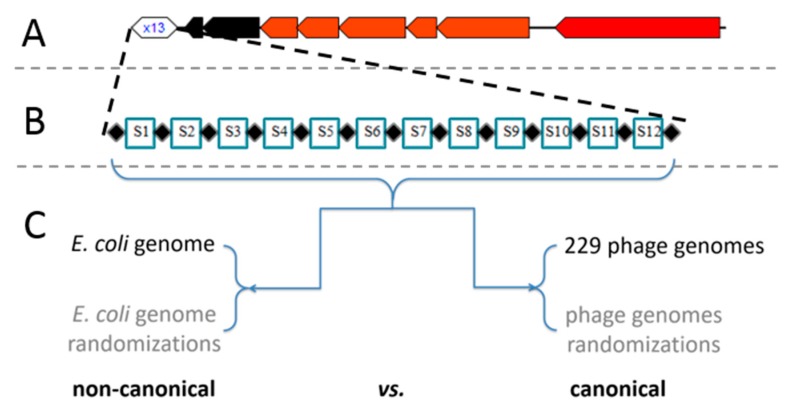
Figure 1
Figure 1
(A) Overall organization of the analyzed CRISPR/Cas locus generated by [42]. (B) Schematic organization of repeats and spacers within the CRISPR array. (C) Scheme of in silico analysis of canonical vs. non-canonical activity.
Figure 2
Figure 2
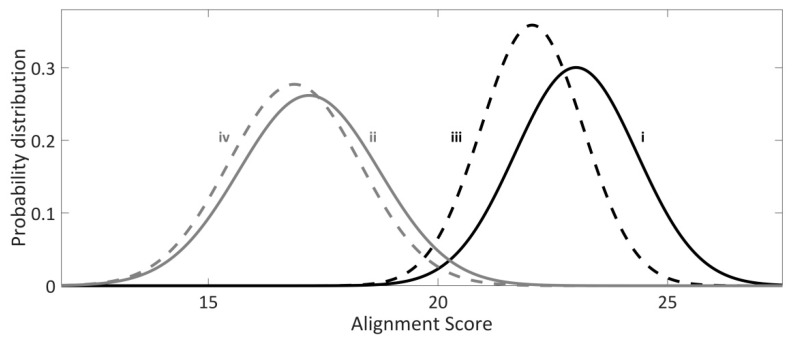
Normalized probability distributions of alignment scores for (i) E. coli genome—black solid curve, (ii) the genomes of all sequenced E. coli infecting bacteriophages—gray solid curve, (iii) randomized E. coli genome background—dashed black curve, (iv) randomized bacteriophage genome background—dashed grey curve.
Figure 3
Figure 3
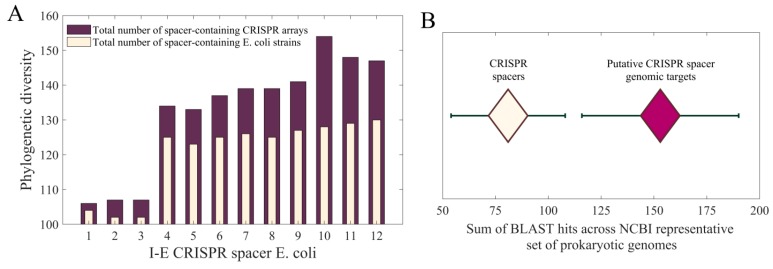
(A) Phylogenetic distribution of I-E E. coli CRISPR spacers throughout the domain of bacteria vs. E. coli species; (B) Phylogenetic distribution of I-E E. coli CRISPR spacers and their putative genomic targets across the NCBI representative set of prokaryotic genomes. For CRISPR array, the sum of hits obtained for all 12 spacers (with three standard deviations) is shown (white diamond). For CRISPR spacer genomic targets (19 targets per spacer), the mean number of hits, summed over 12 spacers, with three standard deviations, is shown (purple diamond).
Figure 4
Figure 4
(A) SAC values associated with hits located in coding and (B) intergenic regions of E. coli vs. randomized E. coli background; (C) SAC values associated with hits located in divergent, (D) convergent and (E) upstream intergenic regions, preceded by schematic representation of the intergenic region classification; On each plot, SAC values are shown as a function of the growing number of hits per spacer, with confidence bound estimates provided for the SAC values associated with randomized background.
Figure 5
Figure 5
(A) Schematic representation of the functional classification of hits associated with coding regions, based on the DNA strand that is being targeted, and (B) the interference RnpC; (C) The plot showing the difference between SAC values associated with targets classified as RNA− and RNA+ category.
Figure 6
Figure 6
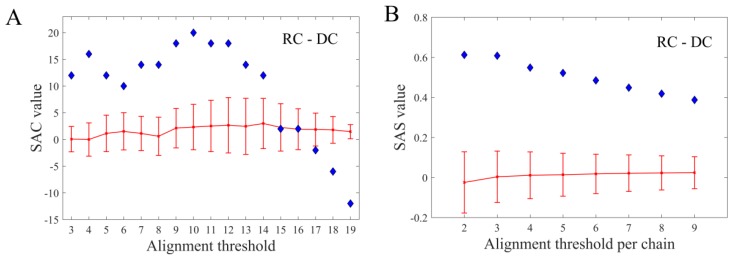
(A) The plot showing the difference between SAC and (B) SAS values associated with hits on the reverse and direct DNA strand of the E. coli genome shown as a function of the increasing number of hits per chain.
Figure 7
Figure 7
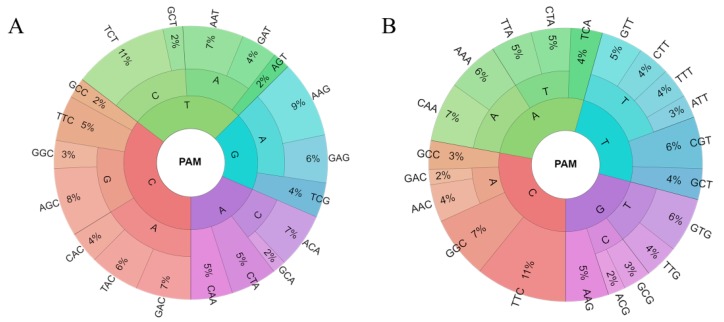
(A) The PAM-wheel of 3nt-long statistically overrepresented motifs flanking the theoretical and (B) the actual start of the alignment on the targeted strand, in the 3′–5′ direction. The percentages are shown as a function of the associated Z scores [(actual motif counts—sum of all overrepresented motif counts)/sum of all overrepresented motif counts)].

References

    1. Kirchner M., Schneider S. CRISPR-Cas: From the Bacterial Adaptive Immune System to a Versatile Tool for Genome Engineering. Angew. Chem. Int. Ed. 2015;54:13508–13514. doi: 10.1002/anie.201504741. - DOI - PubMed
    1. Barrangou R., Marraffini L.A. CRISPR-Cas systems: Prokaryotes upgrade to adaptive immunity. Mol. Cell. 2014;54:234–244. doi: 10.1016/j.molcel.2014.03.011. - DOI - PMC - PubMed
    1. Caplan A.L., Parent B., Shen M., Plunkett C. No time to waste—the ethical challenges created by CRISPR: CRISPR/Cas, being an efficient, simple, and cheap technology to edit the genome of any organism, raises many ethical and regulatory issues beyond the use to manipulate human germ line cells. EMBO Rep. 2015;16:1421–1426. doi: 10.15252/embr.201541337. - DOI - PMC - PubMed
    1. Vora S., Tuttle M., Cheng J., Church G. Next stop for the CRISPR revolution: RNA-guided epigenetic regulators. FEBS J. 2016;283:3181–3193. doi: 10.1111/febs.13768. - DOI - PubMed
    1. Cano-Rodriguez D., Rots M.G. Epigenetic editing: On the verge of reprogramming gene expression at will. Curr. Genet. Med. Rep. 2016;4:170–179. doi: 10.1007/s40142-016-0104-3. - DOI - PMC - PubMed

MeSH terms

LinkOut - more resources