


Attentional avoidance in peer victimized individuals with and without psychiatric disorders
- PMID: 30795803
- PMCID: PMC6387543
- DOI: 10.1186/s40359-019-0284-1
Attentional avoidance in peer victimized individuals with and without psychiatric disorders
Abstract
Background: Attentional biases are a relatively robust phenomenon among clinical populations but less pronounced in healthy participants. However, regarding the components of attentional biases and the directions of attention allocation, there are several inconsistencies in the literature. The present study examined whether these inconsistencies can be traced back to previous experiences of relational peer victimization in clinical populations.
Methods: Participants were subjects with a diagnosed psychiatric disorder (n = 30) and healthy controls (n = 31). Additionally, the sample was divided into two subgroups according to the participants' reports of previous relational peer victimization (high peer victimization: n = 28; low peer victimization: n = 33). Attentional biases were measured by the Emotional Stroop task and a dot-probe task.
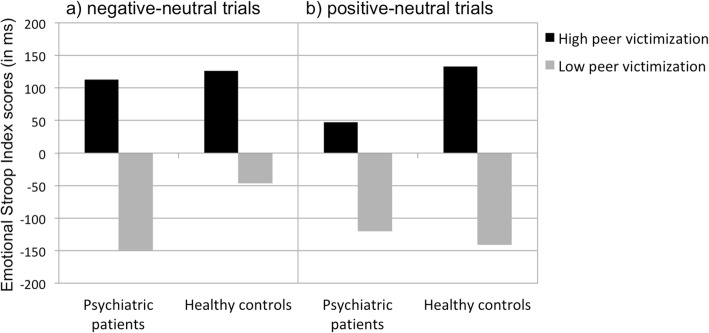
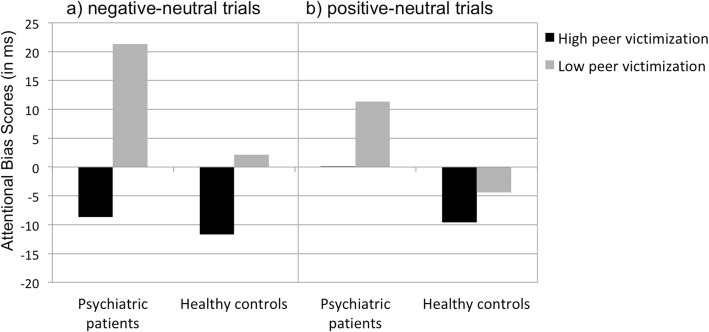
Results: In both samples, peer victimized participants showed delayed response times when color-naming negative and positive compared to neutral adjectives in the Emotional Stroop task. Likewise, the dot-probe task indicated attentional avoidance of both negative and positive words in peer victimized participants with and without a psychiatric disorder. Interestingly, presence of a psychiatric disorder did not have a significant effect on attentional biases.
Conclusion: Both tasks could detect that attentional processes were linked to the experience of peer victimization rather than to the current diagnostic status of the participants. Attentional avoidance of emotional stimuli may prevent victimized individuals from responding adequately to environmental stimuli, which may increase the risk for the development of psychopathology.
Keywords: Attention; Attentional avoidance; Attentional bias; Child maltreatment; Peer victimization.
Conflict of interest statement
Ethics approval and consent to participate
The study was performed in accordance with the declaration of Helsinki and approved by the Ethics Committee of Bielefeld University. All participants signed an informed consent form.
Consent for publication
Not applicable.
Competing interests
The authors declare that they have no competing interests.
Publisher’s Note
Springer Nature remains neutral with regard to jurisdictional claims in published maps and institutional affiliations.
Figures
References
-
- Bar-Haim Y, Lamy D, Pergamin L, Bakermans-Kranenburg MJ, van IJzendoorn MH. Threat-related attentional bias in anxious and nonanxious individuals: a meta-analytic study. Psychol Bull. 2007;133:1–24. - PubMed
-
- Mogg K, Bradley BP. A cognitive-motivational analysis of anxiety. Behav Res Ther. 1998;36(9):809–848. - PubMed
-
- Williams JM, Mathews A, MacLeod C. The emotional Stroop task and psychopathology. Psychol Bull. 1996;120:3–24. - PubMed
MeSH terms
LinkOut - more resources
Full Text Sources
Medical
