


Exploring the relationship between the big five personality characteristics and dietary habits among students in a Ghanaian University
- PMID: 30795819
- PMCID: PMC6387496
- DOI: 10.1186/s40359-019-0286-z
Exploring the relationship between the big five personality characteristics and dietary habits among students in a Ghanaian University
Abstract
Background: Adherence to good dietary practices has been linked to disease prevention and better quality of life yet, University students are known to have poor dietary intake and diet quality. For an effective behaviour modification in dietary habits, an understanding of the association between an individual's personality traits and dietary habits are of much significance. The aim of this study was to determine the relationship between personality traits and dietary habits among University students in Ghana.
Methods: A cross-sectional design involving 400 students was employed. Information on socio-demographic characteristics and Body Mass Index were obtained. The big 5 Personality traits (extraversion, conscientiousness, agreeableness, openness and neuroticism) was assessed using a 50-item International Personality Item Pool (IPIP) by Goldberg. The three factor eating questionnaire (TFEQ) was used to obtain further information on dietary habits.
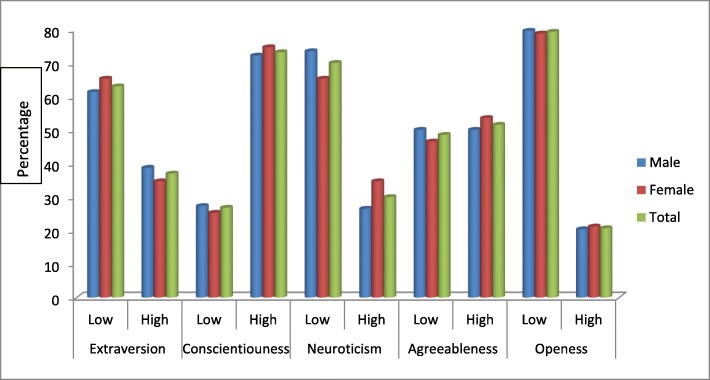
Results: The majority of the students had high scores for conscientiousness. Except for neuroticism, all the personality traits had a significant association with at least one of the dietary habits explored. Extraversion was positively associated with neophagia (p = 0.028) and food interest (p = 0.008), conscientiousness was associated with variety (p = 0.045) and sugar moderation (p = 0.006), agreeableness was associated with neophagia (p = 0.005), skipping of meals (p = 0.007) and variety (p = 0.005) and openness associated with food interest (p = 0.009).
Conclusion: Personality traits showed associations with certain dietary habits but further studies are required to identify persons who are at risk of diet related diseases to inform the development of appropriate interventions.
Keywords: Agreeableness and openness; Conscientiousness; Dietary; Extraversion; Ghana; Neuroticism; Students.
Conflict of interest statement
Ethics approval and consent to participate
Ethical approval was obtained from the Protocol and Ethics Review committee of the School of Biomedical and Allied Health Sciences, University of Ghana. The reference number is SBAHS-ET./10,443,580/AA/6A/2012–2013. Written informed consent was sought from all participating students.
Consent for publication
Not applicable.
Competing interests
Authors declare no competing interests.
Publisher’s Note
Springer Nature remains neutral with regard to jurisdictional claims in published maps and institutional affiliations.
References
-
- MacNicol SA, Murray SM, Austin EJ. Relationships between personality, attitudes and dietary behaviour in a group of Scottish adolescents. Personal Individ Differ. 2003;35(8):1753–1764. doi: 10.1016/S0191-8869(02)00404-X. - DOI
MeSH terms
LinkOut - more resources
Full Text Sources
