


Vitamin D supplementation and total cancer incidence and mortality: a meta-analysis of randomized controlled trials
- PMID: 30796437
- PMCID: PMC6821324
- DOI: 10.1093/annonc/mdz059
Vitamin D supplementation and total cancer incidence and mortality: a meta-analysis of randomized controlled trials
Abstract
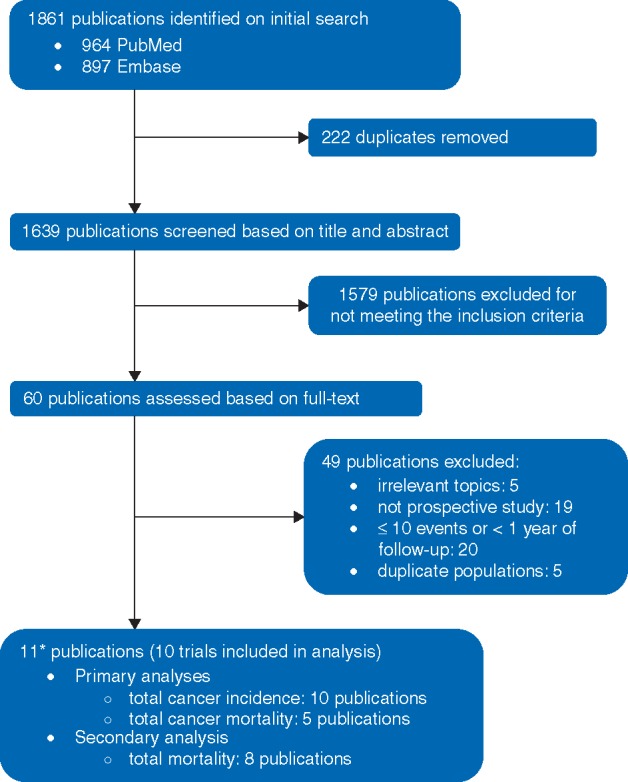
Background: Previous meta-analyses of randomized controlled trials (RCTs) of vitamin D supplementation and total cancer incidence and mortality found inconsistent results, and most included trials administered generally low doses of vitamin D (≤1100 IU/day). We updated the meta-analysis by incorporating recent RCTs that have tested higher doses of vitamin D supplements.
Materials and methods: PubMed and Embase were searched from the inception to November 2018. Summary relative risks (RRs) and 95% confidence intervals (CIs) were estimated using a random-effects model.
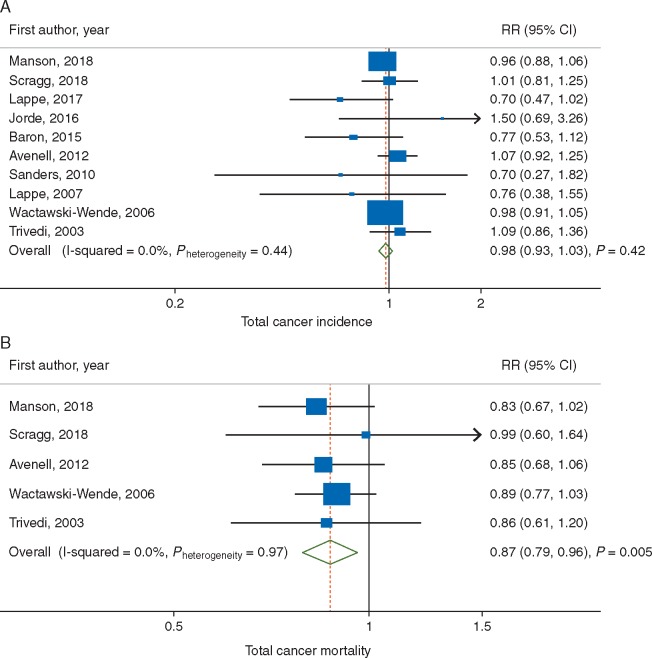
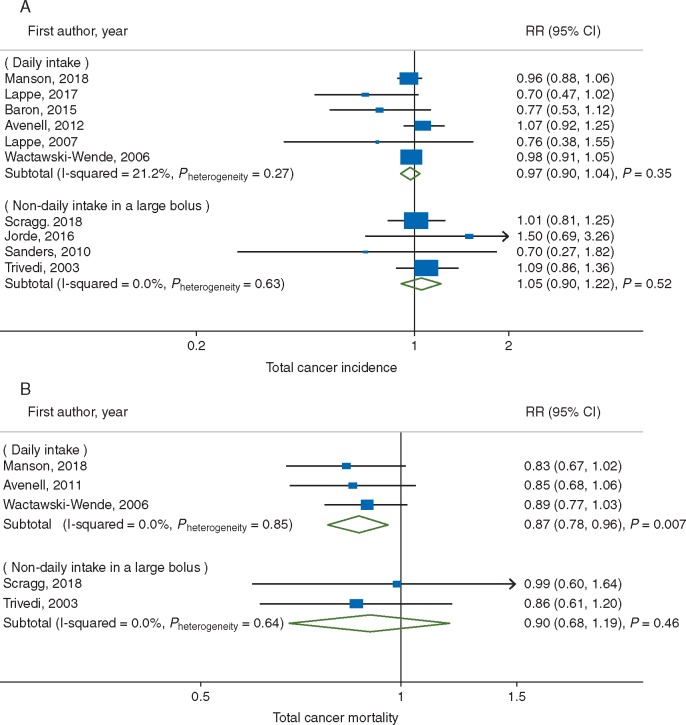
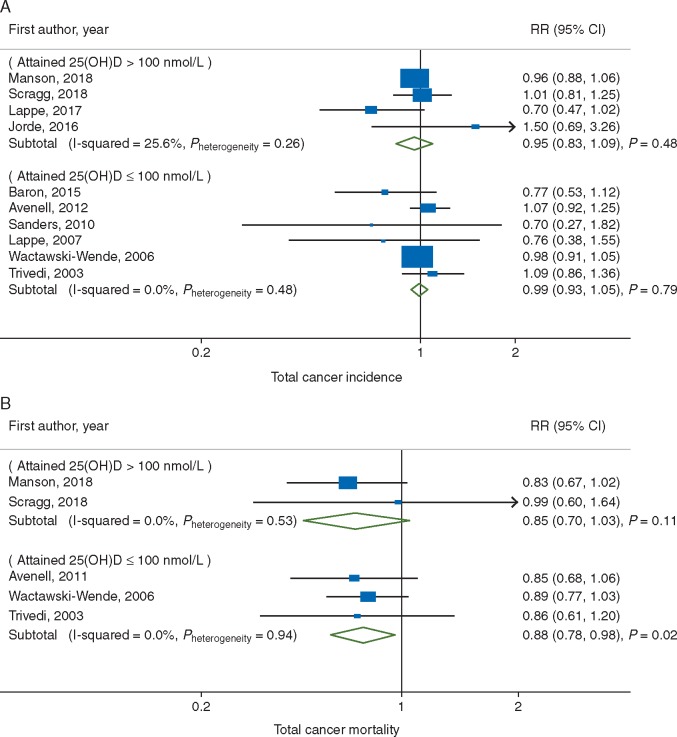
Results: For total cancer incidence, 10 trials were included [6537 cases; 3-10 years of follow-up; 54-135 nmol/l of attained levels of circulating 25(OH) vitamin D [25(OH)D] in the intervention group]. The summary RR was 0.98 (95% CI, 0.93-1.03; P = 0.42; I2 = 0%). The results remained null across subgroups tested, including even when attained 25(OH)D levels exceeded 100 nmol/l (RR, 0.95; 95% CI, 0.83-1.09; P = 0.48; I2 = 26%). For total cancer mortality, five trials were included [1591 deaths; 3-10 years of follow-up; 54-135 nmol/l of attained levels of circulating 25(OH)D in the intervention group]. The summary RR was 0.87 (95% CI, 0.79-0.96; P = 0.005; I2 = 0%), which was largely attributable to interventions with daily dosing (as opposed to infrequent bolus dosing). No statistically significant heterogeneity was observed by attained levels of circulating 25(OH)D (Pheterogeneity = 0.83), with RR being 0.88 (95% CI, 0.78-0.98; P = 0.02; I2 = 0%) for ≤100 nmol/l and 0.85 (95% CI, 0.70-1.03; P = 0.11; I2 = 0%) for >100 nmol/l.
Conclusions: In an updated meta-analysis of RCTs, vitamin D supplementation significantly reduced total cancer mortality but did not reduce total cancer incidence.
Keywords: cancer incidence; cancer mortality; circulating 25(OH)D; meta-analysis; randomized controlled trial; vitamin D supplements.
© The Author(s) 2019. Published by Oxford University Press on behalf of the European Society for Medical Oncology. All rights reserved. For permissions, please email: journals.permissions@oup.com.
Figures
Comment in
-
Vitamin D: should public health recommendations also consider cancer outcomes?Ann Oncol. 2019 May 1;30(5):667-668. doi: 10.1093/annonc/mdz089. Ann Oncol. 2019. PMID: 30887014 No abstract available.
References
-
- Garland CF, Comstock GW, Garland FC. et al. Serum 25-hydroxyvitamin D and colon cancer: eight-year prospective study. Lancet 1989; 2(8673): 1176–1178. - PubMed
-
- Feldman D, Krishnan AV, Swami S. et al. The role of vitamin D in reducing cancer risk and progression. Nat Rev Cancer 2014; 14(5): 342–357. - PubMed
-
- Gandini S, Boniol M, Haukka J. et al. Meta-analysis of observational studies of serum 25-hydroxyvitamin D levels and colorectal, breast and prostate cancer and colorectal adenoma. Int J Cancer 2011; 128(6): 1414–1424. - PubMed
