


Functional Improvements Utilizing the Short Physical Performance Battery (SPPB) in the Elderly after Epidural Steroid Injections
- PMID: 30796532
- PMCID: PMC6766078
- DOI: 10.1007/s11916-019-0748-2
Functional Improvements Utilizing the Short Physical Performance Battery (SPPB) in the Elderly after Epidural Steroid Injections
Abstract
Purpose of review: The treatment of debilitating pain and loss of function secondary to lumbar stenosis is in high demand with the aging patient population. Options, including epidural steroid injections (ESIs) and medication therapy, are limited and it is unclear if they provide any functional improvements. In this prospective study, we evaluate functional outcomes in older adults with symptomatic lumbar stenosis treated with ESIs compared to those managed with medications by introducing the Short Physical Performance Battery (SPPB). Our study was IRB-approved and included 16 patients, 68 to 83 years old, with symptomatic back and radicular leg pain secondary to lumbar stenosis. Patients could elect to undergo a lumbar ESI (n = 11) or be treated via medication management (n = 5). Numeric pain score, SPPB score, and adverse events were measured and compared at baseline and a 1-month follow-up visit.
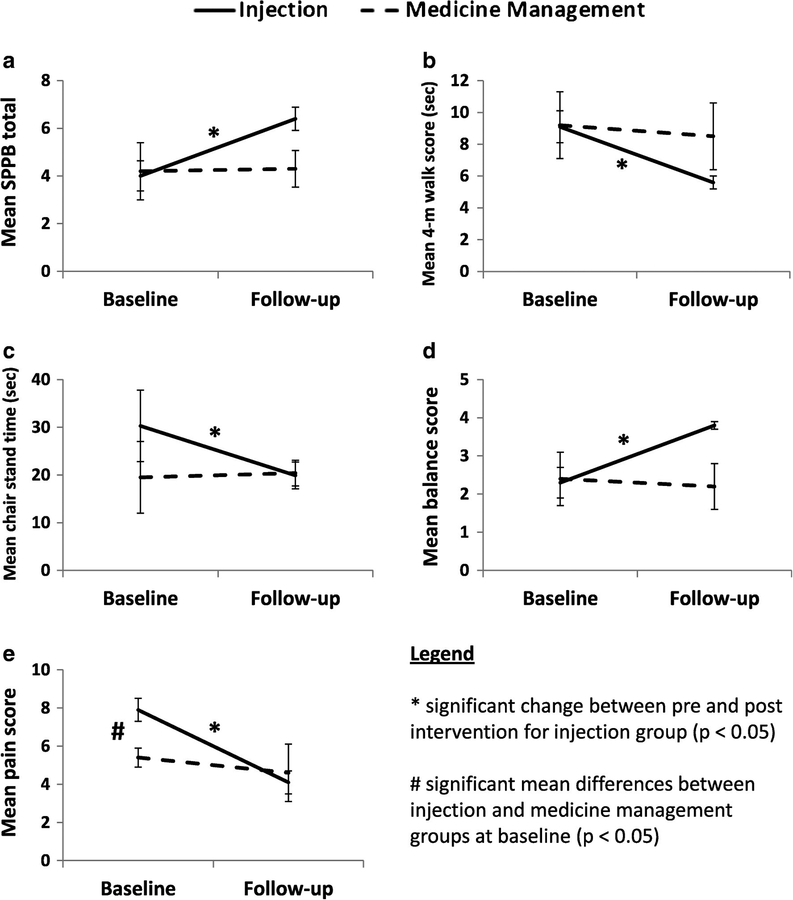
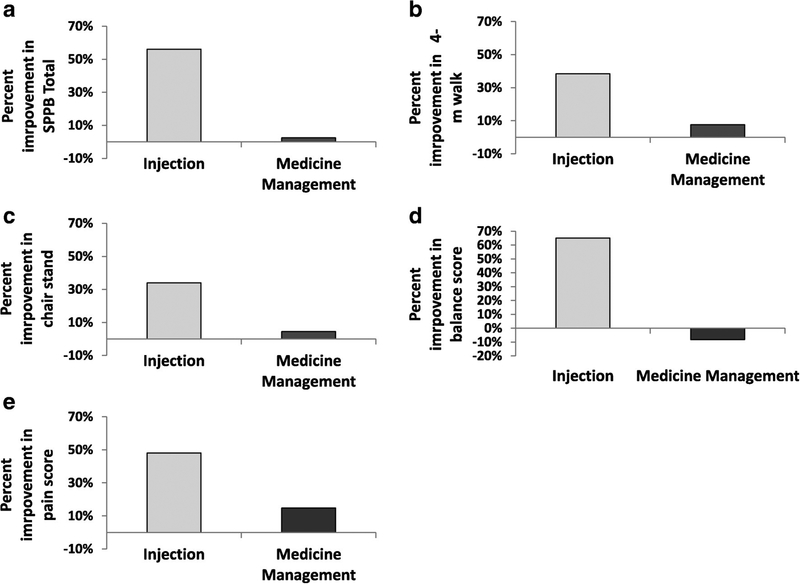
Recent findings: Statistically significant improvements were observed from baseline compared to the 1-month follow-up for total SPPB score in the injection group. Similar improvements in the injection group were observed for pain scores and the SPPB subcomponents such as the 4-m walk test, chair stand time, and balance score. Comparatively, no statistically significant improvements were observed in the medication group. Lumbar ESIs improved objective physical capacity parameters and pain scores in elderly patients with symptomatic lumbar stenosis compared to medication management. In addition, the SPPB is an easy-to-use tool to measure changes in physical function in older adults and could easily be integrated into an outpatient pain clinic.
Keywords: Elderly; Epidural steroid injections; Lumbar stenosis and radicular pain; Short physical performance battery (SPPB).
Conflict of interest statement
Conflict of interest: Each author certifies that he or she, or a member of his or her immediate family, has no commercial association (i.e., consultancies, stock ownership, equity interest, patent/licensing arrangements, etc.) that might pose a conflict of interest in connection with the submitted manuscript.
Figures
References
-
- Kovacs FM, Urrútia G, Alarcón JD. Surgery versus conservative treatment for symptomatic lumbar spinal stenosis: A systematic review of randomized controlled trials. Spine. 2011; 36:E1335–1351. - PubMed
-
- Issack PS, Cunningham ME, Pumberger M, Hughes AP, Cammisa FP. Degenerative lumbar spinal stenosis: Evaluation and management. J Am Acad Orthop Surg. 2012;20:527–535. - PubMed
-
- Borenstein D. Mechanical low back pain: a rheumatologist’s view. Nat Rev Rheumatol. 2013;9:643–653. - PubMed
-
- Kreiner SD, Shaffer WO, Baisden JL, Gilbert TJ, Summers JT, Toton JF, Hwang SW, Mendel RC, Reitman CA; North American Spine Society. An evidence-based clinical guideline for the diagnosis and treatment of degenerative lumbar spinal stenosis (update). Spine J. 2013;13:734–743. - PubMed
Publication types
MeSH terms
Substances
Grants and funding
LinkOut - more resources
Full Text Sources
Medical
Research Materials
