. 2019 Nov:165:107000.
doi: 10.1016/j.nlm.2019.02.010. Epub 2019 Feb 20.

Home-cage hypoactivity in mouse genetic models of autism spectrum disorder

Affiliations

Home-cage hypoactivity in mouse genetic models of autism spectrum disorder

Christopher C Angelakos et al. Neurobiol Learn Mem. 2019 Nov.

Abstract

Genome-wide association and whole exome sequencing studies from Autism Spectrum Disorder (ASD) patient populations have implicated numerous risk factor genes whose mutation or deletion results in significantly increased incidence of ASD. Behavioral studies of monogenic mutant mouse models of ASD-associated genes have been useful for identifying aberrant neural circuitry. However, behavioral results often differ from lab to lab, and studies incorporating both males and females are often not performed despite the significant sex-bias of ASD. In this study, we sought to investigate the simple, passive behavior of home-cage activity monitoring across multiple 24-h days in four different monogenic mouse models of ASD: Shank3b-/-, Cntnap2-/-, Pcdh10+/-, and Fmr1 knockout mice. Relative to sex-matched wildtype (WT) littermates, we discovered significant home-cage hypoactivity, particularly in the dark (active) phase of the light/dark cycle, in male mice of all four ASD-associated transgenic models. For Cntnap2-/- and Pcdh10+/- mice, these activity alterations were sex-specific, as female mice did not exhibit home-cage activity differences relative to sex-matched WT controls. These home-cage hypoactivity alterations differ from activity findings previously reported using short-term activity measurements in a novel open field. Despite circadian problems reported in human ASD patients, none of the mouse models studied had alterations in free-running circadian period. Together, these findings highlight a shared phenotype across several monogenic mouse models of ASD, outline the importance of methodology on behavioral interpretation, and in some genetic lines parallel the male-enhanced phenotypic presentation observed in human ASDs.

Keywords: Autism; Circadian rhythms; Home-cage activity; Hypoactivity; Mouse models; Sex differences.


Conflict of interest statement

Conflicts of interest

The authors declare no competing financial interests.

Figures
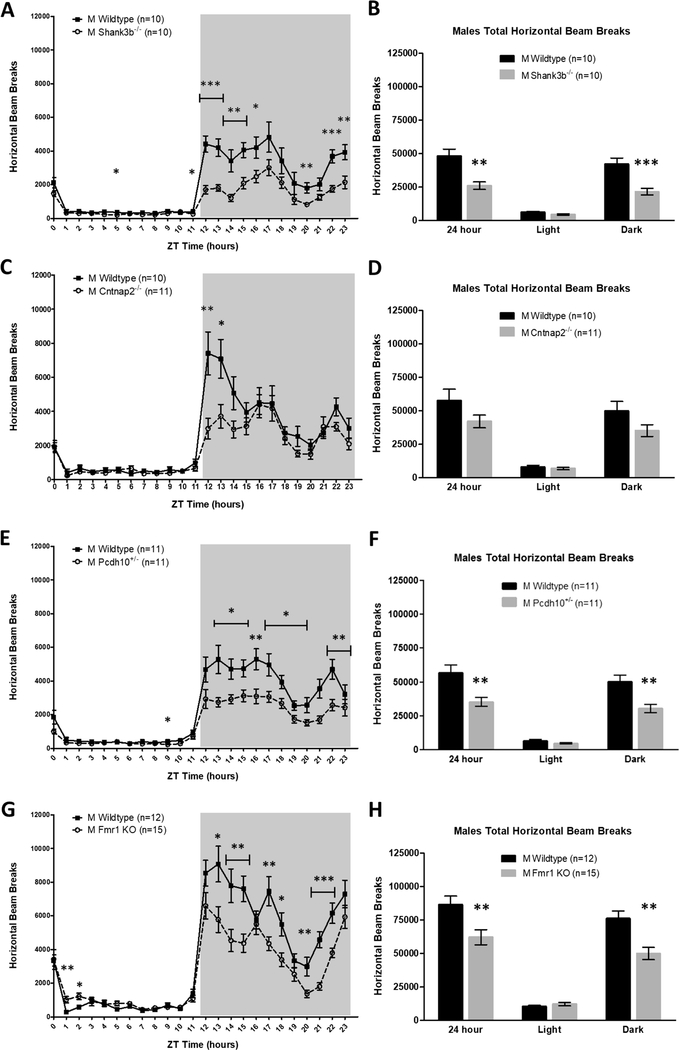
Fig. 1.
Fig. 1.
Male Shank3b−/−, Cntnap2−/−, Pcdh10+/−, and Fmr1 KO mice are hypoactive in the home-cage relative to sex-matched WT controls. (A,B) Shank3b−/− males exhibit significantly reduced horizontal activity compared to WT littermates. Expressed in 1-h bins (A) and by light/dark cycle (B). (C,D) Cntnap2−/− males have decreased horizontal activity compared to WT controls. Expressed in 1-h bins (C) and by light/dark cycle (D). (E,F) Pcdh10+/− males display significantly less horizontal activity than WT littermates. Expressed in 1-h bins (E) and by light/dark cycle (F). (G,H) Fmr1 KO males demonstrate significantly lower horizontal activity than WT controls. Expressed in 1-h bins (G) and by light/dark cycle (H). Mean ± standard error of the mean (s.e.m.) *p < 0.05, **p < 0.01, ***p < 0.001.
Fig. 2.
Fig. 2.
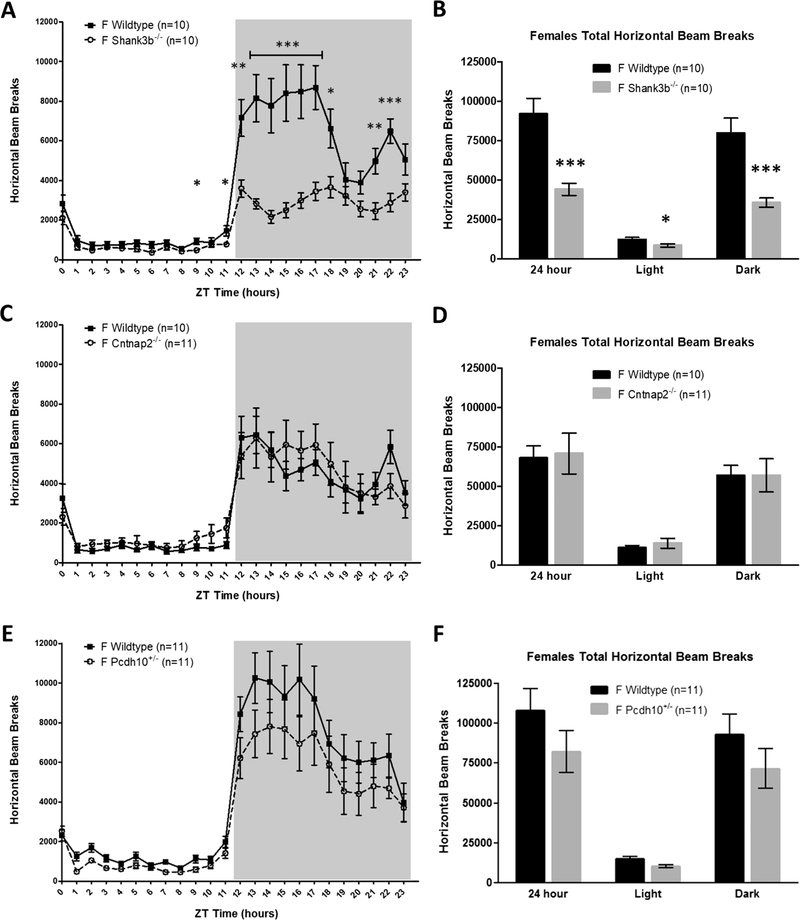
Female Shank3b−/− mice are hypoactive, but female Cntnap2+/− and Pcdh10+/− display no home-cage activity differences, relative to sex-matched WT controls. (A,B) Shank3b−/− females exhibit significantly reduced horizontal activity compared to WT littermates. Expressed in 1-h bins (A) and by light/dark cycle (B). (C,D) Cntnap2−/− females have no differences in horizontal activity compared to WT controls. Expressed in 1-h bins (C) and by light/dark cycle (D). (E,F) Pcdh10+/− females display no differences in horizontal activity in comparison to WT littermates. Expressed in 1-h bins (E) and by light/dark cycle (F). Mean ± standard error of the mean (s.e.m.) *p < 0.05, **p < 0.01, ***p < 0.001.
Fig. 3.
Fig. 3.
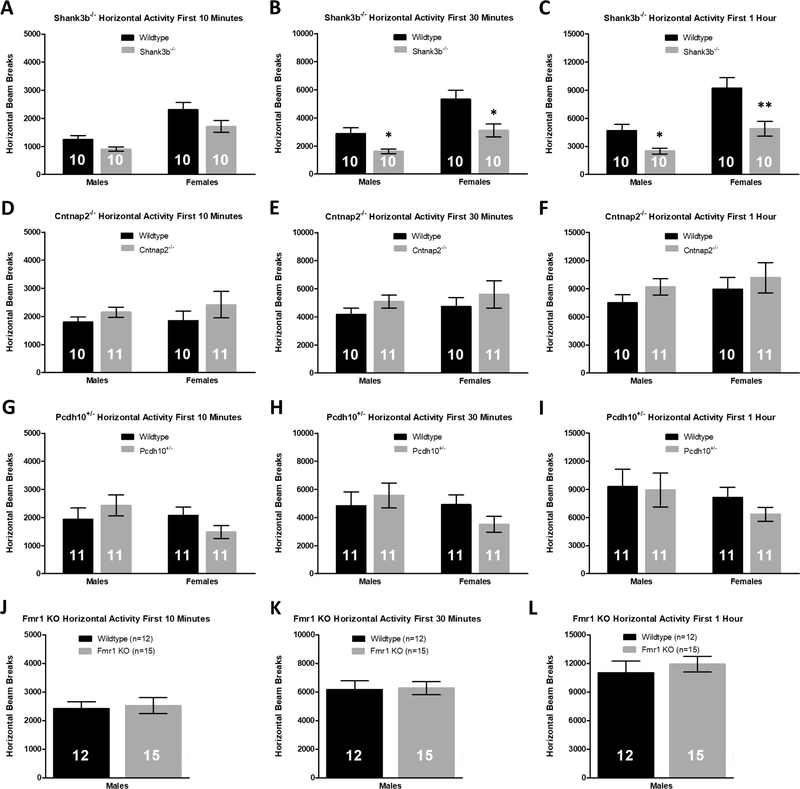
Shank3b−/− mice are hypoactive during habituation to the activity monitors, but Cntnap2−/−, Pcdh10+/−, and Fmr1 KO mice exhibit no activity differences in the habituation phase relative to sex-matched WT littermates. (A–C) Shank3b−/− males and females have reduced horizontal activity in the first 30 min (B) and 1h (C) of activity monitoring in comparison to sex-matched WT controls. D-F) There are no differences in activity counts between Cntnap2−/− mice and WT during the first 10 min (D), 30 min (E), or 1h (F) of habituation. (G–I) Pcdh10+/− male and female mice display similar activity levels during the first hour of habituation compared to sex-matched WT littermates. (J–L) There are no differences in activity counts during the habituation phase between Fmr1 KO males and WT controls. Mean ± standard error of the mean (s.e.m.) *p < 0.05, **p < 0.01.
Fig. 4.
Fig. 4.
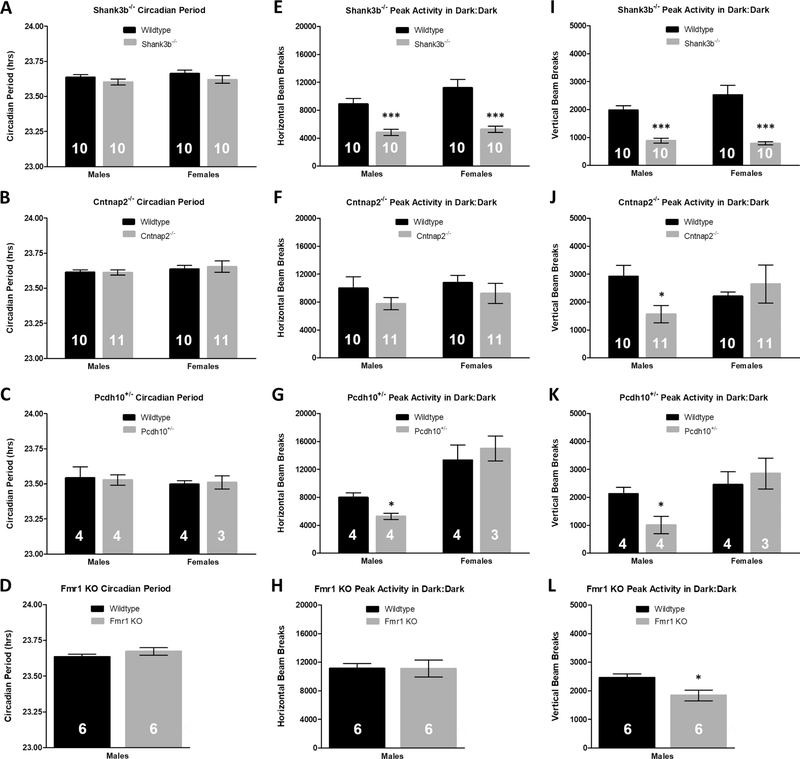
Normal free-running circadian periods and hypoactivity in Shank3b−/−, Cntnap2−/−, Pcdh10+/−, and Fmr1 KO mice during constant darkness. A-D) Relative to sex-matched WT controls, there are no differences in free-running circadian period (tau) in (A) Shank3b−/− males (23.60 ± 0.02 h, WT: 23.64 ± 0.02 h; p = 0.25) or females (23.62 ± 0.03 h, WT: 23.67 ± 0.02 h; p = 0.25), (B) Cntnap2−/− males (23.61 ± 0.02 h, WT: 23.61 ± 0.02 h; p =0.93) or females (23.65 ± 0.04 h, WT: 23.64 ± 0.03 h; p= 0.64), (C) Pcdh10+/− males (23.53 ± 0.04 h, WT: 23.54 ± 0.08 h; p= 0.87) or females (23.51 ± 0.05 h, WT: 23.50 ± 0.03 h; p =0.83), or (D) Fmr1 KO males (23.67 ± 0.02 h, WT: 23.64 ± 0.02 h; p =0.26). (E–L) Peak activity patterns during DD (1-h bins) are similar to activity patterns observed during 12h:12 h LD. (E,I) Shank3b−/− male and female mice have lower peak activity in DD than sex-matched WT controls. (F,J) Relative to sex-matched WT in DD, male Cntnap2−/− mice are not hypoactive in the (F) horizontal axis, but are hypoactive in the (J) vertical direction. Female Cntnap2−/− mice are not hypoactive relative to sex-matched WT in DD. (G,K) Pcdh10+/− males but not females have lower peak activity levels in DD compared to WT. (H,L) Fmr1 KO males do not have altered peak activity levels in the (H) XY-axis, but display reduced peak activity in the (L) Z-axis during DD in comparison to WT littermates. Mean ± standard error of the mean (s.e.m.) *p < 0.05, **p < 0.01, ***p < 0.001.

References

    1. American Psychiatric Association (2013). Diagnostic and statistical manual of mental disorders-5. Washington, DC: American Psychiatric Association.
    1. Angelakos CC, Watson AJ, O’Brien WT, Krainock KS, Nickl-Jockschat T, & Abel T. (2016). Hyperactivity and male-specific sleep deficits in the 16p11.2 deletion mouse model of autism. Autism Research. 10.1002/aur.1707. - DOI - PMC - PubMed
    1. Antshel KM, Zhang-James Y, Wagner KE, Ledesma A, & Faraone SV (2016). An update on the comorbidity of ADHD and ASD: A focus on clinical management. Expert Review of Neurotherapeutics, 16(3), 279–293. 10.1586/14737175.2016.1146591. - DOI - PubMed
    1. Arbogast T, Ouagazzal A-M, Chevalier C, Kopanitsa M, Afinowi N, Migliavacca E, … Herault Y. (2016). Reciprocal effects on neurocognitive and metabolic phenotypes in mouse models of 16p11.2 deletion and duplication syndromes. PLoS Genetics, 12(2), e1005709. 10.1371/journal.pgen.1005709. - DOI - PMC - PubMed
    1. Baio J, Wiggins L, Christensen DL, Maenner MJ, Daniels J, Warren Z, … Dowling NF (2018). Prevalence of autism spectrum disorder among children aged 8 years — Autism and developmental disabilities monitoring network, 11 sites, United States, 2014. Morbidity and Mortality Weekly Report. Surveillance Summaries (Washington, D.C.: 2002), 67(6), 1–23. 10.15585/mmwr.ss6706a1. - DOI - PMC - PubMed

Publication types

MeSH terms