Review
. 2019 Apr;30(4):244-257.
doi: 10.1016/j.tem.2019.01.008. Epub 2019 Feb 21.

Mathematical Modelling of Endocrine Systems

Affiliations
Review

Mathematical Modelling of Endocrine Systems

Eder Zavala et al. Trends Endocrinol Metab. 2019 Apr.

Abstract

Hormone rhythms are ubiquitous and essential to sustain normal physiological functions. Combined mathematical modelling and experimental approaches have shown that these rhythms result from regulatory processes occurring at multiple levels of organisation and require continuous dynamic equilibration, particularly in response to stimuli. We review how such an interdisciplinary approach has been successfully applied to unravel complex regulatory mechanisms in the metabolic, stress, and reproductive axes. We discuss how this strategy is likely to be instrumental for making progress in emerging areas such as chronobiology and network physiology. Ultimately, we envisage that the insight provided by mathematical models could lead to novel experimental tools able to continuously adapt parameters to gradual physiological changes and the design of clinical interventions to restore normal endocrine function.

Keywords: chronotherapy; circadian rhythms; hormone dynamics; hybrid systems; regulatory networks; ultradian oscillations.


Figures

Figure 1
Figure 1
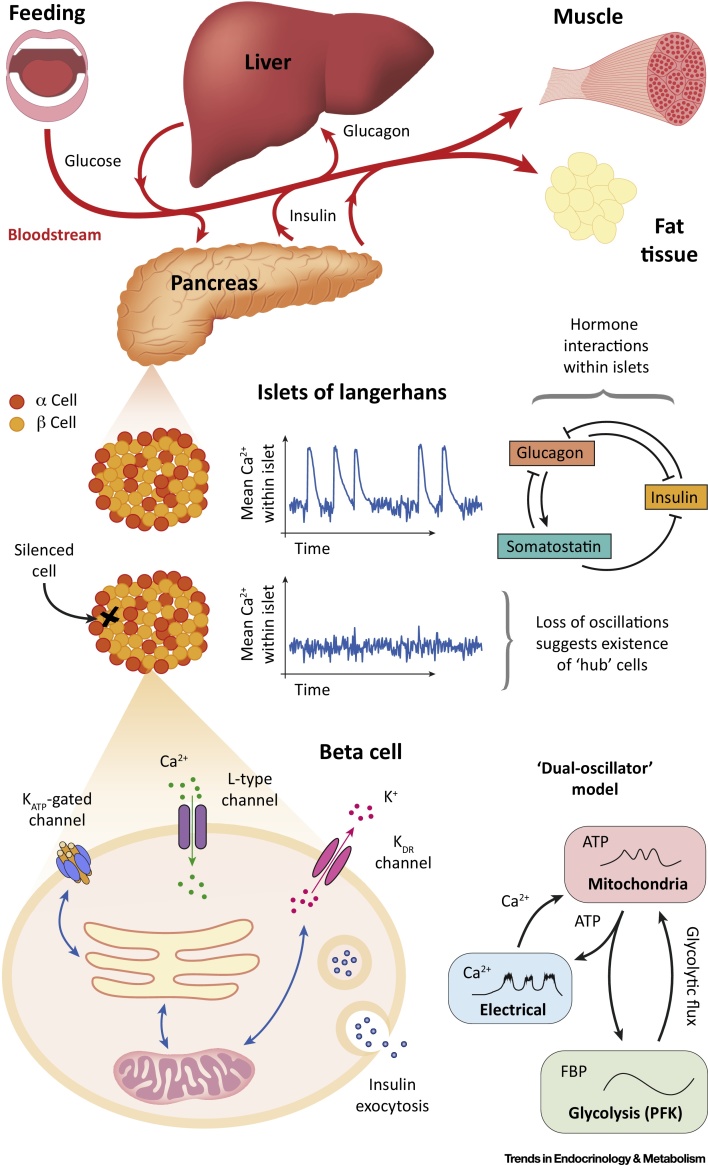
The Metabolic Axis. Regulation of blood plasma glucose levels is achieved primarily through the complementary actions of the hormones insulin, glucagon, and somatostatin. Insulin promotes the absorption of glucose from the blood by the liver and peripheral tissues, thus lowering the blood glucose concentration. In these tissues, glucose is then converted to glycogen or fat and subsequently stored. Glucagon plays the opposite role to insulin, encouraging tissues to transform these substrates back into glucose for secretion into the bloodstream. Somatostatin inhibits the secretion of insulin and glucagon by, respectively, beta and alpha cells, both of which reside in multicellular structures known as the islets of Langerhans, which are located in the pancreas. Mathematical models of beta cell behaviour typically account for the electrical activity originating from ion channels involved in insulin secretion. Recent models have also accounted for beta cell metabolism, including, for example, the glycolytic activity and mitochondrial components shown in the ‘dual-oscillator model’ (see text).
Figure 2
Figure 2
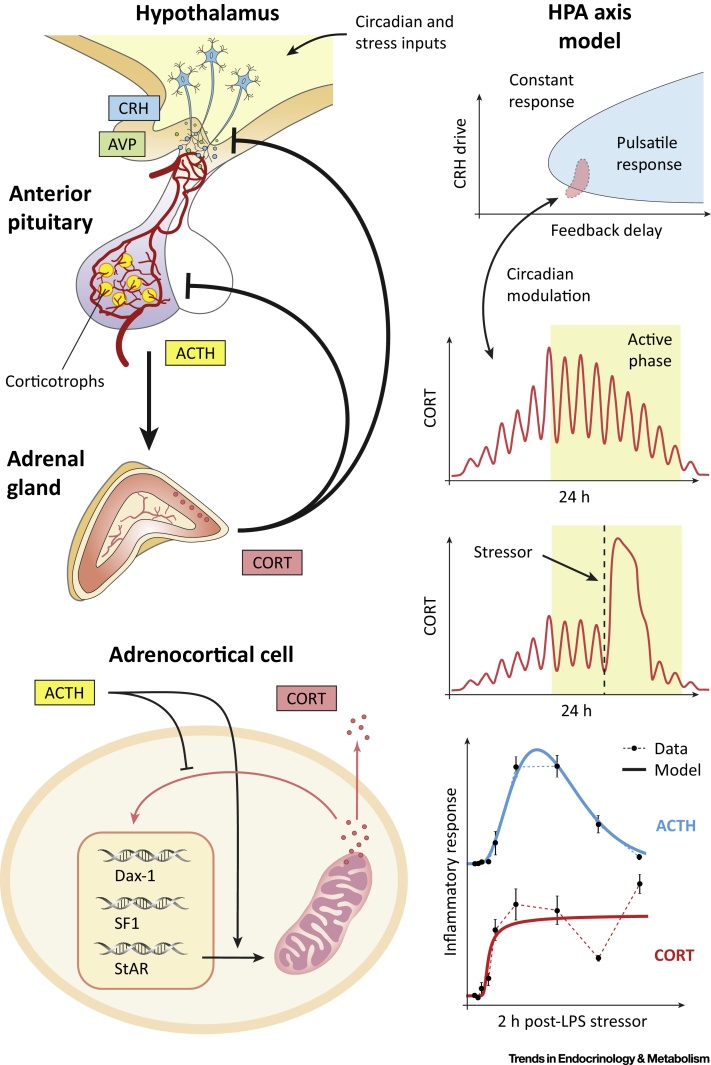
The Hypothalamic–Pituitary–Adrenal (HPA) Axis. Endogenous glucocorticoids (CORT) are vital hormones involved in many physiological processes that are key to homeostasis and survival (e.g., mediating the stress response, anti-inflammatory and immunosuppressive effects, regulation of glucose expenditure). The circulating levels of CORT are controlled by the HPA axis. Corticotropin-releasing hormone (CRH) and arginine vasopressin (AVP) stimulate the release of adrenocorticotropic hormone (ACTH) from the pituitary. ACTH in turn stimulates the adrenal glands to synthesise CORT, which further regulates its own synthesis through an intra-adrenal feedback loop. Within the HPA axis, CORT acts to inhibit ACTH in the pituitary as well as CRH and AVP in the hypothalamus, creating a dual negative-feedback loop. Combined mathematical and experimental studies have demonstrated that the tightly coordinated release of ACTH and CORT in ultradian pulses, observed under normal physiological conditions, is governed by this negative feedback . These pulses have been shown to play an important role in the optimal responsiveness of glucocorticoid-sensitive neural processes. However, under pathological conditions (e.g., inflammation, chronic stress, neurological dysfunction) or ageing these pulsatile dynamics are altered and the tight synchrony between ACTH and CORT becomes significantly disrupted .
Figure 3
Figure 3
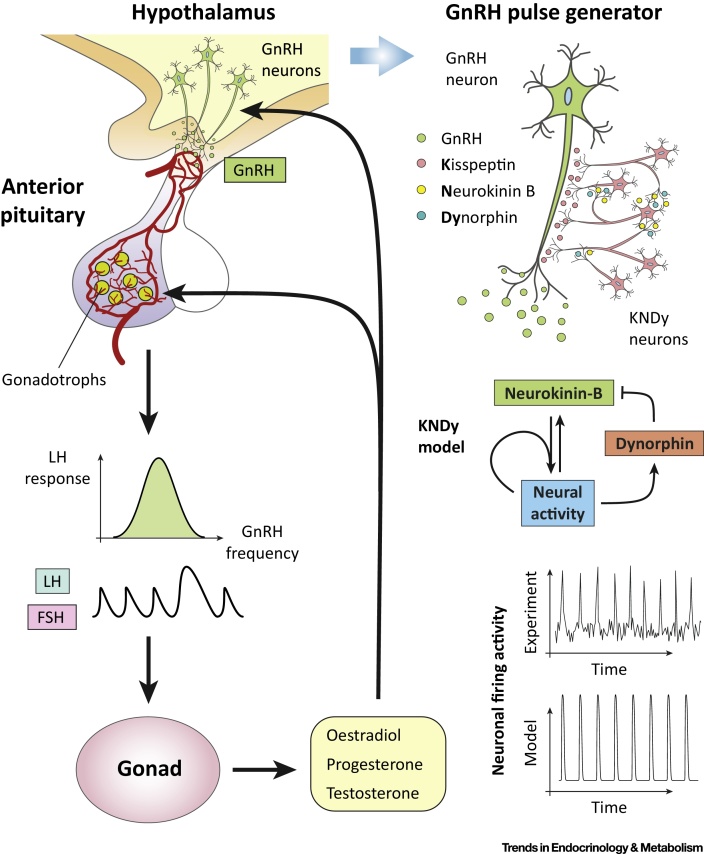
The Hypothalamic–Pituitary–Gonadal (HPG) Axis. Reproduction is controlled by the HPG axis. Gonadotropin-releasing hormone (GnRH), secreted by GnRH neurons located at the hypothalamus, stimulate the release of gonadotropin hormones [luteinizing hormone (LH) and follicle-stimulating hormone (FSH)] from the pituitary. The release of gonadotropins critically depends on GnRH pulsatile dynamics that are driven by hypothalamic neuronal networks. Gonadotropins act on the gonads, initiating processes involved in gametogenesis and ovulation and triggering the release of sex steroids (oestradiol, testosterone, progesterone) that feedback on the brain and pituitary gland to modulate GnRH and LH/FSH secretion dynamics. Mathematical models have offered insight into how hypothalamic neurons coexpressing kisspeptin, neurokinin-B, and dynorphin control the pulsatile dynamics of GnRH secretion and how these pulsatile signals are decoded by single cells at the pituitary gland.
Figure 4
Figure 4
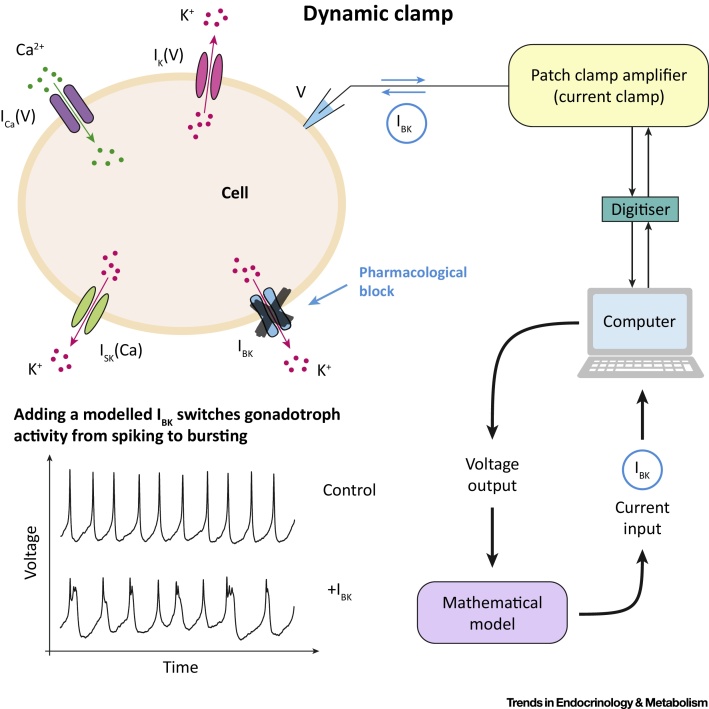
The Dynamic Clamp: A Real Time, Simultaneous Modelling and Experimental Hybrid System. Traditionally, mathematical models have been integrated with experiments via an iterative process: predictions from models are tested against results from appropriate experiments and the models are then updated to address any discrepancies between the two. While this has been, and continues to be, a fruitful endeavour in many cases, hybrid experiments allow the two to be brought together in a real time and interactive fashion. Hybrid systems enable us to manipulate the values of key parameters with the freedom of a mathematical model. At the same time, the effects of these manipulations are observed in real biological systems. One example of a hybrid system is the dynamic clamp protocol for electrically excitable cells . In this system, a mathematical model is used to provide a command signal to the cell from which an electrical recording is being taken. Importantly, since the real-time membrane potential of the cell can be provided to the model, this can be used to inject signals that mimic ionic currents that may or may not be present in the real cell. In this way, parameters associated with these currents can be manipulated, or entirely different channels can be incorporated into the cell. Recently, this method has been used to determine the role of large-conductance potassium (BK) channels in shaping the electrical activity of pituitary cells (see text) .

References

    1. Leng G., Macgregor D.J. Mathematical modelling in neuroendocrinology. J. Neuroendocrinol. 2008;20:713–718. - PubMed
    1. Leng G., MacGregor D.J. Models in neuroendocrinology. Math. Biosci. 2018;305:29–41. - PubMed
    1. Bertram R. Mathematical modeling in neuroendocrinology. Compr. Physiol. 2015;5:911–927. - PubMed
    1. Pattaranit R., van den Berg H.A. Mathematical models of energy homeostasis. J. R. Soc. Interface. 2008;5:1119–1135. - PMC - PubMed
    1. Nyman E. Insulin signaling – mathematical modeling comes of age. Trends Endocrinol. Metab. 2012;23:107–115. - PubMed

Publication types