


An Overview of Peripheral Blood Mononuclear Cells as a Model for Immunological Research of Toxoplasma gondii and Other Apicomplexan Parasites
- PMID: 30800644
- PMCID: PMC6376612
- DOI: 10.3389/fcimb.2019.00024
An Overview of Peripheral Blood Mononuclear Cells as a Model for Immunological Research of Toxoplasma gondii and Other Apicomplexan Parasites
Abstract
In biology, models are experimental systems meant to recreate aspects of diseases or human tissue with the goal of generating inferences and approximations that can contribute to the resolution of specific biological problems. Although there are many models for studying intracellular parasites, their data have produced critical contradictions, especially in immunological assays. Peripheral blood mononuclear cells (PBMCs) represent an attractive tissue source in pharmacogenomics and in molecular and immunologic studies, as these cells are easily collected from patients and can serve as sentinel tissue for monitoring physiological perturbations due to disease. However, these cells are a very sensitive model due to variables such as temperature, type of stimulus and time of collection as part of posterior processes. PBMCs have been used to study Toxoplasma gondii and other apicomplexan parasites. For instance, this model is frequently used in new therapies or vaccines that use peptides or recombinant proteins derived from the parasite. The immune response to T. gondii is highly variable, so it may be necessary to refine this cellular model. This mini review highlights the major approaches in which PBMCs are used as a model of study for T. gondii and other apicomplexan parasites. The variables related to this model have significant implications for data interpretation and conclusions related to host-parasite interaction.
Keywords: PBMCs (peripheral blood mononuclear cells); apicomplexa; immunologic research; model of study; toxoplasma gondii.
Figures
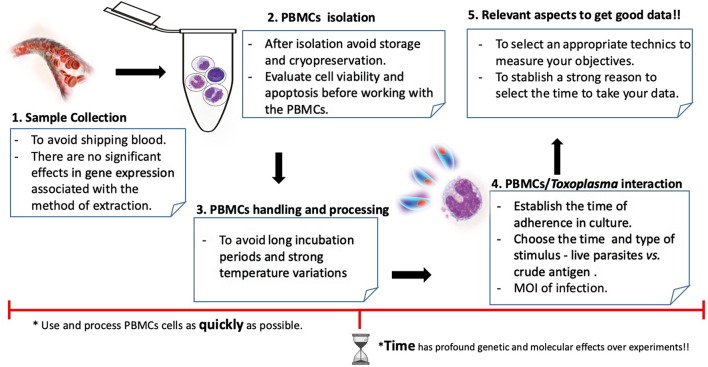
References
-
- Alfonzo M., Badell E., Pourcel C., Dumas G., Colle J. H., Scott-Algara D. (2005). Cell-mediated and not humoral immune response is responsible for partial protection against toxoplasmosis in SCID mice reconstituted with human PBMC. Inmunologia 24, 273–282.
-
- Alfonzo M., Blanc D., Troadec C., Huerre M., Eliaszewicz M., Gónzalez G., et al. (2002). Temporary restoration of immune response against Toxoplasma gondii in HIV-infected individuals after HAART, as studied in the hu-PBMC-SCID mouse model. Clin. Exp. Immunol. 129, 411–419. 10.1046/j.1365-2249.2002.01941.x - DOI - PMC - PubMed
-
- Anum D., Kusi K. A., Ganeshan H., Hollingdale M. R., Ofori M. F., Koram K. A., et al. (2015). Measuring naturally acquired ex vivo IFN-γ responses to Plasmodium falciparum cell-traversal protein for ookinetes and sporozoites (CelTOS) in Ghanaian adults. Malar. J. 14, 1–8. 10.1186/s12936-014-0539-5 - DOI - PMC - PubMed
-
- Awasthi V., Chauhan R., Chattopadhyay D., Das J. (2017). Effect of l-arginine on the growth of Plasmodium falciparum and immune modulation of host cells. J. Vector Borne Dis. 54, 139–145. - PubMed
Publication types
MeSH terms
LinkOut - more resources
Full Text Sources
