


Treatment of melanoma of unknown primary in the era of immunotherapy and targeted therapy: A Dutch population-based study
- PMID: 30801710
- PMCID: PMC6900034
- DOI: 10.1002/ijc.32229
Treatment of melanoma of unknown primary in the era of immunotherapy and targeted therapy: A Dutch population-based study
Abstract
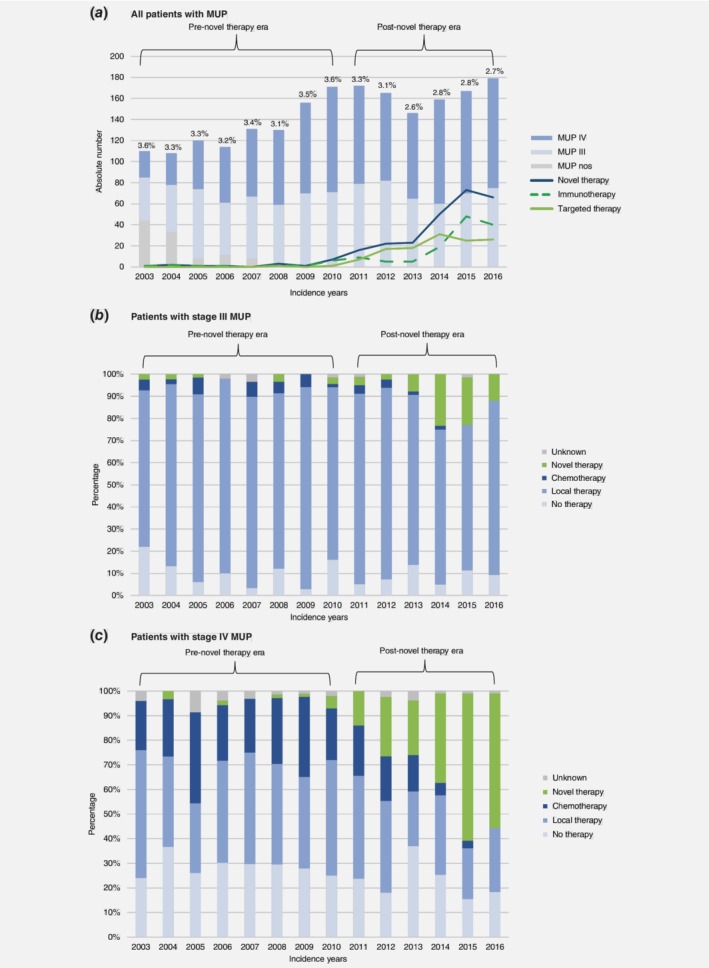
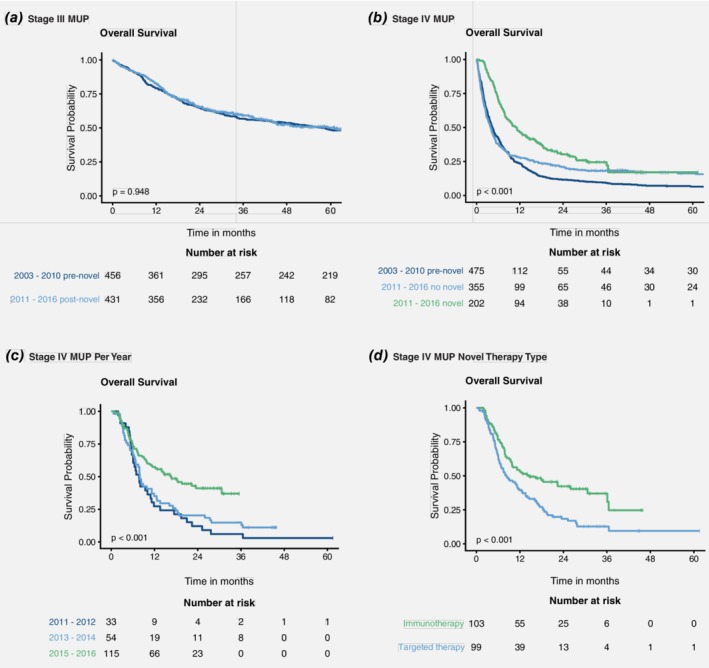
Melanoma of unknown primary (MUP) may have a different biology to melanoma of known primary, but clinical trials of novel therapies (e.g., immune checkpoint or BRAF/MEK inhibitors) have not reported the outcomes in this population. We therefore evaluated the overall survival (OS) among patients with MUP in the era of novel therapy. Data for stage III or IV MUP were extracted from a nationwide database for the period 2003-2016, with classification based on the eighth edition of the American Joint Committee on Cancer criteria. The population was divided into pre- (2003-2010) and post- (2011-2016) novel therapy eras. Also, OS in the post-novel era was compared between patients with stage IV MUP by whether they received novel therapy. In total, 2028 of 65,110 patients (3.1%) were diagnosed with MUP. Metastatic sites were known in 1919 of 2028 patients, and most had stage IV disease (53.8%). For patients with stage III MUP, the 5-year OS rates were 48.5% and 50.2% in the pre- and post-novel eras, respectively (p = 0.948). For those with stage IV MUP, the median OS durations were unchanged in the pre-novel era and post-novel era when novel therapy was not used (both 4 months); however, OS improved to 11 months when novel therapy was used in the post-novel era (p < 0.001). In conclusion, more than half of the patients with MUP are diagnosed with stage IV and the introduction of novel therapy appears to have significantly improved the OS of these patients.
Keywords: immunotherapy; melanoma; targeted therapy; unknown primary.
© 2019 The Authors. International Journal of Cancer published by John Wiley & Sons Ltd on behalf of UICC.
Figures
Comment in
-
Author's reply to: The real-world outcome of metastatic melanoma: Unknown primary vs. known cutaneous.Int J Cancer. 2019 Dec 1;145(11):3175-3176. doi: 10.1002/ijc.32630. Epub 2019 Sep 3. Int J Cancer. 2019. PMID: 31423580 No abstract available.
-
The real-world outcome of metastatic melanoma: Unknown primary vs. known cutaneous.Int J Cancer. 2019 Dec 1;145(11):3173-3174. doi: 10.1002/ijc.32631. Epub 2019 Sep 3. Int J Cancer. 2019. PMID: 31423583 No abstract available.
-
Author's reply to: Air pollution and incident bladder cancer: A risk assessment.Int J Cancer. 2019 Dec 1;145(11):3178. doi: 10.1002/ijc.32632. Epub 2019 Aug 30. Int J Cancer. 2019. PMID: 31423586 No abstract available.
References
-
- Sacchetto L, Zanetti R, Comber H, et al. Trends in incidence of thick, thin and in situ melanoma in Europe. Eur J Cancer 2018;92:108–18. - PubMed
-
- Kamposioras K, Pentheroudakis G, Pectasides D, et al. Malignant melanoma of unknown primary site. To make the long story short. A systematic review of the literature. Crit Rev Oncol Hematol 2011;78:112–26. - PubMed
-
- de Waal AC, Aben KK, van Rossum MM, et al. Melanoma of unknown primary origin: a population‐based study in The Netherlands. Eur J Cancer 2013;49:676–83. - PubMed
-
- Bae JM, Choi YY, Kim DS, et al. Metastatic melanomas of unknown primary show better prognosis than those of known primary: a systematic review and meta‐analysis of observational studies. J Am Acad Dermatol 2015;72:59–70. - PubMed
MeSH terms
LinkOut - more resources
Full Text Sources
Medical
Research Materials
