Review
. 2019 Mar;189(3):492-501.
doi: 10.1016/j.ajpath.2018.11.013.

Mammalian Target of Rapamycin: A Metabolic Rheostat for Regulating Adipose Tissue Function and Cardiovascular Health

Affiliations
Review

Mammalian Target of Rapamycin: A Metabolic Rheostat for Regulating Adipose Tissue Function and Cardiovascular Health

Matthew F Wipperman et al. Am J Pathol. 2019 Mar.

Abstract

The complex relationship between diet and metabolism is an important contributor to cellular metabolism and health. Over the past few decades, a central role for mammalian target of rapamycin (mTOR) in the regulation of multiple cellular processes, including the response to food intake, maintaining homeostasis, and the pathogenesis of disease, has been shown. Herein, we first review our current understanding of the biochemical functions of mTOR and its response to fluctuations in hormone levels, like insulin. Second, we highlight the role of mTOR in lipogenesis, adipogenesis, β-oxidation of lipids, and ketosis of carbohydrates, lipids, and proteins. Special attention is paid to recent advances in mTOR signaling in white versus brown adipose tissues. Finally, we review how mTOR regulates cardiovascular health and disease. Together, these insights define a clearer picture of the connection between mTOR signaling, metabolic health, and disease.


Figures

Figure 1
Figure 1
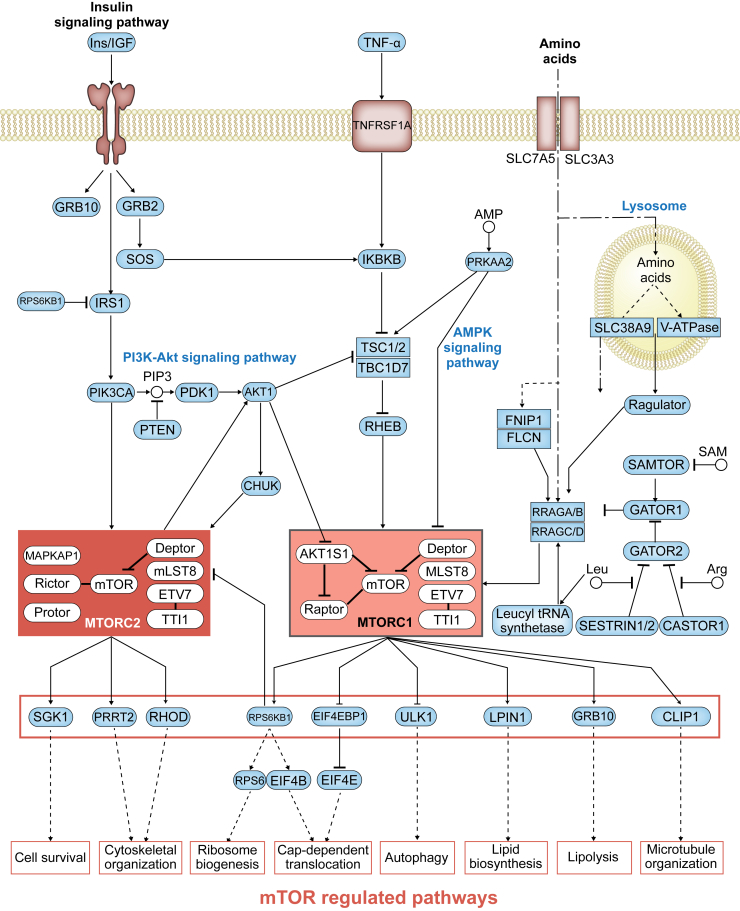
The mammalian target of rapamycin (mTOR) regulatory network. The mTOR signaling pathway in Homo sapiens senses a variety of upstream signals, with distinctive downstream inputs. The insulin signaling pathway, cytokines such as tumor necrosis factor (TNF), and amino acids stimulate a variety of signaling molecules, such as phosphatidylinositol-4,5-bisphosphate 3-kinase (PI3K), AKT1, and ras related GTP binding A (RRAGA), respectively, which in turn activate the mTOR complex 1 (MTORC1) and mTOR complex 2 (MTORC2). These complexes activate a variety of cell processes. Adapted from Kanehisa et al, with permission from Kyoto Encyclopedia of Genes and Genomes database. CHUK, conserved helix-loop-helix ubiquitous kinase; IRS1, insulin receptor–related substrate 1; PDK1, phosphoinositide-dependent kinase-1; PIP3, phosphatidylinositol (3,4,5)-trisphosphate; SAM, S-adenosyl methionine; SGK, serum/glucocorticoid regulated kinase.
Figure 2
Figure 2
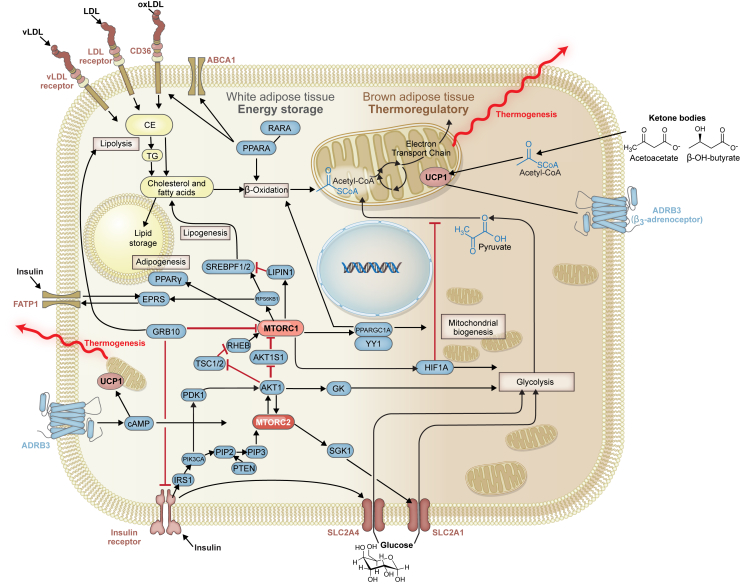
Mammalian target of rapamycin (mTOR)–regulated pathways in white adipose tissue and brown adipose tissue. mTOR-related signaling regulates the metabolic capacity of adipose tissue, as well as its lipid storage and thermogenic potential. For example, a variety of modified lipoproteins, once bound to their receptors, can activate free and esterified cholesterol pathways affecting fatty acid oxidation, sterol storage, lipogenesis and lipolysis, and adipogenesis. Transcription factors, such as the peroxisome proliferator-activated receptors (PPARs) and sterol regulatory element-binding protein 1/2 (SREBP1/2), can be activated by the mTOR complexes once they are stimulated by effector molecules, such as phosphatidylinositol 3,4,5-trisphosphate 3-phosphatase (PTEN), phosphatidylinositol-4,5-bisphosphate 3-kinase (PI3K), and phosphatidylinositol (4,5)-bisphosphate (PIP2). PPAR and SREBP are important in the regulation of cholesterol metabolism and its storage in the cell. EPRS, glutamyl-prolyl tRNA synthetase; LDL, low-density lipoprotein; MTORC1, mTOR complex 1; MTORC2, mTOR complex 2; PDK1, phosphoinositide-dependent kinase-1; PIP3, phosphatidylinositol (3,4,5)-trisphosphate.

References

    1. Saxton R.A., Sabatini D.M. mTOR signaling in growth, metabolism, and disease. Cell. 2017;168:960–976. - PMC - PubMed
    1. Kanehisa M., Goto S. KEGG: kyoto encyclopedia of genes and genomes. Nucleic Acids Res. 2000;28:27–30. - PMC - PubMed
    1. Kanehisa M., Sato Y., Kawashima M., Furumichi M., Tanabe M. KEGG as a reference resource for gene and protein annotation. Nucleic Acids Res. 2016;44:D457–D462. - PMC - PubMed
    1. Sciarretta S., Forte M., Frati G., Sadoshima J. New insights into the role of mTOR signaling in the cardiovascular system. Circ Res. 2018;122:489–505. - PMC - PubMed
    1. Ardestani A., Lupse B., Kido Y., Leibowitz G., Maedler K. mTORC1 signaling: a double-edged sword in diabetic beta cells. Cell Metab. 2018;27:314–331. - PubMed

Publication types

Substances