


Mineralocorticoid Antagonism and Vascular Function in Early Autosomal Dominant Polycystic Kidney Disease: A Randomized Controlled Trial
- PMID: 30803706
- PMCID: PMC6660387
- DOI: 10.1053/j.ajkd.2018.12.037
Mineralocorticoid Antagonism and Vascular Function in Early Autosomal Dominant Polycystic Kidney Disease: A Randomized Controlled Trial
Abstract
Rationale & objective: Vascular dysfunction, characterized by impaired vascular endothelial function and increased large-elastic artery stiffness, is evident early in autosomal dominant polycystic kidney disease (ADPKD) and is an important predictor of cardiovascular events and mortality. Aldosterone excess has been implicated in the development of endothelial dysfunction and arterial stiffness, in part by causing increased oxidative stress and inflammation. We hypothesized that aldosterone antagonism would reduce vascular dysfunction in patients with early-stage ADPKD.
Study design: Prospective, randomized, controlled, double-blind, clinical trial.
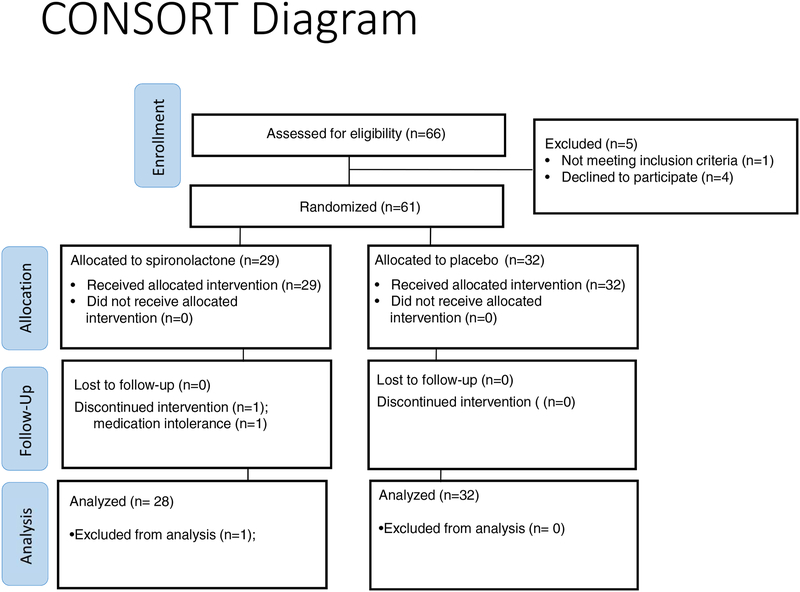
Setting & participants: 61 adults aged 20 to 55 years with ADPKD, estimated glomerular filtration rate ≥ 60mL/min/1.73m2, and receiving a renin-angiotensin-aldosterone system inhibitor.
Intervention: Spironolactone (maximum dose, 50mg/d) or placebo for 24 weeks.
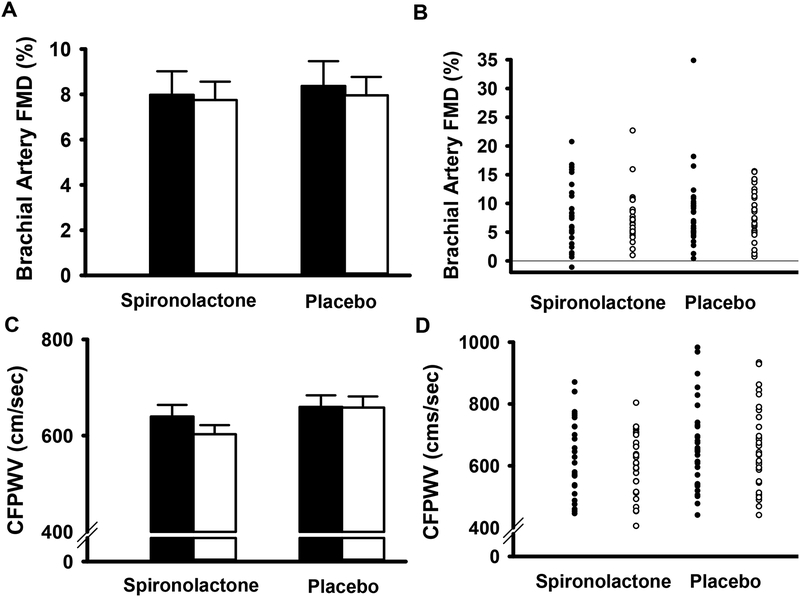
Outcomes: Change in brachial artery flow-mediated dilation (FMDBA) was the primary end point and change in carotid-femoral pulse-wave velocity (CFPWV) was the secondary end point.
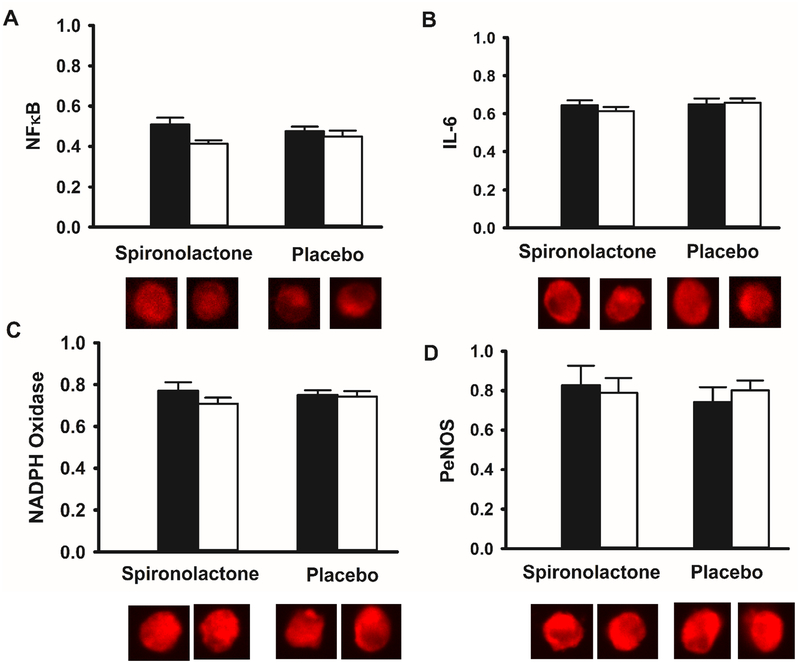
Results: 60 participants completed the trial. Participants had a mean age of 34±10 (SD) years, 54% were women, and 84% were non-Hispanic white. Spironolactone did not change FMDBA (8.0% ± 5.5% and 7.8% ± 4.3% at baseline and 24 weeks, respectively, vs corresponding values in the placebo group of 8.4% ± 6.2% and 8.0% ± 4.6%; P=0.9for comparison of change between groups) or CFPWV (640±127 and 603±101cm/s at baseline and 24 weeks, respectively, vs corresponding values in the placebo group of 659±138 and 658±131cm/s; P=0.1). Brachial systolic blood pressure was reduced with spironolactone (median change, -6 [IQR, -15, 1] vs -2 [IQR, -7, 10] mm Hg in the placebo group; P=0.04). Spironolactone did not change the majority of circulating and/or endothelial cell markers of oxidative stress/inflammation and did not change vascular oxidative stress.
Limitations: Low level of baseline vascular dysfunction; lack of aldosterone measurements.
Conclusions: 24 weeks of aldosterone antagonism reduced systolic blood pressure without changing vascular function in patients with early-stage ADPKD.
Funding: NIDDK, NIH National Center for Advancing Translational Sciences, and the Zell Family Foundation.
Trial registration: Registered at ClinicalTrials.gov with study number NCT01853553.
Keywords: Autosomal dominant polycystic kidney disease (ADPKD); aldosterone antagonist; cardiovascular disease; clinical trial; endothelium; large-elastic artery stiffness; mineralocorticoid; oxidative stress; polycystic kidney disease; pulse wave velocity (PWV); randomized controlled trial (RCT); spironolactone; vascular dysfunction; vascular endothelial function.
Copyright © 2019 National Kidney Foundation, Inc. Published by Elsevier Inc. All rights reserved.
Figures
References
-
- Torres VE, Harris PC, Pirson Y. Autosomal dominant polycystic kidney disease. Lancet. 2007;369(9569):1287–1301. - PubMed
-
- Gabow PA, Johnson AM, Kaehny WD, et al. Factors affecting the progression of renal disease in autosomal-dominant polycystic kidney disease. Kidney Int. 1992;41(5):1311–1319. - PubMed
-
- Fick GM, Johnson AM, Hammond WS, Gabow PA. Causes of death in autosomal dominant polycystic kidney disease. J Am Soc Nephrol. 1995;5(12):2048–2056. - PubMed
-
- Kocaman O, Oflaz H, Yekeler E, et al. Endothelial dysfunction and increased carotid intima-media thickness in patients with autosomal dominant polycystic kidney disease. Am J Kidney Dis. 2004;43(5):854–860. - PubMed
Publication types
MeSH terms
Substances
Associated data
Grants and funding
LinkOut - more resources
Full Text Sources
Medical
